Careerplanb · June 23, 2026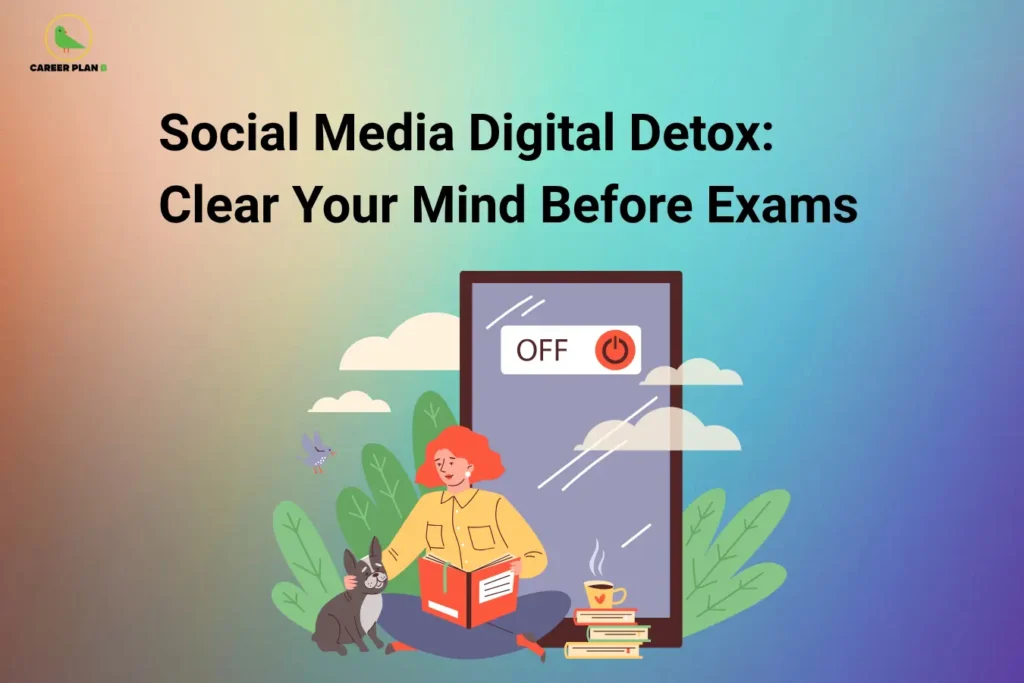
Introduction
It is 11:30 PM. Your CUET 2026 exam is just around the corner. You open your phone to check one notification and 45 minutes later, you are still scrolling through Instagram reels, watching someone’s study vlog, and reading a Twitter thread about exam tips that somehow led you to a debate about something completely unrelated. Sound familiar? You are not alone. Nearly every student preparing for a competitive exam has been here. The problem is not that you are lazy or undisciplined. The problem is that social media is literally designed to keep you hooked and your brain, already tired from studying, does not stand a chance against it.
This is exactly why a social media digital detox before your CUET 2026 exam is not just a “nice to do” it might actually be the most important study decision you make this season. In this blog, we will walk you through what a digital detox really means for students, how social media is quietly affecting your preparation, simple ways to reduce screen time before exams, and what happens to your brain when you finally give it a proper rest. No lectures, no guilt, just practical, honest advice that actually works.
What Is a Digital Detox — And Why Should Students Care?
Let’s get one thing straight first. A social media digital detox does not mean throwing your phone into a river or disappearing from the internet forever. It simply means taking a deliberate, time-bound break from social media platforms — Instagram, YouTube shorts, Snapchat, Twitter, WhatsApp forwards so your mind can actually breathe and function at its best.
Think of your brain like a glass of water. When you are constantly receiving notifications, scrolling feeds, and switching between apps, it is like someone keeps dropping stones into that glass. The water gets murky. Your thoughts become scattered. Studying feels harder than it should be. A digital detox is just letting that glass settle so the water becomes clear again.
Now, here’s why this matters especially for you as a CUET 2026 aspirant. The CUET UG 2026 exam is scheduled from 11 May to 31 May, which means you’re either in the middle of your exams or entering the final stretch of preparation.
At this stage, every hour, a good night’s sleep, and each focused revision session becomes critical. However, all of that can be quietly disrupted when screen time before exams goes unchecked.
How Social Media Is Secretly Hurting Your CUET 2026 Preparation
You might think, “I only check my phone for 20 minutes between study sessions. That can’t be doing much harm.” But here’s what is actually happening under the surface.
It Breaks Your Focus — And Rebuilding It Takes Much Longer Than You Think
Research has shown that the average person’s attention is easily interrupted by a single notification, and it takes about 23 minutes to fully refocus after that distraction. Read that again. Twenty-three minutes — just to get back to where you were. So if you pick up your phone three times during a two-hour study session, you may not have had even one full hour of actual deep focus. That is a staggering amount of lost productivity, and most students never even realise it is happening.
It Fuels Comparison Anxiety
Social media feeds are full of other aspirants posting their study schedules, their scores, their “productive day” videos. And every time you see that, a small voice in your head whispers, am I doing enough? Are they better prepared than me? Social media platforms often present idealised versions of reality, leading to unhealthy comparisons and diminished self-esteem, which contributes to a cycle of unhappiness. During exam prep, this kind of comparison anxiety is fuel for self-doubt and self-doubt is the last thing you need right now.
It Disturbs Your Sleep — And Sleep Is Everything Before Exams
This one is critical. A 2024 study in the Journal of Social Sciences found that students who actively engage on social media during evening hours suffer from poor sleep patterns, which often reflects in poor concentration, memory, and overall academic progress. And it gets more specific than that — the blue light emitted by screens disrupts the body’s circadian rhythm by suppressing melatonin, the hormone responsible for sleep, essentially tricking the brain into thinking it is still daytime, making it harder to fall and stay asleep. When you sleep poorly, your brain cannot consolidate what you studied. All that revision? It is not sticking the way it should.
Signs You Need a Social Media Break Right Now
Before jumping into the how, let’s do a quick honest check. Read through the list below and see how many of these feel true for you:
- You pick up your phone within the first 10 minutes of waking up
- You feel restless or anxious if you haven’t checked your notifications for an hour
- You open Instagram “just to check one thing” and lose 30 minutes without realising it
- You feel mentally tired even before you’ve started studying
- You find yourself comparing your preparation with other students on social media
- Your sleep feels lighter, and you wake up feeling unrefreshed
- You feel productive watching study-related content on YouTube but actually absorb very little
- You’ve set app timers before and ignored them anyway
If you ticked three or more of these, it is a clear signal. Your phone is not just a distraction right now. It is actively working against your CUET 2026 preparation. The good news? You do not have to quit cold turkey.
How to Do a Digital Detox Without Going Cold Turkey
The biggest mistake students make is thinking a social media break has to be all-or-nothing. It doesn’t. The goal is not to punish yourself. The goal is to reclaim your mental space gradually and sustainably.
Step 1: Start With a Screen Time Audit
Before you change anything, know where you actually stand. Both Android and iOS have built-in screen time trackers. Go check yours right now — honestly, the numbers might surprise you. The average Indian spends 2 hours 30 minutes daily on social media, accessing 7.6 different platforms per month, with Gen Z spending nearly 50% more time than the global average. For a student in the middle of CUET prep, even one hour of social media a day is one hour taken away from revision, sleep, or recovery.
Once you see the data, you will find it much easier to make changes because it is no longer abstract. It is right there in black and white.
Step 2: Set App Limits or Use Focus Modes
Both Android and iPhone allow you to set daily time limits on specific apps. Use them. Set Instagram to 15 minutes a day. Turn WhatsApp notifications off during your study hours. Use your phone’s built-in “Focus Mode” or “Do Not Disturb” during study blocks. For added help, apps like Forest or Opal can make phone detox tips actually stick — they gamify the process, so putting your phone down feels like winning something rather than giving something up.
Step 3: Replace Scroll Time With Study Rituals
The reason social media is so hard to quit is that it fills a need — usually boredom, rest, or emotional stimulation. If you just remove it without replacing it, you will reach for your phone out of habit within minutes. Instead, deliberately replace that time. Take a 10-minute walk. Drink a glass of water and stretch. Do a quick breathing exercise. Call a friend for 10 minutes instead of scrolling their feed for 30. These micro-habits train your brain to seek rest in ways that actually restore you.
Step 4: Create Phone-Free Zones
Pick one physical space in your home that becomes completely phone-free during study hours. Ideally, your study desk. The simple act of not having your phone within reach reduces the temptation dramatically. Research consistently shows that even the visible presence of a phone even face-down reduces cognitive capacity. Out of sight truly is out of mind here.
Practical Day-Wise Detox Plan for CUET 2026 Aspirants
Here is a gentle, achievable plan you can begin today. You do not need to follow it perfectly — just aim for progress over perfection.
| Day | Goal | Action |
| Day 1 | Awareness | Check your screen time. Identify your top 3 most-used apps. |
| Day 2–3 | Set limits | Apply 30-minute daily caps on Instagram, YouTube Shorts, and Twitter. |
| Day 4–5 | Phone-free mornings | No phone for the first hour after waking up. Use that time for revision or breakfast. |
| Day 6–7 | Phone-free study blocks | Study for 2 hours without your phone in the room. Use a physical timer. |
| Week 2 onwards | Digital curfew | No social media after 9 PM. Replace with reading, light stretching, or journaling. |
What Happens to Your Brain When You Detox?
Here is the part that should genuinely excite you, because the science is quite remarkable.
When you consistently reduce your screen time before exams and take a proper social media break, your brain does not just feel better it actually performs better. Research suggests that students who implement structured digital boundaries experience measurable improvements, including a 22% improvement in sustained attention, a 34% increase in working memory capacity, and a 27% enhancement in task-switching ability. In the context of an exam like CUET 2026 — where you need to switch between subjects, retain large volumes of information, and stay sharp across multiple sections these are not small gains. These are game-changing ones.
A 2024 randomised controlled trial published in BMC Medicine found that people who reduced their smartphone use to two hours per day for three weeks experienced improved sleep quality, better mood, lower perceived stress, and a pronounced reduction in symptoms of smartphone addiction. Three weeks. That is all it took to see real, measurable change. If your CUET 2026 exam is coming up, you still have enough time to experience these benefits.
Prolonged exposure to blue light and disrupted sleep patterns can lead to long-term changes in the brain’s hippocampus, the area critical for memory and learning. Flip that around, and reducing screen exposure before bed means your hippocampus can do its job properly which is to consolidate everything you studied during the day into long-term memory. That is revision happening while you sleep, for free. You just have to put the phone down.
And there is one more benefit students often overlook: reducing social media notifications and rapid app switching often improves focus, working memory, and mental clarity within just a few days of beginning a detox. You do not have to wait weeks to feel the difference. The shift can start almost immediately.
How Career Plan B Helps
Career Plan B helps students prepare for CUET 2026 with a balanced approach that supports both academic success and emotional wellbeing:
- Personalized Career Counselling: Helps students manage exam-related stress, build sustainable study strategies, and make informed academic decisions.
- Psycheintel & Career Assessment Tests: Identifies strengths, aptitude, personality traits, and suitable academic and career pathways.
- Admission & Academic Profile Guidance: Supports students in building a strong academic profile and navigating university admissions strategically.
- Career Roadmapping: Helps students create a clear long-term plan aligned with their goals, interests, and future aspirations.
- Holistic End-to-End Guidance: Assists students throughout CUET preparation, admissions, and career planning so they feel supported not just academically, but personally and emotionally as well.
For Latest Information
Frequently Asked Questions
- How many days before CUET 2026 should I start my digital detox?
Ideally, start at least 3 to 4 weeks before your exam. Research by cognitive neuroscientist David Strayer at the University of Utah found that the brain’s prefrontal cortex needs approximately three full days to begin restoring from constant technological demands, and measurable cognitive improvements become more pronounced over longer periods. Starting early gives you the full benefit of better focus, better sleep, and better retention — right when your preparation needs it the most.
- Can I still use my phone for CUET-related resources and NTA updates?
Absolutely. A digital detox is specifically about cutting recreational social media usage — not educational tools. You should continue checking the official NTA CUET website at cuet.nta.nic.in for all exam-related announcements, admit card updates, and official advisories. The key is intentionality: open your phone with a purpose, complete that task, and close it.
- What if I feel anxious or restless when I stop using social media?
That restlessness is completely normal — and it is actually a sign that the detox is working. Mood benefits from a digital detox are not always immediate; if screens are masking loneliness or stress, the first few days can feel worse before they feel better. Push through the first 48 to 72 hours. After that, most students report feeling calmer, more focused, and genuinely more in control of their time.
- Is WhatsApp counted as “social media” in a detox?
Yes and no. WhatsApp itself is a communication tool — but those group chats full of exam memes, forwards, and peer comparison? Those function exactly like social media and have the same distracting effect on your brain. The rule of thumb: if it is pulling your attention away from study or sleep, limit it during exam season. You can check messages at fixed times — say, once in the morning and once in the evening — rather than leaving notifications on all day.
- Can a social media break actually improve my CUET score?
While no study directly links a digital detox to CUET scores specifically, the underlying science is clear. Better focus, improved memory consolidation, and reduced exam stress management all contribute to better performance in any high-stakes exam. Research has consistently found a negative correlation between high social media usage and academic performance. Reducing that usage, especially in the crucial weeks before your exam, gives your brain the conditions it needs to absorb and apply what you have studied.
Conclusion
You have worked hard to get to this point in your CUET 2026 journey. The chapters you have revised, the mock tests you have given, the hours you have invested — none of that should be quietly undermined by the thirty-minute scroll sessions you barely notice anymore. A social media digital detox is not about being extreme or cutting yourself off from the world. It is about protecting your mental space during the most important exam weeks of your year. It is one of the simplest, most evidence-backed things you can do right now and it costs you nothing except a bit of intentional willpower.
Start small. Turn off notifications tonight. Put your phone outside the bedroom when you go to sleep. Give yourself one phone-free morning this week and see how different your focus feels. The version of you that walks into the CUET 2026 exam hall well-rested, clear-headed, and calm is absolutely within reach and it starts with putting the phone down. You have got this.