Team5 · July 30, 2026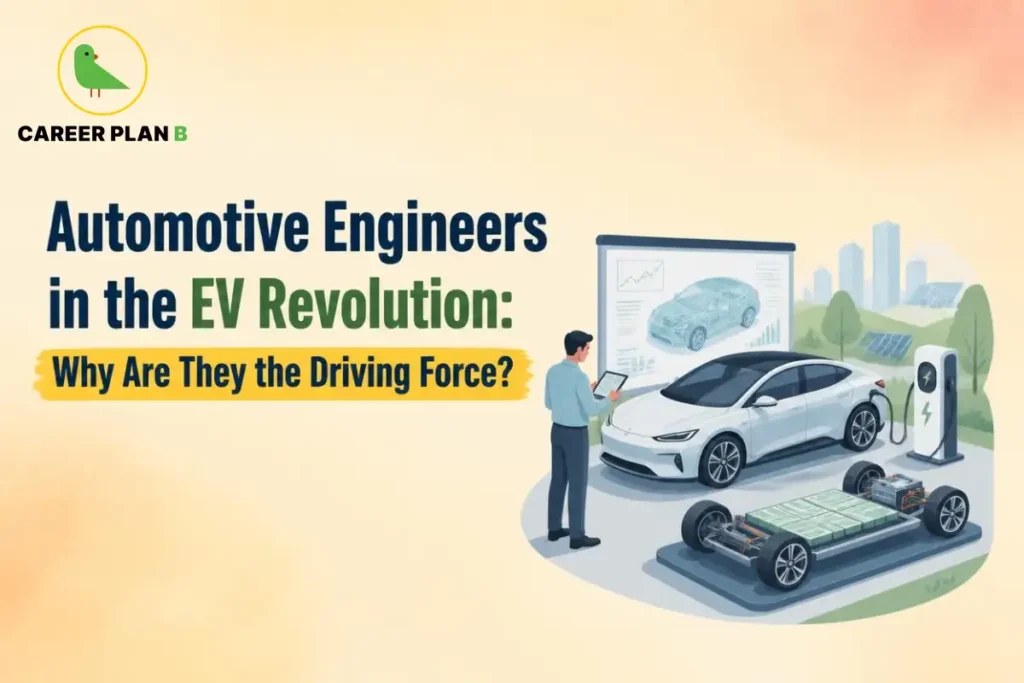
Introduction
The world is shifting gears literally. By 2030, over 60 million electric vehicles are expected to be on roads worldwide. Petrol stations are making way for charging hubs, and car companies that once dismissed EVs are now racing to electrify their entire lineups. At the centre of this seismic shift? Automotive engineers. The automotive engineers’ EV revolution is not just a buzzword; it is a full-scale transformation of how humanity moves. And engineers are the ones making it happen, one battery cell, motor winding, and software algorithm at a time.
In this blog, we will explore what makes automotive engineers so indispensable to the EV revolution, what skills are in demand, and how you can carve out a future-proof career in this fast-growing field.
The EV Revolution Is Here And It’s Moving Fast
Electric vehicles are no longer a niche product for eco-enthusiasts. They are going mainstream and fast. According to the International Energy Agency (IEA), global EV sales hit a record 14 million units in 2023, accounting for 18% of all cars sold that year. The European Parliament has also passed legislation mandating a complete phase-out of new petrol and diesel cars by 2035. Closer to home, India’s government-backed EV30@30 campaign led by NITI Aayog aims for 30% of all new vehicle sales to be electric by 2030.
What Do Automotive Engineers Actually Do in the EV World?
The role of an automotive engineer has evolved far beyond designing engines and exhaust pipes. In the EV era, engineers work across a fascinating range of high-impact domains.
Battery Technology and Design
The battery is the heart of every EV. Engineers working in battery technology and design are responsible for improving energy density, cutting charge times, and making batteries safer and more cost-effective. This includes research into lithium-ion, solid-state, and next-generation battery chemistries.
Electric Powertrain Development
Unlike combustion engines, EVs use electric motors paired with single or multi-speed transmissions. Engineers specialising in electric powertrain development optimise motor efficiency, torque delivery, and regenerative braking, all of which directly affect performance and driving range.
Software, Firmware & Vehicle Integration
Modern EVs are essentially computers on wheels. Automotive engineers collaborate with software teams to build Battery Management Systems (BMS), Over-The-Air (OTA) update frameworks, and Advanced Driver-Assistance Systems (ADAS).
Charging Infrastructure & Safety Systems
From fast-charging circuit design to international safety compliance, engineers also shape the broader ecosystem that supports EVs, not just the vehicles themselves.
Why Traditional Automotive Skills Still Matter
Here is something that surprises many students: you do not need to completely reinvent yourself to work in EV innovation and R&D. Core skills from mechanical engineering, thermal management, structural analysis, and materials science are directly applicable in the EV world. Managing heat in a battery pack, for instance, uses the same thermodynamics principles as cooling a combustion engine. The most sought-after engineers today are “T-shaped” professionals, those with broad automotive knowledge and deep expertise in one EV-specific area. This blend of mechanical intuition and electrical know-how is precisely what leading companies are hiring for right now.
The Skills EV Companies Are Desperately Looking For
If you are planning a career in electric vehicle engineering, here are the skills that will make you stand out:
Technical Skills:
- Battery chemistry and battery management systems
- Power electronics and motor control
- Embedded systems and firmware development
- CAD/CAE tools such as CATIA, ANSYS, and MATLAB/Simulink
- Knowledge of EV safety standards ISO 26262 and IEC 62133
Soft Skills:
- Cross-functional collaboration
- Systems thinking and structured problem-solving
- Adaptability to rapidly changing technologies
Top companies actively hiring include Tesla, BMW, Tata Motors EV, Ola Electric, Mahindra Electric, BYD, and a rapidly expanding ecosystem of EV startups across India and globally.
Have Any Doubts?
EV Career Opportunities: Where Can You Go?
Sustainable automotive careers in the EV space are diverse and well-compensated. Here is a quick snapshot:
| Role | Average Salary (India) | Global Range |
|---|---|---|
| EV Design Engineer | ₹6–12 LPA | $70,000–$110,000 |
| Battery Systems Engineer | ₹8–15 LPA | $90,000–$130,000 |
| Powertrain Engineer | ₹7–14 LPA | $85,000–$120,000 |
| EV R&D Specialist | ₹10–18 LPA | $100,000–$140,000 |
EV career opportunities are not limited to automakers alone. Energy companies, government bodies, infrastructure firms, and even aerospace organisations are investing in electric propulsion, significantly broadening your career horizon.
How Career Plan B Helps
Navigating the world of EV engineering can feel overwhelming, especially when the field is evolving so rapidly. Career Plan B offers personalised career counselling, psychometric and career assessment tests through their PsycheIntel tool, and structured career roadmapping to help you identify whether EV engineering truly aligns with your strengths and goals. Whether you are a student exploring engineering specialisations or a working professional considering a pivot into sustainable automotive careers, Career Plan B provides clear, expert-backed guidance to help you move forward with confidence.
For Latest Information
Frequently Asked Questions
- Do I need an electrical engineering degree to work in EV engineering?
Not necessarily. Mechanical, electronics, and mechatronics graduates are all in demand.
- Is India a good market for EV engineering careers?
Absolutely. With government schemes like FAME II and a booming startup ecosystem, India is one of the fastest-growing EV markets in the world, and the demand for skilled engineers is accelerating.
- How do I bridge the skill gap between ICE and EV engineering?
Several universities and online platforms now offer EV-specific certification programmes.
- What is the long-term scope for automotive engineers in the EV space?
The scope is enormous. As electrification expands into commercial vehicles, two-wheelers, and public transport, the demand for engineers with electric vehicle engineering expertise will only grow through 2030 and beyond.
- Can I build an EV engineering career outside India?
Yes. Countries like Germany, the USA, China, and South Korea have thriving EV sectors.
Conclusion
The automotive engineers’ EV revolution is not a distant future; it is happening right now, on roads, in factories, and in R&D labs across the world. Engineers who understand battery systems, electric powertrains, and vehicle software are not just employable; they are essential. Whether you are a student choosing your engineering path or a professional looking to future-proof your skills, there has never been a better time to align yourself with the future of the automotive industry.
The EV wave is here. The only question is, are you ready to drive it? Take the first step today. Visit Career Plan B and get personalised guidance to build your road map into the world of EV engineering.