Team6 · September 24, 2026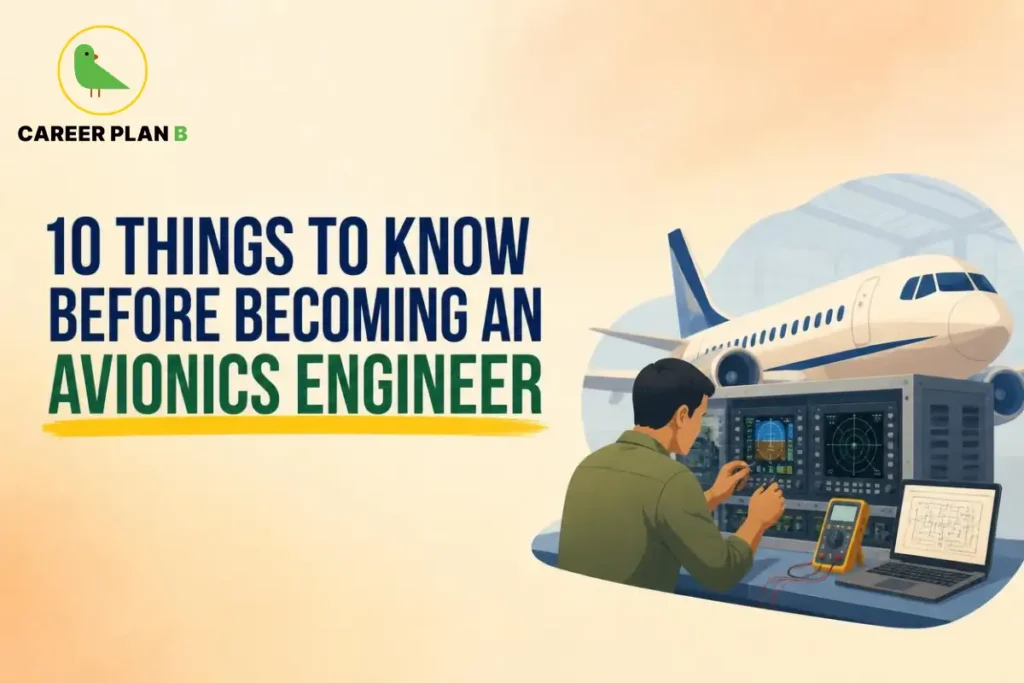
Introduction
Every time an aircraft takes off, lands safely, or navigates through zero-visibility cloud cover, it is not just the engines doing the work. Behind every safe flight is a sophisticated network of electronic systems, navigation units, communication equipment, flight management computers, radar systems, and autopilot controls, all designed, tested, and maintained by avionics engineers. If you are drawn to the idea of becoming an avionics engineer, you are looking at one of the most technically specialised and genuinely high-stakes careers in modern engineering.
Avionics engineering sits at the intersection of electronics, software, and aerospace, and it demands a very specific combination of skills, qualifications, and commitment. Before you commit to this path, there are ten things every aspiring student must understand, from the right academic choices in Class 12 all the way to what your career will actually look like on the other side.
This blog covers all ten, so you can walk into this field with your eyes fully open.
1. Avionics Engineering Is Not the Same as Aerospace Engineering
This is the first and most important distinction to make. Aerospace engineering is a broad field covering the design and development of aircraft and spacecraft, including structures, propulsion, aerodynamics, and materials. Avionics engineering is a specialised sub-discipline focused specifically on the electronic systems that make aircraft and spacecraft function safely and intelligently.
The word “avionics” itself is a combination of aviation and electronics. Avionics engineers work on navigation systems, communication systems, flight management computers, autopilot systems, radar, and onboard data systems. While aerospace engineers may design the body and engines of an aircraft, avionics engineers design and maintain the electronic brain that controls it.
If electronics, embedded systems, and signal processing excite you as much as flight itself, avionics is the more precise fit.
2. Your Class 12 Subject Choices Matter More Than You Think
Becoming an avionics engineer begins well before any entrance exam; it begins with your Class 11 and 12 subject selection. Physics, Chemistry, and Mathematics (PCM) are mandatory for any route into avionics engineering. Of these, Physics and Mathematics carry the most weight, since avionics draws heavily on electromagnetism, circuit theory, signal processing, and applied mathematics.
Students pursuing avionics engineering after 12th science have two primary degree routes. A BTech in Avionics, Aerospace Engineering with an electronics specialisation, or electronics and Communication Engineering (ECE) are the most direct undergraduate pathways. A BSc in Physics or BSc Electronics followed by an MTech in Avionics is a less direct but valid alternative route. The BTech route, particularly in avionics or ECE, remains the most widely recognised pathway into core avionics roles in India’s defence, space, and aviation sectors.
3. You Need to Clear Competitive Entrance Exams
Admission to strong avionics and aerospace engineering programmes in India runs through competitive national entrance examinations. There is no shortcut around this step, and the earlier you begin preparing, the better your institutional options will be.
Avionics Engineering Entrance Exams India Key Details
JEE Main is conducted by the National Testing Agency (NTA) and is the gateway to NITs, IIITs, and other centrally funded technical institutions offering aerospace and electronics engineering programmes. JEE Advanced is required for admission to the IITs, which offer India’s most rigorous avionics and aerospace electronics programmes. Only the top 2.5 lakh JEE Main qualifiers are eligible to sit for JEE Advanced.
IIST Entrance: The Indian Institute of Space Science and Technology (IIST), Thiruvananthapuram, offers a dedicated Avionics BTech programme directly linked to ISRO. Admission is through JEE Advanced scores, making it one of the most competitive and prestigious avionics-specific routes in India.
State-level entrance exams such as MHT-CET, KCET, and WBJEE provide access to state government and private engineering colleges offering electronics and aerospace programmes with avionics components.
4. The Best Colleges in India for Avionics Engineering
Choosing the right institution is one of the most consequential decisions in your journey to becoming an avionics engineer. The quality of your faculty, laboratory infrastructure, research opportunities, and industry connections will shape both your learning and your placement outcomes.
| Institution | Programme | Entrance Exam |
|---|---|---|
| IIST Thiruvananthapuram | B.Tech. Avionics | JEE Advanced |
| IIT Bombay | B.Tech. Aerospace Engineering | JEE Advanced |
| IIT Madras | B.Tech. Aerospace Engineering | JEE Advanced |
| IIT Kanpur | B.Tech. Aerospace Engineering | JEE Advanced |
| PEC University of Technology, Chandigarh | B.Tech. Aerospace Engineering | JEE Main / State CET |
| Manipal Institute of Technology | B.Tech. Aeronautical Engineering | MET / JEE Main |
| SRM Institute of Science and Technology | B.Tech. Avionics | SRMJEEE / JEE Main |
| Amity University | B.Tech. Aerospace Engineering | JEE Main / Amity JEE |
For official seat allocation and counselling details for IITs and NITs, visit the Joint Seat Allocation Authority (JoSAA). IIST, as India’s only dedicated space university with an avionics programme, deserves special mention. Graduates from IIST’s BTech Avionics programme are typically absorbed directly into ISRO, making it the single most direct route to a career in India’s space sector for avionics engineers.
5. Avionics Engineers Need a Very Specific Skill Set
This is where many students underestimate the demands of the field. Avionics engineering is not general electronics; it is electronics applied to some of the most safety-critical systems in existence. A failure in an avionics system does not cause inconvenience; it can cause catastrophe. That reality shapes everything about how avionics engineers are trained and what they are expected to know.
Avionics Engineer Skills and Qualifications
The core avionics engineering skills and qualifications include the following:
Technical Skills:
- Embedded systems design and programming
- Digital signal processing and RF communications
- Navigation systems: GPS, INS, ILS, VOR
- Flight management and autopilot systems
- Avionics software development (DO-178C standards)
- Circuit design and PCB layout for aerospace-grade hardware
- Systems integration and testing methodologies
- Familiarity with aviation safety standards and certifications (DO-254, MIL-STD)
Analytical and Problem-Solving Skills:
- Fault diagnosis in complex, multi-system environments
- Reliability engineering and failure mode analysis (FMEA)
- Strong mathematical grounding in control systems and signal theory
Professional Skills:
- Technical documentation for safety-critical systems
- Cross-disciplinary collaboration with aerospace, software, and mechanical engineers
- Attention to detail at a level that leaves zero margin for error
These skills are developed progressively through your undergraduate curriculum, laboratory sessions, internships, and project work, but students who supplement their formal education with self-driven learning in embedded systems and avionics software build a significant advantage.
6. Postgraduate Education Significantly Expands Your Options
A BTech in avionics or aerospace engineering opens the door, but an MTech or research degree can take you significantly further, especially in India’s government research and space sectors. MTech programmes in Avionics, Aerospace Electronics, or Guidance and Navigation are available at IITs and select institutions, with admission through GATE scores. GATE in Electronics and Communication Engineering (ECE) or Aerospace Engineering are the relevant papers.
Postgraduate qualifications unlock research scientist positions at ISRO, DRDO, and NAL (National Aerospace Laboratories), where the most technically advanced avionics work in India is carried out. They also significantly increase salary levels and long-term career trajectory, particularly in defence and space research organisations. For students with a PhD, avionics research positions at institutions like IISc and TIFR become accessible, as do international research collaborations and academic careers.
7. Your Primary Employers Will Be in Defence, Space, and Aviation
Understanding who actually hires avionics engineers in India is essential before committing to the field. The aerospace and avionics job opportunities India offers are concentrated in three primary sectors, and all three are growing.
Defence Sector:
- DRDO (Defence Research and Development Organisation) develops avionics systems for missiles, fighter aircraft, and defence electronics
- HAL (Hindustan Aeronautics Limited) designs, manufactures, and maintains military and civil aircraft, with dedicated avionics divisions
- BEL (Bharat Electronics Limited) develops avionics and defence electronics systems
Space Sector:
- ISRO (Indian Space Research Organisation) India’s primary employer of avionics engineers for launch vehicle and satellite navigation systems
- Private space companies operating under the IN-SPACe framework
Civil Aviation Sector:
- The Airports Authority of India (AAI) manages navigation aids and communication systems at Indian airports
- Directorate General of Civil Aviation (DGCA), the regulatory body overseeing aviation safety and avionics certification in India
- Airlines and MRO (Maintenance, Repair, and Overhaul) companies employing avionics maintenance engineers
Private defence manufacturers operating under India’s Make in India initiative are also emerging as a significant employer as India expands its domestic defence production.
8. Avionics Engineer Salary in India: What to Realistically Expect
One of the most practical questions students and parents ask before committing to a specialised engineering path is what the financial return actually looks like. Here is a realistic avionics engineer salary ladder in India:
| Career Stage | Role | Approximate Salary (India) |
|---|---|---|
| Entry Level | Graduate Engineer Trainee, Junior Avionics Engineer | ₹5–8 LPA |
| Mid-level | Avionics Engineer, Systems Integration Engineer | ₹8–18 LPA |
| Senior Level | Senior Avionics Engineer, Project Lead, Technical Specialist | ₹18–35 LPA |
| Leadership / Research | Chief Avionics Engineer, Research Scientist, Programme Director | ₹35–60+ LPA |
Government sector roles at ISRO, DRDO, and HAL offer strong job security, structured pay scales, and world-class research exposure. Private sector and MNC roles, particularly with global aerospace companies, offer higher variable compensation and faster salary progression. International avionics roles in the US, Europe, and the Gulf carry significantly higher salary ranges, making global mobility an important consideration for ambitious avionics engineers with strong academic profiles.
9. Avionics Engineering Has Strong Global Career Prospects
Avionics engineering careers in India are growing, but the global picture is equally compelling. Aviation is an inherently international industry, and avionics engineers with strong academic credentials and practical experience are in demand across the world. Global employers actively hiring avionics engineers include Boeing, Airbus, Honeywell Aerospace, Thales Group, Raytheon Technologies, Northrop Grumman, and Lockheed Martin. Space agencies, including NASA and ESA, also hire avionics specialists for spacecraft development and mission systems.
The Gulf aviation sector, anchored by Emirates, Etihad, Qatar Airways, and their associated MRO operations, is another major destination for Indian avionics professionals, offering competitive salaries and significant international exposure. For Indian students with IIST or IIT backgrounds, global aerospace companies have established recruitment pipelines, making international career mobility a realistic prospect from the outset of your career.
10. Clarity of Purpose Is Your Most Important Asset
Becoming an avionics engineer is a long, specialised, and demanding path. The entrance exams are competitive. The undergraduate curriculum is rigorous. The postgraduate pathway is strongly recommended. The work itself involves systems where precision is not optional; it is a professional and ethical obligation. Before committing to this field, ask yourself honestly: Do I find electronics and embedded systems genuinely fascinating, not just as a career choice but as a subject I would happily spend hours exploring? Am I comfortable with the idea that my work will directly influence flight safety? Do I have the patience for deep technical specialisation over a long career?
If your answers are ‘yes’, avionics engineering is not just a viable path; it is a genuinely excellent one. If you are uncertain, that uncertainty deserves to be explored carefully before you commit four or more years to a specialised programme.
How Career Plan B Helps
Becoming an avionics engineer demands clarity about your aptitude, interests, and long-term goals well before you sit your first entrance exam. Career Plan B helps PCM students make exactly this determination through the Psycheintel psychometric assessment, which identifies whether your strengths genuinely align with technical engineering, electronics, and systems thinking or whether a different branch of aerospace or engineering is a better fit. Paired with one-on-one career counselling and a structured roadmap covering entrance exam strategy, college selection, and career planning, Career Plan B ensures you pursue avionics engineering or the right alternative with full confidence and a concrete plan.
Get In Touch With Us
Frequently Asked Questions
Q1. What is the eligibility for becoming an avionics engineer in India?
Becoming an avionics engineer requires completion of Class 12 with Physics, Chemistry, and Mathematics with a minimum of 75% aggregate marks. Admission to BTech Avionics or Aerospace Engineering is primarily through JEE Main for NITs and JEE Advanced for IITs and IIST. IIST Thiruvananthapuram is the only institution offering a dedicated BTech Avionics programme in India.
Q2. Which entrance exams are required for avionics engineering after 12th science?
The primary avionics engineering entrance exams in India are JEE Main and JEE Advanced. IIST India’s premier avionics engineering institution uses JEE Advanced scores for admission. State-level CETs provide access to electronics and aerospace programmes at state and private colleges. GATE is required for MTech admissions.
Q3. What skills are most important for an avionics engineer?
The most critical avionics engineer skills and qualifications include embedded systems design, digital signal processing, navigation systems knowledge, avionics software development, and systems integration. Equally important are analytical problem-solving, fault diagnosis, and familiarity with aviation safety and certification standards like DO-178C and DO-254.
Q4. What is the salary of an avionics engineer in India?
The avionics engineer salary in India at entry level ranges from ₹5–8 LPA at government organisations like ISRO, DRDO, and HAL. Mid-level roles typically range from ₹8–18 LPA, while senior and leadership roles at major organisations and MNCs can reach ₹35–60+ LPA.
Conclusion
Becoming an avionics engineer means choosing a career at the most technically demanding intersection of electronics, software, and aerospace, where the work you do directly influences flight safety and space exploration. It is not a casual choice. It demands the right academic foundation, competitive entrance performance, a specific and well-developed skill set, and a genuine passion for the systems that keep aircraft and spacecraft functioning with precision.
But for students who bring that passion and commitment, avionics engineering offers something rare: a career where technical excellence, national importance, and global relevance all come together in the same role.
Not sure if avionics engineering is the right engineering branch for you? Visit Career Plan B, take the Psycheintel assessment, and speak with a career counsellor who can help you map your aptitude to the right specialisation. The right engineering career starts with the right self-knowledge, and Career Plan B is built exactly for that.