Careerplanb · May 5, 2026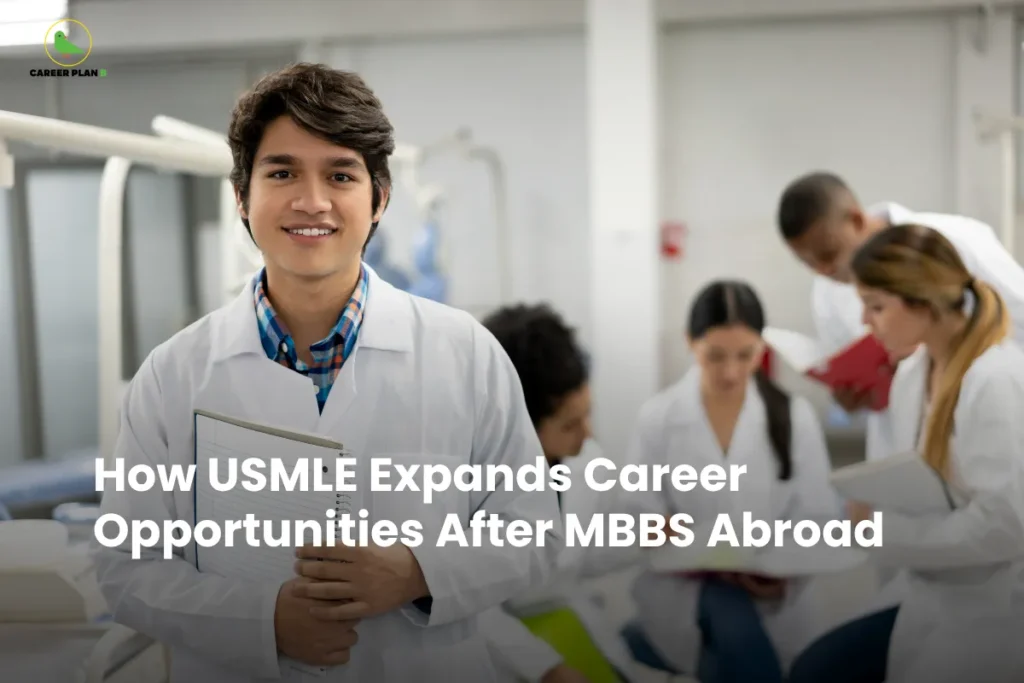
Introduction
Completing your MBBS abroad is a monumental achievement, but for many graduates in 2026, the question “What comes next?” can feel daunting. Whether you studied in Georgia, the Philippines, Russia, or elsewhere, you have likely realised that a medical degree is just the beginning. In an increasingly competitive global healthcare market, how do you ensure your skills are recognized worldwide?
The answer for thousands of International Medical Graduates (IMGs) is the United States Medical Licensing Examination (USMLE). Often dubbed the “global passport of medicine”, the USMLE is more than just a gateway to America; it is a transformative credential that redefines your professional trajectory.
Confused about your next steps? Get a personalized roadmap tailored to your career goals.
Why USMLE is the Ultimate Pivot for MBBS Abroad Students
For students who have pursued an MBBS abroad, the USMLE acts as a powerful equalizer. It provides a standardized benchmark that proves your clinical knowledge and skills meet the highest global standards. But is the USMLE only about practicing in the United States?
While many aim for the U.S., the certification is highly respected in countries across the Middle East (like the UAE and Qatar), and it significantly bolsters your profile for competitive fellowships in the UK or Australia. By clearing these steps, you transition from being a “foreign graduate” to a globally validated physician.
What are the immediate benefits of ECFMG certification?
Once you pass Step 1 and Step 2 CK, you move toward ECFMG certification. In 2026, this certification remains the gold standard for verifying that an IMG is ready to enter the U.S. healthcare system. It signals to hospitals and research institutions worldwide that you possess the rigour and dedication required for high-stakes clinical environments.
Navigating the 2026 Landscape: The Match and Beyond
The journey to a U.S. medical residency Match is often seen as the primary goal. Despite the rigorous nature of the exams, the data is encouraging. In recent years, the match rate for non-US IMGs has seen a steady climb as healthcare demands increase.
However, the USMLE opens doors that extend far beyond a standard residency. Many graduates use their scores to secure:
- Clinical rotations in USA: Essential for gaining hands-on experience and letters of recommendation.
- Medical fellowship opportunities: Allowing you to specialise in cutting-edge fields like Interventional Cardiology or Oncology.
- Research Tracks: Working at prestigious institutions like the Mayo Clinic or Johns Hopkins.
Diverse Career Pathways: More Than Just a White Coat
What if your interests lie outside the traditional hospital ward? Career opportunities after USMLE are surprisingly diverse. The depth of knowledge required to pass the exams makes you an ideal candidate for several high-growth sectors:
- Healthcare Consulting Careers: Global firms like McKinsey or BCG value doctors who understand the clinical nuances of the U.S. healthcare system.
- Health-Tech & AI: With the 2026 boom in medical AI, tech companies are looking for USMLE-qualified doctors to help bridge the gap between medicine and machine learning.
- Hospital Administration: Leading international hospitals prioritize administrators who understand global medical standards.
How Career Plan B Supports Every Step
- Personalized Counseling: In-depth one-on-one counseling to align specialization, college choices, and career goals.
- Timeline & Reminder Service: Never miss a deadline—receive timely reminders and updates about institute-wise counseling calendars.
- Document Checklist & Verification: Guidance to prepare all required documentation, reducing stress on D-day.
- Preference Analysis: Analysis of seat trends, cut-offs, and college quality to build a winning choice list.
- Mock Counseling & Strategy: Practice sessions to simulate real counseling—boosting your confidence, reducing errors.
- Support for Appeals/Technical Issues: Help in resolving portal issues, appeals, or queries with admission authorities.
For Latest Information
Frequently Asked Questions (FAQ)
- Is the USMLE still worth it with the Step 1 Pass/Fail change?
Absolutely. While Step 1 is now Pass/Fail, it has made Step 2 CK the critical differentiator. High scores in
Step 2 CK are now more important than ever for a successful Match. - Can I take the USMLE if my college isn’t ECFMG accredited?
As of 2024/2025, your medical school must be accredited by an agency recognized by the World Federation for Medical Education (WFME). It is vital to check your school’s status before starting the process. - How much time does the entire USMLE process take?
Typically, it takes 1.5 to 3 years to complete all steps, including gaining clinical experience in the U.S. and applying for the Match. - What happens if I don’t match into a residency?
The USMLE credential remains valuable for research positions, public health roles, or practicing in other countries that recognize the exam, ensuring your efforts are never wasted.
Conclusion: Thinking Beyond Borders
The USMLE is undoubtedly a marathon, not a sprint. However, for the MBBS abroad graduate, it represents the most effective way to break through professional ceilings. It transforms a local degree into a global career, offering financial stability, clinical excellence, and the prestige of working within the world’s most advanced healthcare systems.
If you are ready to stop wondering “what if” and start building a world-class medical career, the time to plan is now. Your degree is the foundation—the USMLE is the skyscraper you build upon it.
Ready to map out your global medical journey? Contact Career Plan B today for a personalized roadmap!