Careerplanb · June 27, 2026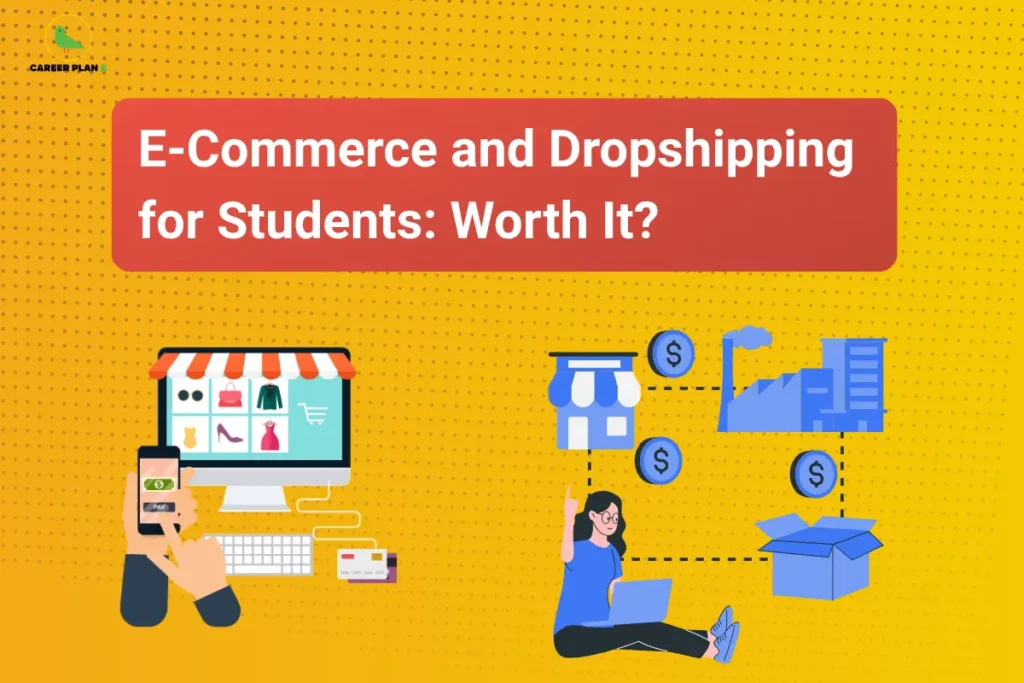
Introduction
Over the last few years, social media has completely changed how students think about money, careers, and success. Earlier, most students focused almost entirely on marks, entrance exams, and placements. Today, many teenagers and college students are also thinking about side hustles, online businesses, freelancing, content creation, and financial independence much earlier than previous generations ever did.
Somewhere inside that shift, e-commerce and dropshipping became extremely popular.
Students now regularly come across videos claiming that anyone can build an online store, earn passive income, and become financially successful without investment, experience, or even advanced skills. The idea sounds exciting, especially to young people who want freedom, flexibility, and independence alongside studies.
That is exactly why conversations around e-commerce for students have grown rapidly in India.
But behind the success stories, there is also confusion, unrealistic expectations, and pressure that students rarely talk about openly.
Some students genuinely enjoy entrepreneurship and business-building. Others quietly start side hustles because they feel inadequate watching everyone else “make money online.”
And sometimes, students are not chasing business opportunities at all.
They are chasing the fear of being left behind.
According to the International Labour Organization (ILO), digital entrepreneurship and online platform work are becoming increasingly common among young people globally as technology reshapes employment patterns and economic participation.
Source: International Labour Organization Digital Economy Research
But that does not automatically mean every student should jump into dropshipping simply because it looks trendy online.
The more important question is whether students actually understand what these businesses involve beyond social media hype.
What Is E-Commerce and How Is Dropshipping Different?
E-commerce simply means selling products or services online. This can include clothing brands, handmade products, digital products, customised items, educational material, art, or almost anything sold through websites or online marketplaces.
Dropshipping is a specific type of e-commerce model where the seller does not keep physical inventory. Instead, when a customer places an order, the supplier ships the product directly to the customer.
This is why dropshipping often attracts students. The model appears easier to start because students do not need warehouses, manufacturing units, or large upfront stock investments.
On paper, it sounds simple.
Create a website. Add products. Run advertisements. Earn profit.
But real businesses rarely work as smoothly as social media clips make them appear.
Why Students Feel Drawn Towards Online Businesses
One of the biggest reasons students become interested in e-commerce is psychological, not financial.
Students today are constantly exposed to stories of teenagers making money online, building brands early, or achieving “success” before graduation. Over time, this creates a subtle pressure where traditional student life starts feeling “slow” or “ordinary”.
A student studying normally may suddenly feel unproductive because someone online claims to be earning lakhs through dropshipping at nineteen.
That comparison affects more students than people realise.
At the same time, there are also genuine reasons students feel attracted towards entrepreneurship. Many students want:
- Financial independence
- Real-world business exposure
- Practical skill development
- Freedom to experiment creatively
- Experience beyond academics
- Understanding of marketing and digital business
Those motivations are completely valid.
In fact, entrepreneurship at a young age can teach responsibility, communication, adaptability, and problem-solving in ways that classrooms sometimes cannot.
The issue is not curiosity.
The issue is unrealistic expectations.
The Reality Behind Dropshipping and Online Side Hustles
Social media often presents dropshipping as a shortcut to fast money. What students rarely see are the parts that actually make businesses difficult.
A successful e-commerce business usually involves:
- Product research
- Branding
- Customer communication
- Website management
- Marketing strategy
- Advertisement spending
- Handling refunds and complaints
- Logistics coordination
- Consistency and patience
Many students enter dropshipping believing it is passive income from the beginning. In reality, most businesses require active effort for a long time before they become stable. And many online stores fail. That is not meant to discourage students. It is simply reality.
According to research from the Organisation for Economic Co-operation and Development (OECD), entrepreneurial ventures among young people often struggle because of unrealistic expectations, a lack of business understanding, and limited long-term planning.
Source: OECD Youth Entrepreneurship Research
This is why students should approach side hustles as learning experiences first and income sources second.
That mindset changes everything.
What Students Can Actually Learn from E-Commerce
Even if a student’s first online business does not become profitable immediately, the learning experience itself can still be valuable.
Students involved in e-commerce often develop skills like the following:
- Communication
- Marketing understanding
- Graphic design basics
- Customer psychology
- Time management
- Problem-solving
- Financial awareness
- Negotiation
- Content creation
These skills become useful across many careers, not only entrepreneurship.
For example, a student managing a small online page learns how people make purchasing decisions. A student handling customer messages develops communication confidence. Someone experimenting with product branding learns visual storytelling and market positioning.
Sometimes, the most important outcome is not the money earned. It is the maturity gained through responsibility.
But Not Every Student Needs a Side Hustle
This is important to say clearly because many students quietly feel guilty for not “doing enough”. You do not need a business at sixteen to have a successful future. You do not need to monetise every hobby. You do not need to convert your teenage years into a constant productivity competition.
Some students genuinely enjoy entrepreneurship and should absolutely explore it responsibly. Others may benefit far more from academics, skill-building, creative hobbies, sports, internships, or simply understanding themselves better first.
And honestly, many students start side hustles not because they love business but because they feel pressured by online culture. That difference matters. A side hustle built from curiosity feels energising. A side hustle built from comparison usually feels exhausting very quickly.
Signs a Student May Actually Enjoy Entrepreneurship
Not every student interested in money automatically enjoys entrepreneurship. Real business-building requires patience, consistency, emotional resilience, and long-term thinking.
A student may genuinely enjoy e-commerce or online business if they
- Enjoy solving problems independently
- Like experimenting creatively
- Are curious about branding and marketing
- Can handle uncertainty reasonably well
- Enjoy learning practical business skills
- Stay interested even when results are slow
Meanwhile, students driven purely by quick income expectations often lose motivation rapidly once they realise businesses involve mistakes, delays, customer complaints, and inconsistent results.
Entrepreneurship looks exciting online because social media mostly shows outcomes. Very few people show the months of confusion behind those outcomes.
Balancing Studies and Side Hustles Is Harder Than Students Expect
Many students underestimate how mentally demanding it can be to balance academics alongside online businesses.
Managing orders, learning marketing, handling social media, studying for exams, and maintaining personal life all together can become overwhelming surprisingly fast.
This becomes especially difficult in India’s highly competitive academic environment, where entrance exams, board exams, and career decisions already create intense pressure for students.
According to UNESCO education studies, adolescent learning environments work best when students maintain balanced cognitive and emotional development instead of functioning under constant performance pressure.
Source: UNESCO Education Research
Students should ask themselves honestly:
- Am I genuinely enjoying this process?
- Is this helping me grow?
- Or am I constantly anxious about “keeping up” with others online?
Because sometimes what appears ambitious externally is actually burnout developing quietly.
Smart Ways Students Can Explore E-Commerce Without Risking Everything
Students interested in entrepreneurship do not need to immediately launch large businesses or invest heavily. There are healthier ways to explore business building gradually.
For example, students can:
- Learn basic marketing through small projects
- Sell handmade or customised products on a small scale
- Experiment with content creation
- Learn website basics
- Study branding and consumer psychology
- Help with family businesses
- Explore digital skills like design or editing
- Build small passion-based projects first
The safest early business experiences are usually the ones focused on learning rather than immediate profit.
This allows students to understand whether they genuinely enjoy entrepreneurship before turning it into major pressure.
Why Career Clarity Matters Before Chasing Trends
One of the biggest mistakes students make is blindly following online business trends without understanding their own strengths, interests, or personality first.
A student who genuinely enjoys creativity may thrive in branding or design-focused businesses. Another student may prefer analytical fields, structured careers, or research-based work instead of entrepreneurship.
Neither path is superior.
But confusion increases when students start chasing whatever currently looks successful online without understanding themselves properly.
This is where structured career guidance becomes valuable. Programmes like Career counselling for students help students understand aptitude, behavioural tendencies, interests, and long-term career compatibility before making major decisions based purely on trends or comparison.
Because not every student needs the same version of success.
Comparison Table: Potential Benefits vs Challenges of E-Commerce for Students
| Potential Benefits | Possible Challenges |
| Early business exposure | Academic distraction |
| Financial awareness | Unrealistic expectations |
| Skill development | Mental stress and burnout |
| Creativity and experimentation | Inconsistent income |
| Communication improvement | Online comparison pressure |
| Understanding digital marketing | Time management difficulties |
Source: Compiled using OECD youth entrepreneurship research and UNESCO adolescent development studies.
How Career Plan B Helps
Career Plan B helps students navigate CUET 2026 private university subject rules with clarity, confidence, and personalized guidance:
- Personalized Career Counselling: Helps students identify universities and programmes that genuinely align with their strengths, interests, and long-term goals.
- Psycheintel & Career Assessment Tests: Provides insights into aptitude, personality traits, learning styles, and suitable academic and career pathways through data-backed assessments.
- Admission & Academic Profile Guidance: Supports students in understanding CUET subject combinations, decoding university-specific eligibility rules, and building strong academic profiles strategically.
- Career Roadmapping: Helps students create a structured long-term plan aligned with their academic choices and future aspirations.
- End-to-End Guidance: Assists students throughout subject selection, university shortlisting, admissions, and career planning so important details, eligibility requirements, and opportunities never slip through the cracks.
For Latest Information
Frequently Asked Questions
1. Can students legally start dropshipping in India?
Students can explore small online businesses, but legal and payment-related processes may require parental supervision or support if the student is under 18.
2. Is dropshipping good for beginners?
Dropshipping can help beginners understand marketing and online business basics, but it is not as easy or “passive” as social media often presents it.
3. Can students balance studies with e-commerce?
Some students manage both successfully, but balancing academics and business requires discipline, time management, and realistic expectations.
4. Do students need investment to start e-commerce?
Some e-commerce models require very little investment initially, while others involve website costs, advertisements, branding, or product sourcing expenses.
5. Should every student try side hustles?
No. Side hustles are not necessary for everyone. Students should explore them only if they feel a genuine interest and can maintain a healthy balance alongside studies and personal well-being.
Conclusion
E-commerce and dropshipping are neither magical shortcuts nor completely useless distractions. For some students, they become valuable learning experiences that build confidence, responsibility, and real-world skills. For others, it becomes unnecessary pressure created by constant online comparison.
The difference usually depends on motivation.
Students who approach side hustles with curiosity, patience, and realistic expectations often learn far more than just business. But students chasing quick success or validation online often end up exhausted before they even understand what they truly enjoy.
Because sometimes the most important question is not “How fast can I start earning?” But “What kind of work actually feels meaningful to me?”