Careerplanb · June 27, 2026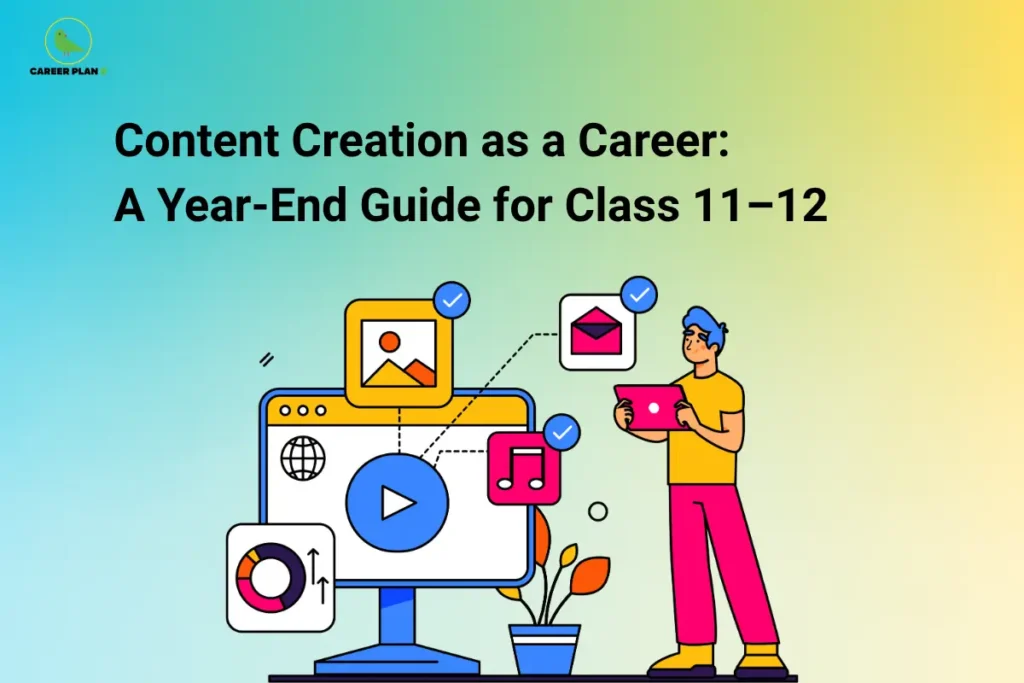
Introduction
Picture this. A seventeen-year-old in Jaipur edits videos on her phone between study breaks. She’s not doing it for marks or a school project. She just enjoys it. By the time she’s in Class 12, she doesn’t know whether to pursue that or listen to the voices telling her to “choose something stable”. That conflict between what genuinely interests a young person and what feels socially acceptable is exactly what this guide is about.
Content creation as a career is no longer a fringe idea in India. According to a landmark Boston Consulting Group report released at WAVES 2025, India’s creator economy currently influences over $350 billion in annual consumer spending, a figure projected to surpass $1 trillion by 2030. YouTube’s creative ecosystem alone contributed over ₹16,000 crore to India’s GDP in 2024 and generated more than 930,000 full-time equivalent jobs. This is not hobby territory anymore. This is an economy.
But before any Class 11 or 12 student makes decisions based on excitement alone, there is a lot worth understanding honestly, clearly, and without the hype.
What Does “Content Creation” Actually Mean as a Career?
This is where most conversations go wrong. When students or parents hear “content creator”, they picture someone filming themselves for Instagram. That is one version of this career. But the professional world that sits behind digital content is far wider and far more structured than most people realise.
Content creation as a career encompasses a range of distinct professional roles. Some of these are creative and editorial. Others are strategic, technical, or managerial. A student entering this space in 2025 or 2026 is not just entering “social media”. They are entering one of the fastest-growing employment ecosystems in India’s digital economy.
Here is what the landscape actually looks like in professional terms:
A content writer or copywriter works with brands, agencies, publications, and startups to produce written material, including articles, website copy, product descriptions, social media captions, scripts, and newsletters. A video producer or editor handles the technical and creative side of video from scripting and shooting to colour grading and platform optimisation. A social media manager runs a brand’s presence across platforms, manages community engagement, analyses performance data, and plans monthly calendars. A content strategist sits at the intersection of marketing and storytelling, mapping what content a brand needs, why, and when. A podcast producer manages audio content end-to-end, including research, recording, editing, and distribution. An SEO content specialist ensures that content is written and structured in ways that search engines can find and rank. These are real jobs with real salaries, real career progression, and real demand.
The Numbers Behind the Opportunity
India is not just participating in the global creator economy; it is one of its three largest ecosystems globally, alongside the United States and China.
According to the BCG report “From Content to Commerce”, published via the Press Information Bureau in May 2025, India has between 2 and 2.5 million active monetised digital creators. The creator ecosystem’s direct revenues, estimated at $20–25 billion today, are projected to grow fivefold to $100–125 billion by the end of the decade.
But there is a sobering number in that same data: only 8 to 10 per cent of creators currently monetise their content effectively. That is not a reason to avoid the field. It is a reason to understand it properly before entering it.
The creators who build sustainable careers are not simply the ones who post the most. They are the ones who combine genuine skill with strategic thinking, people who understand their audience, manage their output professionally, and develop competencies that go beyond the content itself. That combination is what separates a hobby from a career.
Courses and Pathways After Class 12: What Are the Real Options?
The most common misconception is that content creation has no formal academic path. That is not true. There are several well-recognised degree and diploma programmes that build the foundational skills this career demands.
Bachelor of Journalism and Mass Communication (BJMC): A three-year undergraduate degree that covers news writing, broadcast journalism, digital media, advertising, and public relations. It provides the editorial foundation that serious content professionals need. regardless of which medium they eventually work in. Admission typically requires 50–55% in Class 12 from any stream, as per UGC guidelines.
BA in Mass Communication or Media Studies: A broader programme that covers communication theory, visual storytelling, film studies, and digital media. Many universities offer specialisations in digital content, advertising, or PR within this framework.
BBA in Digital Marketing: A management-orientated degree that combines marketing principles with digital tools, analytics, and strategy. Suited for students interested in the business side of content brand communication, campaign management, and media planning.
Diploma or certificate programmes in digital marketing and content: six-month to one-year programmes offered by various institutes. These are skills-focused and cover SEO, social media management, content strategy, and video production and are often chosen by students who pursue them alongside or after a general degree.
It is worth noting that the University Grants Commission (UGC) recognises mass communication and journalism as a formal academic discipline. Students from any stream, arts, commerce, or science, are eligible for most of these programmes.
Skills That Actually Matter in This Field
Formal education gives you a framework. But the content creation industry, more than most others, rewards demonstrated skill over credentials. A student who finishes a degree without building any actual portfolio will struggle. A student who builds a genuine body of work even from Class 11 will enter the field with a real advantage.
The skills that employers and brands consistently look for in content professionals include storytelling and writing ability, video scripting and editing, SEO fundamentals, data literacy (understanding what the numbers on a dashboard mean), graphic design basics, and the ability to adapt tone and format for different platforms. These are learnable. None of them requires a specific stream in school.
What is often underestimated and what makes this career genuinely demanding is the discipline it requires. Consistency, meeting deadlines, responding to briefs, working under creative constraints, and handling feedback professionally. These are not skills that come naturally to everyone, and no course gives them to you. They come from practice.
The Real Challenges: What No One Tells You
An honest guide has to include this. The creator economy in India has a significant income concentration problem. The BCG data is clear: despite millions of creators, fewer than 10 per cent earn meaningfully from their content. This does not mean the career is unviable; it means the career has real entry-level difficulties that need to be planned for.
The path to a sustainable income in this field typically follows two routes. The first is the creator-entrepreneur route, building an audience and monetising through brand partnerships, subscriptions, or digital products. This route can be slow and unpredictable in the early years. The second is the professional services route, working as a salaried or freelance content professional for brands, agencies, or media companies. This route is more structured and provides income stability while skills develop.
Most young people entering this space in their early twenties do a combination of both. They work a content role during the day and build their own channel or publication on the side. That dual-track approach is worth understanding before deciding which path to pursue.
A student who genuinely loves this field should also be comfortable with the following reality: platform algorithms change, trends shift, and what works today may not work in two years. Adaptability is not optional here. It is the core professional skill.
Career Roles and Salary Benchmarks in India
| Role | Experience Level | Approximate Annual Salary (India) | Primary Skills Required |
| Content Writer / Copywriter | 0–2 Years | ₹2.5 – ₹4.5 LPA | Writing, SEO, Research |
| Social Media Manager | 1–4 Years | ₹3 – ₹7 LPA | Analytics, Content Planning, Design |
| Video Editor / Producer | 1–4 Years | ₹3 – ₹8 LPA | Editing, Storytelling, Scripting |
| SEO Content Specialist | 2–5 Years | ₹4 – ₹10 LPA | SEO, Analytics, Keyword Research |
| Content Strategist | 4–8 Years | ₹7 – ₹15 LPA | Brand Strategy, Leadership |
| Digital Marketing Manager | 5–10 Years | ₹10 – ₹25 LPA | Marketing Strategy, Data Analysis, Budgeting |
Salary ranges compiled from publicly available industry data across digital media roles in India (2025–26).
These are professional employment figures, not influencer income estimates, which vary too widely to be useful as a planning reference.
Is This Career Right for You? Honest Questions to Ask Yourself
This is perhaps the most important section of this guide. Excitement about a career field and genuine fit with it are two different things. A Class 11 or 12 student considering content creation should sit with these questions honestly:
Do you actually enjoy the process of making content – the writing, the editing, the research – or do you mostly enjoy the idea of being a content creator? Do you have the patience to work on something consistently for months before it gains traction? Can you take honest feedback on your work without it feeling like personal criticism? Are you drawn to the storytelling and communication aspects of this field, or primarily to the lifestyle you see associated with it? Are you comfortable with income that may be irregular in the early years, or do you need more financial predictability?
None of these are trick questions. They are genuine markers of whether this is a field that will sustain you over the long term, not just excite you in the short term.
Students who answer honestly will either feel more confirmed in this direction or realise they need to explore further. Both outcomes are valuable.
How Career Plan B Helps
Career Plan B helps students navigate CUET 2026 private university subject rules with clarity, confidence, and personalized guidance:
- Personalized Career Counselling: Helps students identify universities and programmes that genuinely align with their strengths, interests, and long-term goals.
- Psycheintel & Career Assessment Tests: Provides insights into aptitude, personality traits, learning styles, and suitable academic and career pathways through data-backed assessments.
- Admission & Academic Profile Guidance: Supports students in understanding CUET subject combinations, decoding university-specific eligibility rules, and building strong academic profiles strategically.
- Career Roadmapping: Helps students create a structured long-term plan aligned with their academic choices and future aspirations.
- End-to-End Guidance: Assists students throughout subject selection, university shortlisting, admissions, and career planning so important details, eligibility requirements, and opportunities never slip through the cracks.
For Latest Information
Frequently Asked Questions
1. Can I pursue content creation as a career after any stream in Class 12?
Yes. Most undergraduate programmes in journalism, mass communication, and digital marketing accept students from the arts, commerce, and science streams. There is no stream restriction, and no background in technology or design is required to begin. Communication skills, curiosity, and a willingness to learn are more important at the entry level than academic stream.
2. What is the difference between being a content creator and working as a content professional?
A content creator typically builds and grows their own channel, platform, or audience, monetising through brand deals, subscriptions, or platform revenue. A content professional works within an organisation or as a freelancer, creating content for brands, agencies, or publications as part of a structured role. Many people in this field do both over time, but they are distinct starting points with different risks and income profiles.
3. Is a formal degree necessary to work in content creation?
A degree in mass communication, journalism, or digital marketing provides a strong foundation and improves employability, particularly in structured roles within agencies or brands. However, the field also values demonstrated portfolio work, real content you have made, campaigns you have managed, or writing you have published. A degree without a portfolio, or a portfolio without any formal training, carries limitations. The combination of both is what tends to open better opportunities.
4. What are the most in-demand content roles in India right now?
Based on current digital industry trends, the highest-demand roles include content strategists, SEO content specialists, video producers and editors, and social media managers. Roles that combine creative skill with analytical ability, particularly those involving data interpretation alongside content production, are growing fastest and typically command stronger salaries at both entry and mid-levels.
Conclusion
Content creation as a career in India is real, growing, and genuinely viable, but only for people who approach it with clarity about what the work actually involves. The excitement of the creator economy is justified by the data. The discipline and skill it demands are equally real, and they cannot be substituted by enthusiasm alone. Students who understand both sides of this picture are the ones who enter the field prepared, not just hopeful.
The question worth sitting with is not just “Can I do this?” It is “Do I understand what this career actually asks of me, and am I building towards that honestly?”