Careerplanb · July 7, 2026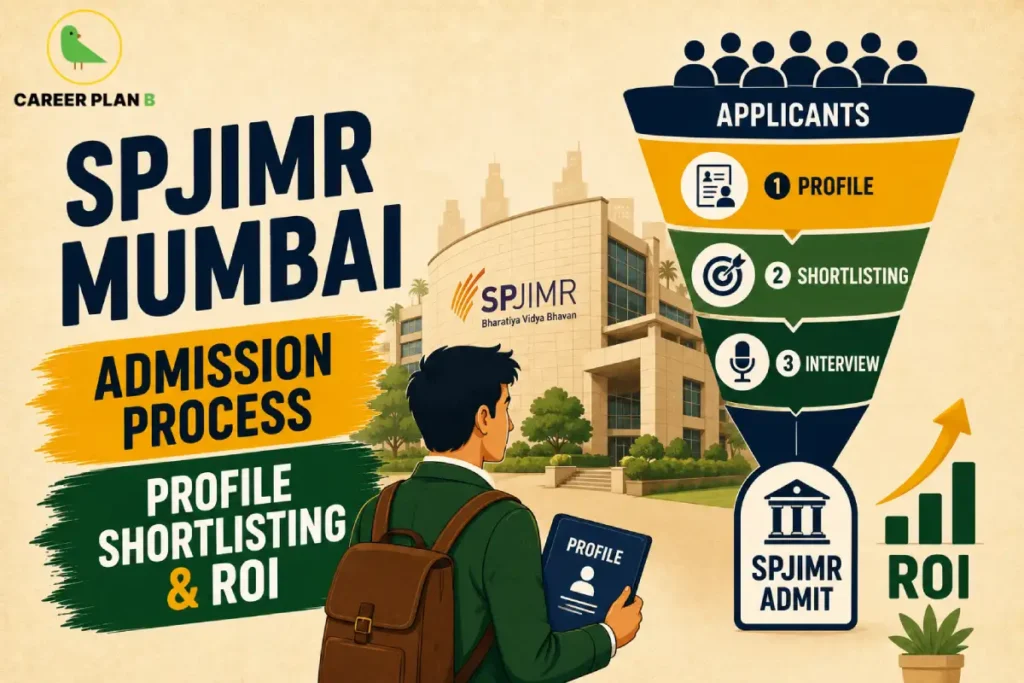
Introduction
Most MBA aspirants think of SPJIMR as a great college with a high CAT cutoff. And they are right on both counts. However, that description leaves out the part that makes SPJIMR genuinely different from almost every other top B-school in India: SPJIMR shortlists on profile, not just percentile.
This is not a marketing claim. Instead, it is a structural feature of the SPJIMR admission process with significant implications for who gets in, how to prepare, and what kind of candidate SPJIMR is actually looking for.
At most top B-schools, the admission funnel works in one direction: score high enough in CAT, get shortlisted, perform in GD and PI, and receive an offer. The CAT score serves as the primary filter, while everything else remains secondary. However, the process at SPJIMR is genuinely different. The institution evaluates a multi-dimensional profile, including academic record, work experience, gender diversity contribution, and personal achievements, alongside CAT scores. As a result, a candidate with a 97 percentile and a weak profile can lose out to a candidate with a 92 percentile and an exceptional one.
Therefore, understanding exactly how this works is the single most valuable piece of information any SPJIMR aspirant can have, and this blog delivers it completely.
S.P. Jain Institute of Management and Research (SPJIMR) holds an AACSB accreditation and consistently ranks among India’s top ten management institutions in the NIRF Rankings published by the Ministry of Education, Government of India. Its PGDM programme delivers average placement CTCs of Rs. 28 to 30 LPA, among the highest of any private management institution in the country. Moreover, its admission process is among the most thoughtfully designed in Indian management education.
So, here is everything you need to know.
About SPJIMR Mumbai
S.P. Jain Institute of Management and Research is located on a stunning 45-acre green campus in Andheri West, Mumbai — managed by the Bharatiya Vidya Bhavan trust. It holds an AACSB accreditation — a quality recognition shared by fewer than 5% of the world’s business schools including Harvard Business School, Wharton, and INSEAD.
SPJIMR is approved by AICTE (All India Council for Technical Education) and recognised by the UGC (University Grants Commission, Government of India). Its PGDM programme is a 2-year full-time programme with specialisations in Finance, Marketing, Operations, and General Management — and it is one of the few management programmes in India where the institutional values are as distinctive and well-articulated as the curriculum.
The institution’s philosophy is built around values-based management education. Programmes like DISHA (a social awareness rural immersion), EKTHA (a village community immersion), and ACE (an applied ethics module) are not electives. They are non-negotiable components of the SPJIMR educational experience. These are woven into the fabric of campus life and shape the kind of graduate SPJIMR produces.
NIRF Rankings 2024 consistently places SPJIMR in the top ten management institutions in India a position it has maintained not through aggressive marketing but through consistent academic quality and exceptional placement outcomes.Official website by SPJI (SPJI)
Have Any Doubts?
The SPJIMR Admission Process — Step by Step
The SPJIMR PGDM admission process for the 2-year full-time programme follows a structured, multi-stage sequence. Here is exactly how it works:
Stage 1: Entrance Exam Score Submission
SPJIMR accepts scores from three entrance examinations:
- CAT (Common Admission Test) — conducted by IIMs
- XAT (Xavier Aptitude Test) — conducted by XLRI Jamshedpur
- GMAT (Graduate Management Admission Test) — conducted by GMAC
There is no single published minimum cutoff for SPJIMR, but based on admission data across recent years, competitive CAT or XAT percentiles for shortlisting typically begin at 90 to 92 percentile. For GMAT, a score of 700 plus is generally competitive.
However and this is the critical point — the exam score is not the only shortlisting criterion. It is one input into a multi-dimensional profile evaluation.
Stage 2: Profile-Based Shortlisting
This is what makes SPJIMR unique. Rather than shortlisting purely on exam percentile, SPJIMR evaluates a composite application profile that includes:
Academic record: Class 10, Class 12, and graduation scores all contribute to the profile score. Consistent academic performance across all three levels is valued more than a single strong score.
Work experience: Professional experience is evaluated on quality and relevance, not just duration. Leadership responsibility, cross-functional exposure, and measurable impact in professional roles are weighted positively.
Gender diversity: SPJIMR actively values gender diversity in its cohort and explicitly weights gender as a component of the shortlisting formula. Female candidates with competitive profiles often find their overall composite score higher than a direct percentile comparison would suggest.
Extra-curricular and personal achievements: Demonstrated leadership, social contribution, sports or arts achievements, and community impact are explicitly considered. A national-level athlete, a student with significant social impact experience, or a candidate with demonstrated leadership credentials in non-academic contexts all benefit from this dimension.
The application essay and statement of purpose: SPJIMR’s application form requires candidates to articulate their career goals, values, and motivation for management education. This essay is evaluated as a genuine profile component — not a formality.
The composite of these factors determines the shortlist — and a candidate with a 92 percentile and a genuinely distinctive profile can and does receive a shortlist over a candidate with a 97 percentile and a thin one. For admission click here SPJIMR Admissions
Stage 3: Group Discussion (GD)
Shortlisted candidates are invited to the SPJIMR campus in Mumbai for the selection process. The Group Discussion round evaluates:
- Communication clarity and effectiveness
- Analytical thinking and structured argumentation
- Listening skills and respect for others’ perspectives
- Ability to build on and synthesise multiple viewpoints
- Knowledge of current affairs, business, and social issues
SPJIMR’s GD topics tend to reflect the institution’s values orientation except topics that combine business analysis with ethical or social dimensions.
Stage 4: Personal Interview (PI)
The Personal Interview at SPJIMR is one of the most distinctive in Indian management education. The panel typically includes SPJIMR faculty, alumni, and senior industry professionals — and the interview goes significantly deeper than standard “tell me about yourself” questions.
SPJIMR PI panels are known for probing:
- Values and ethics: Situational questions that test how you reason through ethical dilemmas in professional contexts
- Career goals: Specific, clear articulation of what you want to do after SPJIMR and why
- Self-awareness: Honest assessment of your own strengths and weaknesses
- Academic and professional depth: Deep knowledge of your graduation subject and your professional domain
- Current affairs and social awareness: Awareness of business, economic, and social issues in India and globally
The Jesuit educational tradition that has influenced SPJIMR’s institutional culture means that the PI is genuinely evaluating character and values alongside intellect and ambition. Candidates who have not thought seriously about why they want to manage, what kind of leader they want to be, and what they believe about their responsibility to society will find the SPJIMR interview challenging in ways that other B-school interviews are not.
Stage 5: Final Offer
After GD and PI, SPJIMR prepares a final merit list based on the composite evaluation. Offer letters are sent and confirmed with fee payment within a specified deadline.
Reference: SPJIMR Admissions Process — spjimr.org/admissions
What Makes a Strong SPJIMR Profile
Based on the multi-dimensional shortlisting framework, here is what a genuinely competitive SPJIMR profile looks like:
Academic consistency: Strong scores across Class 10 (85 plus), Class 12 (85 plus), and graduation (70 plus percentage) contribute positively. A graduation aggregates below 60% is a significant profile weakness even with a strong CAT percentile.
Work experience with demonstrated impact: One to three years of professional experience in a relevant industry, with clear evidence of initiative, leadership, or measurable impact. SPJIMR does not require work experience — but candidates who have it and can articulate its impact have a meaningful profile advantage.
Gender and diversity contribution: Female candidates, candidates from non-engineering backgrounds, candidates from smaller cities or underrepresented regions, and candidates with non-traditional career paths all contribute to the cohort diversity that SPJIMR actively builds for.
Personal achievements: A national or state-level achievement in sports, performing arts, social service, or community leadership adds genuine profile points. It signals the kind of well-rounded, driven individual SPJIMR’s values-based education model is built to develop.
Clear, values-aligned career goals: Candidates who can articulate specific career goals in FMCG brand management, financial consulting, operations leadership, or social entrepreneurship with a clear explanation of why an SPJIMR PGDM is the right next step consistently perform better in the application essay and PI than candidates with vague “I want to be a leader” answers. Click here for admission SPJIMR Programme Philosophy
SPJIMR Fees — The Investment
| Fee Component | Approximate Amount |
| Total Programme Fee (2 years) | Rs. 22 to 24 lakhs |
| Hostel and Accommodation | Rs. 1.5 to 2 lakhs per year |
| Total Estimated Investment | Rs. 25 to 28 lakhs (all inclusive) |
- Scholarships: Merit-based partial scholarships available. Check current details at spjimr.org
- Education Loans: Available from major Indian banks for the AICTE-approved programme
- National Scholarship Portal: Central and state government scholarship schemes available at scholarships.gov.in (Ministry of Education, GOI)
The fee structure places SPJIMR in the upper-mid range of India’s private B-school fee landscape — significantly below ISB (Rs. 40 plus lakhs) and most IIMs, and broadly comparable with MDI and NMIMS.
SPJIMR Placements — The Outcomes
According to placement data published on spjimr.org, SPJIMR’s PGDM delivers some of the strongest placement outcomes among India’s private management institutions:
Average CTC: Rs. 28 to 30 LPA Highest CTC: Rs. 60 plus LPA (top offers) Median CTC: Rs. 26 to 28 LPA
Top Sectors:
- Management Consulting (McKinsey, BCG, Bain, Deloitte, KPMG)
- FMCG and Consumer Goods (Hindustan Unilever, P&G, Nestlé, ITC, Marico)
- Financial Services (Goldman Sachs, JP Morgan, Kotak, HDFC Bank)
- Technology and E-Commerce (Amazon, Google, Flipkart, Microsoft)
- Operations and Supply Chain (Amazon Supply Chain, L&T, Mahindra)
The most distinctive aspect of SPJIMR’s placement record is the consistency of outcomes across specialisations. Unlike B-schools where one specialisation delivers significantly better placement outcomes than others, SPJIMR’s Finance, Marketing, Operations, and General Management tracks all deliver competitive average CTCs within a narrow range. Click here for official report SPJIMR Placements.
SPJIMR ROI — Is It Worth the Investment?
This is the most important question for any candidate evaluating SPJIMR — and it deserves a direct, honest answer.
The straightforward ROI calculation:
Total investment: Rs. 25 to 28 lakhs (fees plus living expenses) Average starting CTC: Rs. 28 to 30 LPA Simple payback period: Less than 12 months of post-PGDM employment
By the simplest measure, SPJIMR’s ROI is extraordinary. The average starting salary exceeds the total programme investment within the first year of employment. Very few management programmes in India at any fee level can claim the same.
The longer-term ROI picture:
SPJIMR’s alumni network of approximately 10,000 professionals across India’s and the world’s leading organisations is one of the most actively engaged alumni communities in Indian management education. SPJIMR alumni are known for supporting fellow alumni in career transitions, referrals, and professional networking with unusual consistency and warmth. This network compounds in value significantly over the first decade of a career.
The AACSB accreditation is globally recognised giving SPJIMR graduates credibility in international hiring markets that many domestic MBA credentials cannot access. For candidates with global career ambitions, this accreditation is a long-term credential advantage.
The values-based education philosophy produces graduates who are regularly described by their employers as unusually principled, socially aware, and culturally sensitive — qualities that matter increasingly in senior leadership roles where technical competence is assumed and character becomes the differentiator.
The honest qualifier:
SPJIMR’s strong ROI assumes you are in the right specialisation and targeting the right career path. FMCG, consulting, and financial services candidates maximise the SPJIMR investment most fully. Candidates targeting niche technical roles or purely domestic manufacturing management may find that a more domain-specific MBA delivers a stronger ROI for their specific career context.
SPJIMR vs Other Top B-Schools — A Quick Comparison
| Factor | SPJIMR | MDI Gurugram | XLRI Jamshedpur | ISB Hyderabad |
| Accreditation | AACSB | AMBA + SAQS | AACSB + AMBA | EQUIS + AACSB + AMBA |
| Avg. CTC | Rs. 28 to 30 LPA | Rs. 25 to 27 LPA | Rs. 32 to 35 LPA | Rs. 24 to 28 LPA |
| Total Fee | Rs. 22 to 24 lakhs | Rs. 22 to 24 lakhs | Rs. 28 to 32 lakhs | Rs. 40 plus lakhs |
| Programme Duration | 2 years | 2 years | 2 years | 1 year |
| Shortlisting Approach | Profile-based (CAT + profile) | CAT-dominant | XAT-dominant | GMAT + experience |
| Location | Mumbai | Gurugram | Jamshedpur | Hyderabad |
| Best Known For | Values-based, FMCG, Consulting | Delhi NCR ecosystem | HR, General Mgmt | Global brand |
How Career Plan B Helps
Preparing for SPJIMR’s profile-based shortlisting requires more than CAT preparation. It requires a strategic understanding of how your profile scores across every evaluated dimension, an honest assessment of where your profile has gaps, and a plan for strengthening those gaps before application.
Career Plan B offers Personalized Career Counselling to help MBA aspirants build SPJIMR-ready profiles, prepare for the distinctive SPJIMR PI, and evaluate whether SPJIMR’s values-based management education is genuinely the right fit for their career goals and personal values.
Through Psycheintel Career Assessment Tests, you gain a data-backed understanding of your professional strengths and ideal career environment.
With Admission and Academic Profile Guidance and a structured Career Roadmap, Career Plan B turns SPJIMR ambition into SPJIMR admission.
Get In Touch With Us
Frequently Asked Questions (FAQs)
Q1. What is the CAT cutoff for SPJIMR Mumbai?
SPJIMR does not publish a fixed CAT cutoff. Based on historical admission patterns, a CAT percentile of 90 to 92 plus is generally the competitive range for shortlisting consideration but the exam score is only one component of a multi-dimensional profile evaluation. A candidate with a 92 percentile and a strong academic record, work experience, and personal achievements can receive a shortlist over a candidate with a 96 percentile and a thinner profile. The profile evaluation is genuine and consequential.
Q2. Does SPJIMR consider work experience for admission?
Yes — work experience is explicitly evaluated as a component of the SPJIMR profile-based shortlisting process. The quality, relevance, and demonstrated impact of professional experience are weighted alongside its duration. Fresh graduates are eligible and do receive admission, but candidates with one to three years of relevant professional experience and a clear career narrative built around that experience have a meaningful profile advantage.
Q3. How is SPJIMR’s Personal Interview different from other B-schools?
SPJIMR’s PI is widely regarded as one of the most distinctive and deeply probing interviews in Indian management education. Unlike standard PI formats that focus primarily on career goals and academic knowledge, SPJIMR’s panels actively evaluate values, ethical reasoning, social awareness, and character alongside professional competence. Situational ethics questions, questions about social responsibility, and probing discussions about your personal beliefs and what kind of leader you want to be are all common. Candidates who have not genuinely reflected on their values and purpose find the SPJIMR PI significantly more challenging than other B-school interviews.
Conclusion
SPJIMR Mumbai is not just a high-ranking B-school with a high CAT cutoff. Instead, it is one of India’s most thoughtfully constructed management education institutions, where the admission process, curriculum, and campus culture reflect a coherent institutional philosophy about what great management education should achieve.
The profile-based shortlisting is not a gimmick. Rather, it signals that SPJIMR looks for a specific kind of candidate: someone who is academically strong, professionally purposeful, personally grounded, and values-driven. Therefore, if you fit that profile, or can build it over the next six to twelve months, SPJIMR can be one of the most rewarding investments in your management career.
The ROI numbers make the financial case clearly. In fact, the average starting salary exceeds the total programme investment within the first year. Moreover, the network, accreditation, and institutional reputation make the longer-term case even more compelling.
However, the most important reason to choose SPJIMR is not the placement average or the AACSB badge. Instead, it is the kind of professional you become over two years at an institution that takes values as seriously as strategy and character as seriously as capability.
Ready to build your SPJIMR application with expert guidance?
Connect with Career Plan B today for a personalised profile assessment, CAT and XAT strategy, PI preparation, and an admission roadmap designed specifically around your profile and ambitions.