Careerplanb · August 10, 2026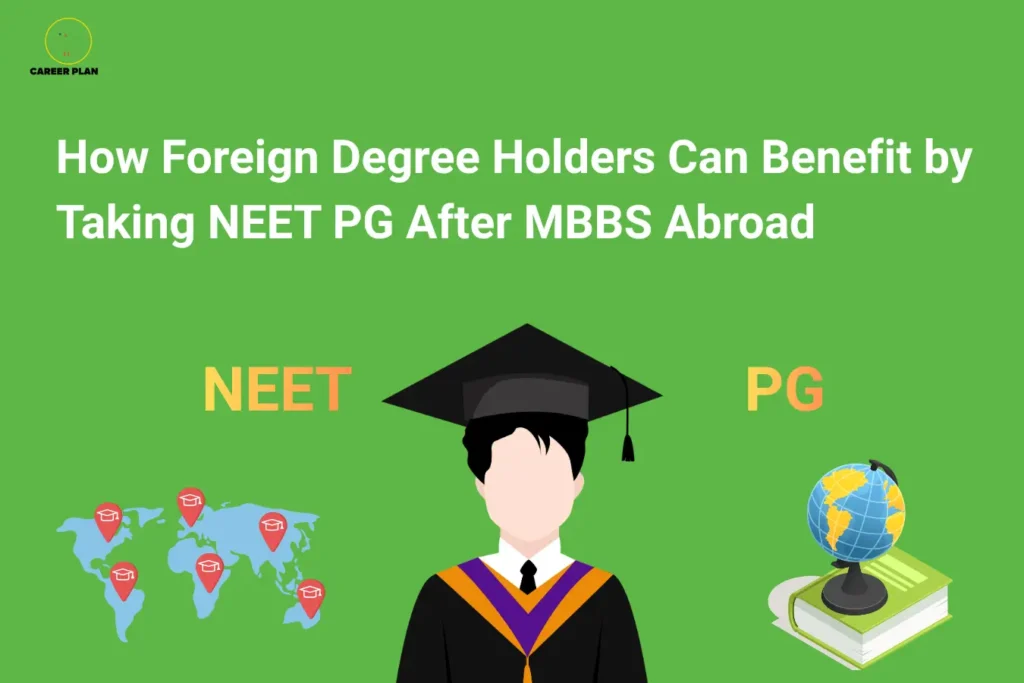
Introduction
Completing MBBS from a foreign university is a popular route for many Indian students seeking quality medical education at an affordable cost. However, returning to India often brings the challenge of proving your qualification and building a strong career.
While clearing the Foreign Medical Graduate Examination (FMGE) is mandatory to practice in India, many foreign degree holders stop there. What they often miss is a powerful next step: appearing for NEET PG.
Taking NEET PG after MBBS abroad opens doors to postgraduate specialization (MD/MS/DNB) in India, which can significantly boost your professional growth, earning potential, and long-term stability.
In this guide, we explore how foreign medical graduates can benefit by taking NEET PG after MBBS abroad, the eligibility process, key advantages, and practical tips to succeed.
Eligibility Criteria for Foreign Medical Graduates (FMGs) to Appear in NEET PG
To appear for NEET PG, foreign degree holders must meet specific requirements set by the National Board of Examinations in Medical Sciences (NBEMS) and the National Medical Commission (NMC):
- You must be an Indian citizen or Overseas Citizen of India (OCI).
- You must have completed your primary medical qualification (MBBS equivalent) from a foreign medical institution listed in the World Directory of Medical Schools.
- You must clear the FMGE (Screening Test).
- After clearing FMGE, you need to complete a compulsory 12-month rotatory internship in India.
- You must obtain permanent registration with the NMC or a State Medical Council.
Only after fulfilling these steps are you eligible to appear for NEET PG and participate in counselling for PG seats.
Major Benefits of Taking NEET PG After MBBS Abroad
Here are the keyways foreign degree holders can benefit by pursuing NEET PG:
1. Access to Postgraduate Specialization in India
Clearing NEET PG allows you to secure an MD, MS, or DNB seat in Indian medical colleges. This is one of the biggest advantages because specialization is essential for career growth in modern medicine.
Without NEET PG, most FMGs remain limited to general practice. With a PG degree from India, you can become a specialist in high-demand fields like Radiology, Dermatology, Internal Medicine, Orthopedics, Pediatrics, or Psychiatry.
2. Higher Earning Potential
A postgraduate degree dramatically increases your income. While a general practitioner (after FMGE) may earn modestly, specialists with MD/MS degrees command significantly higher salaries in both government and private sectors. Many FMGs who complete PG in India earn 2–4 times more than non-specialists.
3. Better Recognition and Credibility in India
An Indian PG degree carries strong recognition within the country. It helps you build trust with patients, hospitals, and colleagues. Many corporate hospitals and medical institutions prefer candidates with Indian postgraduate qualifications.
4. Opportunity for Government Jobs and Academic Roles
Clearing NEET PG opens pathways to:
- Government specialist positions
- Teaching roles in medical colleges
- Senior Resident posts
- Research opportunities
These avenues are often difficult to access without a PG degree from India.
5. Stronger Foundation for Super specialization (DM/MCh)
After completing MD/MS through NEET PG, you become eligible for super specialty courses (DM/MCh) in India. This further enhances your expertise and career prospects in highly specialized fields like Cardiology, Neurology, Oncology, or Neurosurgery.
6. Improved Clinical Exposure and Networking
Studying PG in India gives you exposure to a high volume of patients and diverse clinical cases — something that strengthens your practical skills. You also build valuable professional networks with Indian doctors, which can be useful throughout your career.
7. Long-term Career Stability
With an Indian PG degree, you gain more career options — private practice, hospital jobs, medical tourism, or even teaching. It reduces dependency on uncertain opportunities abroad and provides stability in your home country.
For Personalized Guidance
Challenges Foreign Degree Holders Face and How NEET PG Helps Overcome Them
Many FMGs struggle with limited job opportunities and lower credibility after only clearing FMGE. NEET PG addresses these issues by:
- Upgrading your qualification to specialist level
- Bridging the gap between foreign education and Indian medical standards
- Increasing your competitiveness in the job market
While the competition in NEET PG is tough, the rewards are substantial for those who prepare strategically.
Smart Strategies for FMGs Preparing for NEET PG
- Start Early: Begin NEET PG preparation alongside or immediately after your FMGE and internship.
- Focus on High-Yield Subjects: Give extra attention to Medicine, Surgery, OBGY, Pediatrics, and PSM, as they carry heavy weightage.
- Integrate Clinical Learning: Use your internship period to correlate theory with real cases.
- Regular Mock Tests: Attempt full-length mocks and analyze performance thoroughly.
- Use Standard Resources: Rely on popular NEET PG books and question banks.
Consistency and a structured approach are key to success.
How Career Plan B Helps
Foreign medical graduates often feel overwhelmed while navigating FMGE, internship, and NEET PG preparation simultaneously.
Career Plan B provides expert Personalized Career Counselling tailored for FMGs.
Our Psycheintel and Career Assessment Tests help you understand your strengths and choose the right PG specialization.
With structured Career Road mapping and Admission Guidance, they make the entire journey from FMGE to securing a NEET PG seat smoother and more strategic.
Get In Touch With Us
FAQ
- Can I appear for NEET PG directly after MBBS abroad?
No. You must first clear FMGE, complete your internship in India, and obtain NMC registration.
- Is NEET PG worth it for foreign medical graduates?
Yes. It significantly improves your career prospects, earning potential, and professional recognition in India.
- Which PG branches are good for FMGs through NEET PG?
Popular choices include Radiology, Dermatology, Internal Medicine, Psychiatry, Pediatrics, and Orthopedics, depending on your rank and interest.
- How difficult is NEET PG for FMGs compared to Indian graduates?
The exam is the same for everyone. However, FMGs need to adapt to the Indian medical curriculum and question pattern.
- Can I practice abroad after doing PG in India?
Yes. An Indian PG degree combined with your foreign MBBS can strengthen your profile for opportunities in countries like the UK, Middle East, and others, though additional licensing exams may be required.
For Personalized Guidance
Conclusion
For foreign degree holders, clearing NEET PG after MBBS abroad is more than just an exam — it is a strategic career upgrade. It transforms your foreign MBBS into a strong foundation for specialization, higher earnings, and long-term professional success in India.
While the journey involves clearing FMGE first and then preparing for NEET PG, the benefits far outweigh the effort. With proper planning, consistent preparation, and the right guidance, you can secure a prestigious PG seat and build a rewarding career as a specialist doctor.
If you have completed MBBS abroad, don’t stop at FMGE. Take the next big step with NEET PG and unlock your full potential in Indian healthcare.
Start planning today. Your specialization journey awaits.