Team Career Plan B · July 9, 2026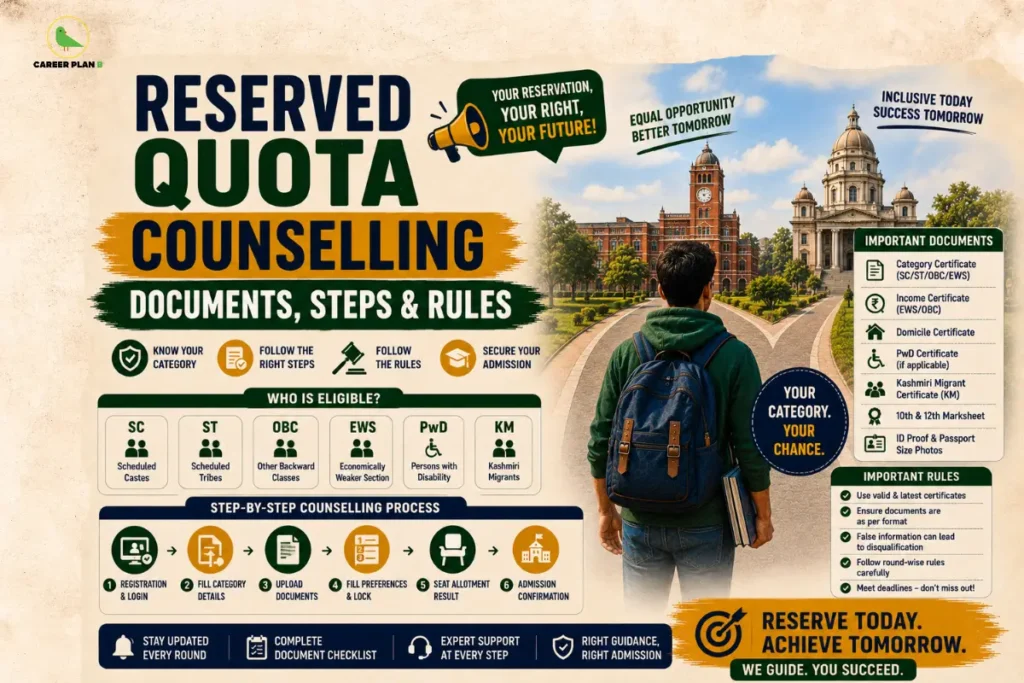
Introduction
Every year, thousands of students sit with their CUET scorecards in hand, hearts full of hope, and a list of documents they are not entirely sure about. Some of them have worked hard for years, belong to reserved categories, and have every right to claim their seat. But somewhere between the score and the seat, the process gets confusing. That is where CUET 2026 reserved quota counselling becomes the bridge between your effort and your admission.
If you are a student from the SC, ST, OBC-NCL, EWS, or PwD category, this blog is written for you. We will walk you through every document you need, every step of the counselling process, and every rule you cannot afford to ignore. No jargon. No confusion. Just a clear path from your scorecard to your seat.
What Is Reserved Quota Counselling and Who Is It For?
Think of counseling as the final gate before you enter your dream college. You have cleared the exam. Your score is out. Now the system needs to verify who you are, which category you belong to, and whether your documents match your claim.
Reserved quota counselling is the official admission process through which seats earmarked for specific categories are filled. Under the reservation policy mandated by the University Grants Commission (UGC), a fixed percentage of seats in central universities are reserved for students from specific backgrounds.
Here is how the seat distribution looks across central universities under CUET:
| Category | Reservation Percentage |
|---|---|
| Scheduled Caste (SC) | 15% |
| Scheduled Tribe (ST) | 7.5% |
| Other Backward Classes (OBC-NCL) | 27% |
| Economically Weaker Section (EWS) | 10% |
| Persons with Benchmark Disabilities (PwD/PwBD) | 5% (Horizontal Reservation) |
Who Qualifies for Reserved Quota Seats?
Qualifying is not just about belonging to a category on paper. You need to meet every eligibility condition set by the institution and the government. The reservation benefits apply to Indian nationals whose categories are recognised under the Constitution of India and subsequent government orders.
For OBC-NCL students, your family must fall outside the creamy layer, which currently means an annual family income of below Rs. 8 lakh. For EWS, the income threshold is the same, but the family should not own significant land or property beyond prescribed limits.
The Documents You Cannot Afford to Miss
This is where most students stumble. Not because they are ineligible, but because they show up with the wrong version of a document, an expired certificate, or a format that the university does not accept. Let us make sure that does not happen to you.
Category-Specific Certificates
These are the non-negotiable documents based on your reservation category:
For SC and ST students:
- Caste certificate issued by a competent authority (Tehsildar or above)
- The certificate must be in the format prescribed by the Government of India
- It should clearly mention the sub-caste and state of origin
For OBC-NCL students:
- OBC certificate issued within the financial year of admission (this is critical — an old certificate will be rejected)
- The certificate must explicitly state “Non-Creamy Layer”
- It should be issued by a Tehsildar, SDM, or District Magistrate
You can refer to the National Commission for Backward Classes website to check whether your caste is included in the central OBC list. Note that state OBC lists and central OBC lists are different. A caste recognised at the state level may not appear on the central list, which applies to central universities under CUET.
For EWS students:
- EWS Income and Asset Certificate issued by a competent authority
- It must be issued for the current financial year
For PwD students:
- Disability certificate from a government hospital or a notified authority
- Percentage of disability must be 40% or above as per the Rights of Persons with Disabilities Act, 2016
- Udid card (Unique Disability ID) is increasingly being required — register at swavlambancard.gov.in
General Documents Required by All Students
Regardless of your category, every student appearing for CUET 2026 counselling needs to carry:
- CUET 2026 scorecard (downloaded from cuet.nta.nic.in)
- Class 10 certificate and marksheet (for date of birth proof)
- Class 12 certificate and marksheet
- Transfer Certificate from your last institution
- Migration Certificate (for students from boards outside the state)
- Passport-size photographs (at least 6 to 8 copies)
- Government-issued photo ID (Aadhaar, PAN, or Passport)
- Self-attested photocopies of all originals
Step-by-Step: How the CUET 2026 Reserved Quota Counselling Process Works
The counselling process can feel like a maze if you are seeing it for the first time. Here is how it actually works, broken into simple steps.
Step 1: Check Your CUET Score and Category Rank
After CUET 2026 results are declared on the NTA official website, check your overall score and your category-wise rank. Reserved quota seats are filled based on merit within each category. Scoring well among the general category does not mean you should not claim your reserved seat — you have earned that right.
Step 2: Register for Centralised Counselling (CSAS Portal)
Central universities participating in CUET use the Common Seat Allocation System (CSAS) for counselling. You need to register on the portal, fill in your personal and academic details, and declare your reservation category.
Make sure you select the correct category at this stage. Errors at registration can delay or cancel your allotment.
Step 3: Fill Your Course and University Preferences
This is your chance to rank your choices. Be strategic here. Research the programmes, check previous year’s cut-offs for your category, and fill preferences in the order of what genuinely suits you — not just by reputation.
Step 4: Document Upload
You will be required to upload scanned copies of all your documents during or immediately after registration. Ensure:
- Scans are clear and legible
- File sizes are within the prescribed limits
- Certificates are in the correct format
Step 5: Seat Allotment
Based on your CUET score, category rank, and programme preferences, the counselling authority allots seats in multiple rounds. You will receive an allotment letter that specifies your allotted university and programme. The authority conducts additional counselling rounds to fill any vacant seats.
Step 6: Reporting and Physical Verification
After receiving your allotment, you must report to the allotted institution within the deadline — either physically or through an online document verification window. This is where your original documents are checked against what you uploaded. Carry everything. Miss nothing.
Rules You Must Know Before You Walk Into Counselling
Validity of Certificates
This is perhaps the most overlooked rule. Here is what students miss:
- OBC-NCL and EWS certificates must be from the current financial year (April 2025 to March 2026 for the 2026 admission cycle). A certificate from last year will not work.
- SC and ST certificates do not expire. However, the competent authority must issue them in the prescribed Central Government format for CUET counselling and admissions.
- PwD certificates must show a minimum of 40% disability. Certificates that do not meet this threshold will not qualify under the reservation.
For Personalized Guidance
Domicile and Income Rules
Some universities and programmes may require a domicile certificate for state-quota seats. However, central universities participating in CUET generally do not consider domicile a barrier because they offer admissions at the national level.
For OBC-NCL and EWS candidates, authorities calculate the gross annual family income by considering income from all sources. During document verification, they may ask you to submit salary slips, income tax returns, and bank statements to verify your eligibility.
Common Mistakes That Cost Students Their Seats
Students lose their reserved quota seats not because they scored less, but because of avoidable errors. Here are the ones that come up repeatedly:
- Uploading an OBC certificate from a previous financial year without realising it needs renewal
- Submitting a state OBC certificate when the central OBC list applies to central universities
- Forgetting to get documents attested by a gazetted officer when required
- Missing the document verification deadline by even a day
- Selecting the wrong category during CSAS registration and not correcting it in time
- Not carrying original documents on reporting day and only bringing photocopies
Each of these mistakes has cost deserving students their seats. Do not let a paperwork gap undo months of preparation.
How Career Plan B Helps
Career Plan B helps students navigate CUET 2026 reserved quota counselling with clarity, confidence, and structured guidance:
- Personalized Career Counselling: Helps students understand their category-wise eligibility, explore suitable universities and courses, and make informed academic decisions aligned with their goals.
- Psycheintel & Career Assessment Tests: Provides data-backed insights into aptitude, personality traits, learning styles, and suitable academic and career pathways.
- Admission & Academic Profile Guidance: Supports students in preparing the correct document checklist, understanding reservation-based counselling rules, and making accurate, timely application decisions.
- Career Roadmapping: Helps students build a structured long-term plan that connects their present academic choices with future career opportunities and growth.
- End-to-End Guidance: Assists students throughout CUET 2026 reserved quota counselling, admissions, and career planning so they can approach the process prepared, confident, and fully informed.
For Latest Information
Frequently Asked Questions
Q1. My OBC certificate was issued last year. Can I still use it?
No. OBC-NCL certificates must be issued in the current financial year. For CUET 2026 admissions, your certificate should be dated between April 2025 and the date of counselling. Get it renewed before you apply.
Q2. What happens if my documents are found incorrect during verification?
Your seat allotment can be cancelled. In cases of fraudulent documents, further disciplinary action may follow. Always ensure your documents are genuine and issued by the correct authority.
Q3. Is the PwD reservation horizontal or vertical?
PwD reservation is horizontal, meaning it cuts across all categories. A PwD student from SC will be counted within the SC quota as a PwD candidate. This is governed by the
Q4. Can I change my reservation category after CSAS registration?
Generally, no. Category declaration during registration is final. Some portals allow corrections during a specific window. Monitor the official NTA and university notifications carefully to know if a correction window is available.
Q5. Do EWS students need to submit a fresh certificate every year?
Yes. The EWS certificate is valid only for the financial year in which it is issued. For CUET 2026, your EWS certificate must be from the financial year 2025 to 2026.
Conclusion
Reserved quota counselling is not a shortcut. It is a constitutional right that supports equal access to education. Your preparation earns you the opportunity, and the reservation policy helps ensure a fair admission process. Students rarely lose their seats because of lower scores. More often, they miss out because they overlook important documents, ignore verification requirements, or misunderstand the counselling rules. Now you know what to carry, what to check, and what to expect.
Walk into CUET 2026 reserved quota counselling with your documents in order, your category verified, and your preferences well thought out. Your score opened the door. Let the right preparation make sure you walk through it.