Team5 · July 10, 2026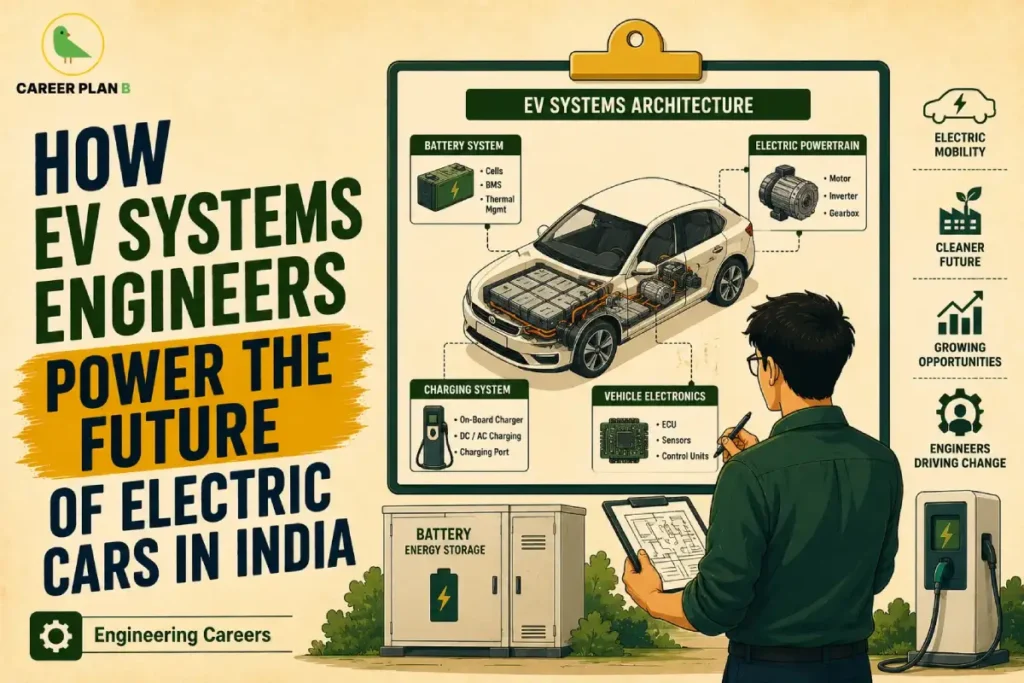
Introduction
Picture this: a car that never visits a petrol pump, charges overnight like your smartphone, and is guided by intelligent software that monitors every component in real time. This is not a vision of the distant future. This is the electric vehicle revolution happening in India right now, and EV Systems Engineer power the future of electric cars by making all of it possible.
India has set a bold target of achieving 30% electric vehicle penetration in new sales by 2030, backed by the government’s FAME India (Faster Adoption and Manufacturing of Hybrid and Electric Vehicles) scheme and the National Electric Mobility Mission Plan. With companies like Tata Motors, Ola Electric, and Ather Energy scaling production rapidly, and global giants investing in Indian EV manufacturing, the demand for skilled EV systems engineers has never been higher.
If you are an engineering student or professional wondering where the automotive industry is headed and where the jobs will be, this blog is your complete guide.
Who Is an EV Systems Engineer?
An EV systems engineer is a specialist who designs, develops, integrates, and tests the complex electrical and electronic systems that make an electric vehicle work. Unlike a traditional automotive engineer who focuses largely on internal combustion engines and mechanical drivetrains, an EV systems engineer works at the intersection of electrical engineering, embedded systems, software, and mechanical integration.
The key systems they work on include:
- Battery pack design and management
- Electric motors and power electronics
- Battery Management Systems (BMS)
- EV charging systems and infrastructure
- Embedded software and vehicle control units
- Thermal management systems
It is a deeply multidisciplinary role, and that is precisely what makes it one of the most exciting and future-proof paths in automotive engineering jobs in India today.
How EV Systems Engineers Power the Future of Electric Cars
Designing the Brain Battery Management Systems (BMS)
The battery is the heart of any electric vehicle, and the battery management system is its brain. EV systems engineers design BMS software and hardware that monitor cell voltage, temperature, and state of charge in real time, ensuring safety, performance, and long battery life. Without a well-engineered BMS, an EV battery can overheat, degrade rapidly, or fail entirely. This is one of the most critical areas of battery technology engineering expertise in India.
Powering the Machine: Electric Motor and Drivetrain Engineering
EV systems engineers design and optimise the electric motors and power electronics, inverters, converters, and motor controllers that convert stored battery energy into motion. Getting this right means the difference between a car that delivers smooth, efficient performance and one that drains its battery prematurely.
Making Charging Smarter: EV Charging Infrastructure
India’s Bureau of Energy Efficiency (BEE) and the Ministry of Power are jointly working to scale up public EV charging infrastructure across the country. EV systems engineers play a direct role in designing AC and DC fast-charging systems, vehicle-to-grid (V2G) interfaces, and smart charging protocols that integrate with the national grid.
Software and Embedded Systems in Modern EVs
Modern electric cars run on millions of lines of code. EV systems engineers develop the embedded firmware and control software that manage everything from regenerative braking to over-the-air software updates. This convergence of hardware and software is what defines the next generation of electric car technology career path opportunities.
Key Roles in Electric Vehicle Engineering Career in India
The electric vehicle engineering career in India is not a single job it is an ecosystem of specialised roles:
- Battery Systems Engineer Designs and tests battery packs and cell chemistries
- Power Electronics Engineer Works on inverters, converters, and motor drives
- Embedded Systems and Firmware Engineer Develops vehicle control software and ECU programming
- EV Charging Infrastructure Engineer Designs charging stations and grid integration systems
- Thermal Management Engineer Manages heat dissipation in battery packs and motors
- Vehicle Integration and Testing Engineer Ensures all EV subsystems work seamlessly together
Each of these roles offers strong growth prospects and contributes directly to how EV systems engineers power the future of electric cars across India and globally.
What Skills Does an EV Systems Engineer Need?
Core Technical Skills:
- Battery electrochemistry and cell technology
- MATLAB and Simulink for system modelling and simulation
- CAN bus and automotive communication protocols
- Embedded C programming and RTOS (Real-Time Operating Systems)
- Power electronics design and analysis
- Knowledge of AIS (Automotive Industry Standards) and BIS standards: bis.gov.in
Emerging Skills for the Future:
- Solid-state battery technology
- Vehicle-to-grid (V2G) and bidirectional charging systems
- AI and machine learning for predictive battery management
- Functional safety standards ISO 26262
Soft Skills:
- Systems-level thinking across mechanical, electrical, and software domains
- Cross-functional teamwork working with design, testing, and supply chain teams
- Problem-solving under real-world performance and safety constraints
Have Any Doubts?
How to Build an Electric Car Technology Career Path in India
Step 1: Choose PCM in Class 12
Physics, chemistry, and mathematics are the foundation for any engineering entrance exam and essential for electric vehicle courses in India.
Step 2: Clear Engineering Entrance Exams
- JEE Main for NITs, IIITs, and centrally funded institutes
- JEE Advanced for IITs
- State-level exams like MHT-CET, WBJEE, and TANCET
Step 3: Choose the Right B.Tech Branch
Best branches for an electric vehicle engineering career in India:
- B.Tech in Electrical Engineering
- B.Tech in Electronics and Communication Engineering
- B.Tech in Mechanical Engineering (with automotive or energy electives)
- B.Tech in Automotive Engineering
Step 4: Gain Hands-On Experience Through Internships
Apply for internships at EV companies and automotive PSUs during your second or third year. Organisations like BHEL and BEL (Bharat Electronics Limited) offer exposure to power electronics and embedded systems directly relevant to EV engineering.
Step 5: Crack GATE for PSU Roles or M.Tech
A strong score in the GATE exam in Electrical Engineering (EE) or Electronics (ECE) opens doors to PSU roles and M.Tech specialisations in EV technology at IITs. Several IITs now offer dedicated programmes in electric mobility and energy systems.
Step 6: Pursue EV-Specific Certifications
- ARAI (Automotive Research Association of India) EV and hybrid vehicle courses: araiindia.com
- ASDC (Automotive Skills Development Council) EV technician and engineer certifications: asdc.org.in
- Short-term EV engineering programmes from IIT Madras, IIT Delhi, and IIT Bombay
Top Companies Hiring EV Engineers in India
Public Sector:
- BHEL EV charging systems and power electronics
- BEL (Bharat Electronics Limited) Defence and civilian EV embedded systems
- DRDO Electric propulsion for defence vehicles
Indian OEMs and EV Companies:
- Tata Motors Leading India’s four-wheeler EV market
- Mahindra Electric SUV and commercial EV platforms
- Ola Electric Two-wheeler EV and battery technology
- Ather Energy Smart EV scooters and charging networks
- Hero Electric, Revolt Motors, Log9 Materials
Global Companies with India Operations:
- Hyundai India, MG Motor India, Maruti Suzuki EV division
The FAME India scheme continues to incentivise EV manufacturing investment, directly driving EV engineer jobs in India across all these organisations.
EV Systems Engineer Salary in India
| Experience Level | Average Annual Salary |
|---|---|
| Entry-Level (0–2 Years) | ₹4.5 – ₹8 LPA |
| Mid-Level (3–7 Years) | ₹9 – ₹18 LPA |
| Senior-Level (8+ Years) | ₹20 – ₹35+ LPA |
| PSU (via GATE – BHEL / BEL) | ₹8 – ₹16 LPA + Additional Benefits & Perks |
Engineers specialising in battery technology or embedded EV software command a significant salary premium, especially at funded EV startups and global OEMs. International opportunities, particularly in Germany, the USA, and South Korea, offer even stronger EV systems engineer salary in India benchmarks for experienced professionals.
How Career Plan B Helps
The electric car technology career path is exciting but complex with multiple branches, specialisations, and evolving technologies to navigate. Career Plan B simplifies this journey with personalised career counselling designed specifically for engineering aspirants. Through Psycheintel-based career assessment tests, Career Plan B helps you identify whether EV systems engineering aligns with your natural strengths and aptitudes. With structured career roadmapping, it guides you through choosing the right B.Tech branch, preparing for GATE, selecting the best electric vehicle courses in India, and planning your entry into top EV companies so you can build your electric vehicle engineering career in India with clarity, confidence, and a concrete plan.
For Latest Information
Frequently Asked Questions (FAQs)
- Is EV engineering a good career in India?
Yes, absolutely. With India’s 30% EV penetration target by 2030, the FAME scheme driving manufacturing growth, and global companies entering the Indian market, EV engineer jobs in India are among the fastest-growing opportunities in the engineering sector today.
- Which B.Tech branch is best for EV systems engineering?
Electrical engineering is the most versatile and widely accepted branch. Electronics and Communication Engineering and Mechanical Engineering with automotive electives are also strong foundations for an electric vehicle engineering career in India.
- Is GATE required for EV engineer jobs?
GATE is not mandatory for private sector and startup roles. However, it is essential for PSU recruitment at organisations like BHEL and BEL and for M.Tech specialisations in EV and energy systems at premier institutes.
- What is the difference between an automotive engineer and an EV systems engineer?
A traditional automotive engineer focuses on mechanical systems, engines, transmissions, and chassis. An EV systems engineer specialises in electrical, electronic, and software systems batteries, motors, BMS, and embedded controls. As the industry transitions to electric, the two roles are increasingly overlapping.
- Can ECE students become EV systems engineers?
Yes. Electronics and Communication Engineering graduates are particularly well-suited for embedded systems, firmware development, and power electronics roles within EV companies making ECE one of the best branches for the electric car technology career path.
Conclusion
The electric vehicle revolution in India is not slowing down; it is accelerating. And at its core, EV systems engineers power the future of electric cars by solving the hardest engineering challenges in battery design, motor performance, embedded software, and smart charging. This is a career that combines cutting-edge technology with real-world impact, and India needs thousands more engineers in this space to meet its 2030 goals.
To recap: choose the right B.Tech branch, build skills in battery systems and embedded software, crack GATE for premium opportunities, gain hands-on experience through internships, and earn EV-specific certifications from ARAI and ASDC.
If you are ready to explore your electric vehicle engineering career in India but need expert guidance on where to start, visit Career Plan B today. The right roadmap, built around your strengths, can put you at the forefront of India’s most exciting engineering revolution.
India’s electric future is being engineered right now. Make sure you are one of the engineers driving it.