Team7 · July 14, 2026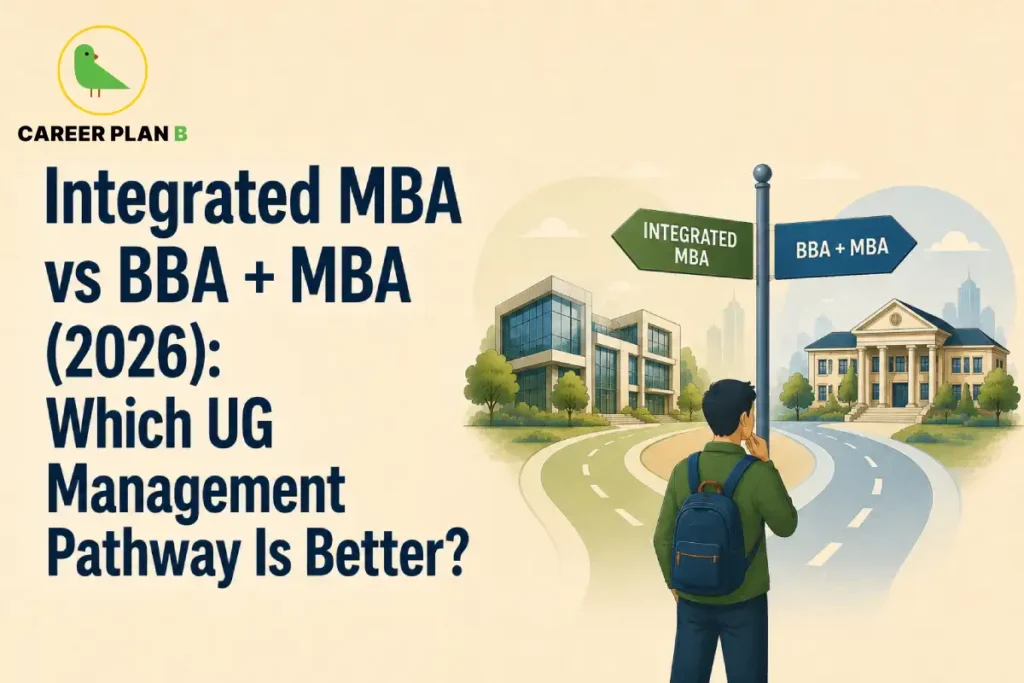
Introduction
Choosing a management course after Class 12 has become more exciting than ever. Alongside the traditional route of pursuing a Bachelor of Business Administration (BBA) followed by an MBA, students now have the option of enrolling in an Integrated Programme in Management (IPM) offered by several Indian Institutes of Management (IIMs). The introduction of these five-year integrated programmes has created new opportunities for students who are certain about building a career in management from an early stage.
For students planning admissions in 2026, understanding the differences between these two pathways is essential. While both eventually lead to a management degree, they differ in curriculum, admission process, flexibility, learning experience, and career planning. Official information from institutions such as IIM Indore, IIM Rohtak, and IIM Ranchi highlights that Integrated MBA programmes are designed to combine undergraduate and postgraduate management education into one structured learning journey.
This guide compares both options to help you decide which pathway aligns better with your academic interests and long-term career goals.
What Is an Integrated MBA?
An Integrated MBA, commonly known as the Integrated Programme in Management (IPM), is a five-year programme that combines undergraduate and postgraduate management education into a single academic pathway.
Instead of completing a bachelor’s degree first and then preparing for MBA entrance exams, students enter the programme immediately after Class 12. IIM Indore introduced India’s first IPM in 2011 with the objective of nurturing future business leaders from an early stage.
The programme blends subjects such as economics, mathematics, statistics, humanities, communication, and management during the initial years before students transition into the institute’s MBA curriculum in the final two years. The MBA component of the programme has also received international accreditation from the Association of MBAs (AMBA), reflecting its global academic standards.
Today, several IIMs including IIM Rohtak, IIM Ranchi, IIM Jammu, and IIM Bodh Gaya offer integrated management programmes with their own admission processes and curriculum structures.
What Is the Traditional BBA + MBA Route?
The traditional pathway remains the most common choice among management aspirants. Students first complete a three- or four-year BBA programme from a university or business school and later appear for MBA entrance examinations such as CAT or other management entrance tests to pursue postgraduate studies.
This route offers greater flexibility because students can choose different universities for their undergraduate and postgraduate education. It also allows them to explore other career options after completing their bachelor’s degree, gain work experience, or even pursue higher education in specialized fields before deciding whether an MBA is the right choice.
For students who are still exploring their interests after Class 12, this pathway provides more time to build their academic profile and make an informed career decision.
Admission Process: How Do They Differ?
One of the biggest differences between the two pathways is the admission process.
Admission to Integrated MBA programmes is conducted immediately after Class 12 through institute-specific entrance examinations. For example, IIM Indore conducts the IPMAT, while IIM Rohtak has its own IPM Aptitude Test (IPMAT).
Some other IIMs use IPMAT scores or JIPMAT for admissions depending on their admission policies. Candidates are shortlisted based on entrance test performance, academic records, and, where applicable, personal interviews.
The traditional BBA + MBA pathway follows two separate admission processes. Students first secure admission into a BBA programme based on university-specific criteria. After graduation, they appear for MBA entrance examinations such as CAT or institute-specific tests to gain admission into business schools. This allows students to strengthen their academic profile over time before applying for an MBA.
For Personalized Guidance
Curriculum and Learning Experience
Integrated MBA programmes follow a carefully designed curriculum that gradually develops analytical thinking, communication skills, quantitative aptitude, leadership abilities, and business knowledge over five years.
For example, IIM Ranchi’s IPM begins with foundational subjects during the first three years and includes compulsory activities such as the Social Internship Immersion Programme (SIIP).
Students who successfully complete the undergraduate phase and meet the required academic standards then progress into the regular MBA curriculum during the fourth and fifth years. This creates a seamless transition from undergraduate education to advanced management studies.
By contrast, students pursuing the traditional BBA + MBA route experience two distinct academic environments. A BBA programme focuses on management fundamentals, while the MBA introduces advanced business concepts after students have gained greater academic maturity and, in many cases, professional exposure.
Flexibility: Which Path Offers More Freedom?
One of the biggest differences between an Integrated MBA and the traditional BBA + MBA pathway is flexibility. An Integrated MBA is designed for students who are confident about pursuing a management career immediately after Class 12. The curriculum is planned as a single academic journey, allowing students to build knowledge progressively without preparing for another MBA entrance examination midway.
However, many IIMs have introduced exit options to provide additional flexibility. For example, IIM Ranchi allows students who complete the first three years and satisfy the programme requirements to exit with a Bachelor of Business Administration (BBA) degree. Students meeting the required academic performance can continue into the MBA phase. (IIM Ranchi)
Similarly, IIM Indore provides an exit option after successful completion of the third year, along with additional opportunities such as student exchange programmes and sabbatical options for eligible students.
The traditional BBA + MBA pathway naturally offers greater flexibility. Students can choose a different university for their MBA, pursue work experience before higher studies, prepare for CAT or other entrance examinations, or even explore specialized postgraduate programmes. This route is ideal for students who want more time before making a long-term management commitment.
Cost Comparison: Which Option Is More Economical?
Cost plays a significant role while choosing a management programme. Although both pathways require substantial investment, the way expenses are distributed differs.
Integrated MBA programmes usually have a structured fee for the undergraduate years, followed by the prevailing MBA fee during the postgraduate phase. For instance, IIM Indore charges an annual programme fee for the first three years, while the fourth and fifth years follow the institute’s current MBA fee structure. Accommodation and campus facilities are included as per institute guidelines. (IIM Indore)
Similarly, IIM Ranchi has a separate fee structure for the first three years of the IPM, with the final two years following the MBA programme fee applicable at that time. (IIM Ranchi)
In the traditional route, students pay separately for their BBA and MBA programmes. This gives them the flexibility to select institutions according to their budget. Some students complete an affordable undergraduate degree before investing in a premium MBA, helping them manage education expenses more effectively.
Career Opportunities and Placements
Both pathways ultimately prepare students for careers in management, consulting, finance, marketing, operations, analytics, entrepreneurship, and general management. The final career opportunities depend more on individual performance, internships, leadership experiences, and skill development than on the pathway itself.
Students enrolled in Integrated MBA programmes at IIMs benefit from continuous learning within one institution. At IIM Indore, students undertake a social internship after the second year and a business internship between the fourth and fifth years alongside the regular MBA cohort. These experiential learning opportunities expose students to real business challenges before final placements. (IIM Indore)
Likewise, IIM Ranchi incorporates experiential learning through classroom discussions, case studies, simulations, group projects, internships, mentorship, and the Social Internship Immersion Programme (SIIP), ensuring students graduate with both academic knowledge and practical experience. (IIM Ranchi)
Students following the traditional BBA + MBA route often gain exposure by studying at two different institutions. This allows them to experience diverse academic environments, build wider professional networks, and strengthen their profile before entering an MBA programme.
Which Pathway Should You Choose?
Choose an Integrated MBA if…
An Integrated MBA is suitable for students who are certain about pursuing a management career immediately after Class 12. It offers a structured curriculum, continuous academic progression, early exposure to business education, and opportunities to learn from experienced faculty over five years without the uncertainty of another MBA admission process.
Choose the Traditional BBA + MBA Route if…
The traditional pathway is better suited for students who are still exploring their interests or prefer greater academic flexibility. It allows them to improve their profile during graduation, prepare for competitive MBA entrance examinations, gain work experience if desired, and choose a business school that aligns with their evolving career aspirations.
How Career Plan B Helps
Selecting the right undergraduate management pathway requires understanding your interests, strengths, and long-term goals.
Career Plan B supports students through Personalized Career Counselling, Psycheintel and Career Assessment Tests, Admission and Academic Profile Guidance, and personalized Career Roadmapping.
These services help students choose between an Integrated MBA and the traditional BBA + MBA pathway based on their individual aspirations rather than following popular trends.
Get In Touch With Us
Frequently Asked Questions
1. Is an Integrated MBA equivalent to pursuing a BBA followed by an MBA?
Yes, An Integrated MBA combines undergraduate and postgraduate management education into one structured programme. The exact degree awarded depends on the institute’s academic regulations. For example, IIM Indore awards a Bachelor of Arts (Foundations of Management) and an MBA upon successful completion of the programme.
2. Can students leave an Integrated MBA after three years?
Some institutes provide this option. IIM Ranchi awards a BBA degree to students who complete all programme requirements and choose to exit after three years. IIM Indore also offers an exit option after the successful completion of the third year.
3. Is CAT required after completing an Integrated MBA?
No, Students who successfully progress through the five-year Integrated MBA programme continue into the MBA phase according to the institute’s academic requirements without appearing for CAT.
4. Which pathway offers more flexibility?
The traditional BBA + MBA route provides greater flexibility because students can change institutions, gain work experience, or pursue different postgraduate options before beginning an MBA.
5. Which option is better for students after Class 12?
There is no one-size-fits-all answer. Students who are confident about a long-term management career may benefit from an Integrated MBA, while those seeking flexibility and additional career exploration may find the traditional BBA + MBA route more suitable.
Conclusion
The choice between an Integrated MBA and a Traditional BBA + MBA depends on your career clarity, learning preferences, and future aspirations. Integrated MBA programmes offered by IIMs provide a structured five-year journey with multidisciplinary learning, internships, and seamless progression into MBA studies.
In contrast, the traditional route offers greater flexibility, allowing students to explore different academic environments and make informed postgraduate decisions.
Before making your decision, evaluate factors such as curriculum, admission process, flexibility, financial investment, internships, and long-term career goals. Selecting the pathway that aligns with your ambitions will help you build a strong foundation for a successful career in management.