Team Career Plan B · July 14, 2026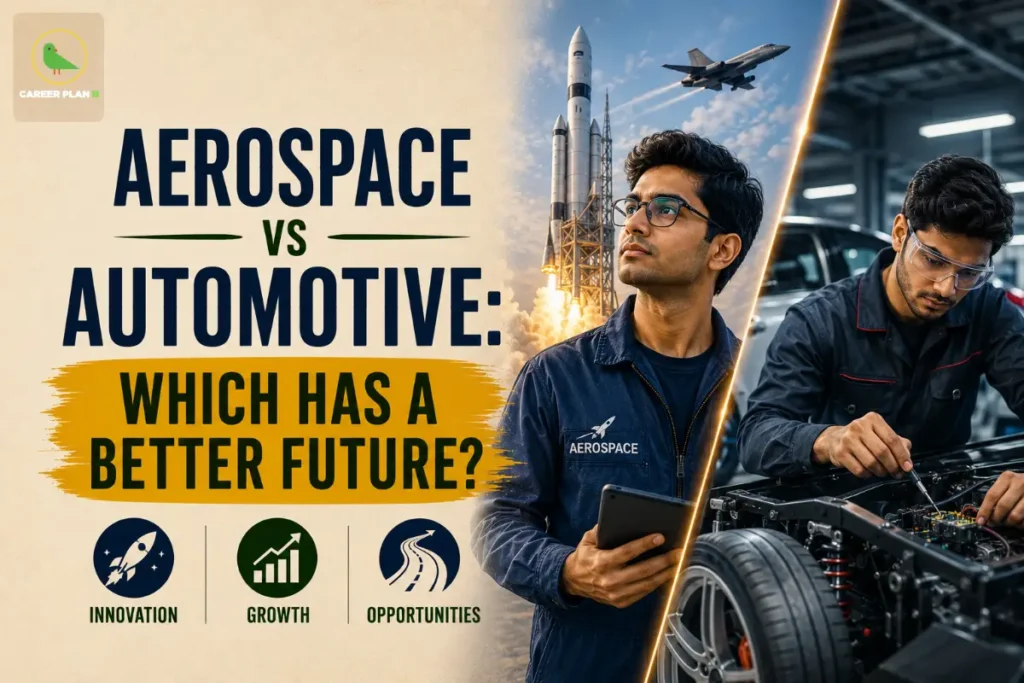
Introduction
With electric vehicles transforming how India drives and the defence and space sectors expanding rapidly, students are increasingly asking the same question: which holds better promise, aerospace vs automotive engineering? Both fields are riding major waves of growth, but for very different reasons. According to the Ministry of Heavy Industries, India’s push toward electric mobility is reshaping the automotive industry, while organizations like DRDO and ISRO continue to expand opportunities in aerospace.
This blog breaks down the difference between aerospace and automotive engineering, comparing career scope, salary, required skills, and future outlook, so you can decide which path truly fits your goals.
Why This Comparison Matters Right Now
Both industries are experiencing major transformation. Automotive engineering is being reshaped by the electric vehicle revolution, while aerospace engineering is benefiting from India’s growing investment in defence modernization and space exploration. This makes it a genuinely exciting time to enter either field, but the career experience in each looks quite different.
What Is Automotive Engineering?
Automotive engineering focuses on the design, manufacturing, and development of vehicles, including cars, trucks, and increasingly, electric vehicles. Core areas include vehicle design, powertrain engineering, manufacturing processes, and emerging EV technologies like battery systems and charging infrastructure.
What Is Aerospace Engineering?
Aerospace engineering is a specialized branch focused on aircraft and spacecraft. It covers aerodynamics, propulsion, structural design, and avionics. Aerospace engineers often work with organizations like DRDO, HAL, and ISRO, contributing to both defence and space exploration projects.
Key Differences Between Aerospace and Automotive Engineering
| Aspect | Automotive Engineering | Aerospace Engineering |
|---|---|---|
| Scope | Broad, applies across vehicle industries | Narrow, focused on aviation and space |
| Specialization | Vehicle design, powertrains, EV tech | Aerodynamics, propulsion, flight systems |
| Industries | Car manufacturing, EV startups, auto components | Defense, aviation, space research |
| Job Flexibility | High, growing demand in EV sector | Moderate, niche-specific roles |
| Entry Competition | Moderate, expanding with EV growth | Often higher due to limited seats |
Career Scope and Job Opportunities
Automotive Engineering Career Scope
Automotive engineering career scope has expanded significantly with India’s shift toward electric mobility. Career options after automotive engineering now include roles in EV design, battery technology, autonomous vehicle systems, and traditional manufacturing, spanning both established automakers and fast-growing EV startups.
Aerospace Engineering Career Scope
The aerospace engineering career scope remains more specialized, with roles in aircraft design, propulsion, and space research. Most opportunities are concentrated in government organizations like DRDO and HAL, along with private aviation and defence companies.
The Future Outlook: EVs vs Space & Defense Growth
Both fields show strong future scope for automotive engineering and aerospace engineering, but the growth drivers differ. The automotive sector is being pushed forward by India’s electric vehicle transition, supported by government schemes under the Ministry of Heavy Industries (heavyindustries.gov.in). Meanwhile, aerospace growth is driven by defence modernisation and India’s expanding space programmeme through ISRO and DRDO. Electric vehicle careers in India are growing rapidly in the short term, while aerospace continues to offer long-term, high-impact opportunities tied to national security and space exploration.
Salary Comparison
| Career Stage | Automotive Engineering (Annual) | Aerospace Engineering (Annual) |
|---|---|---|
| Entry-level (0–2 yrs) | ₹4–7 LPA | ₹5–8 LPA |
| Mid-level (3–7 yrs) | ₹8–14 LPA | ₹10–16 LPA |
| Senior-level (8+ yrs) | ₹15–24 LPA | ₹18–28+ LPA |
When comparing aerospace vs automotive salary in India, aerospace roles tend to offer higher pay at senior levels due to specialization, while automotive engineering, especially in the EV sector, is seeing rapid salary growth at entry and mid-level positions.
Have Any Doubts?
Which Subjects and Skills Do You Need for Each?
Automotive engineering requires strong fundamentals in mechanical design, thermodynamics, manufacturing processes, and increasingly, battery and electrical systems for EVs. Aerospace engineering demands deeper knowledge of aerodynamics, propulsion, structural mechanics, and flight dynamics. Both fields require strong CAD and simulation skills, with automotive engineers increasingly needing knowledge of EV-specific technologies.
For programme eligibility and accreditation, students can check AICTE (aicte-india.org) and UGC. Entry into postgraduate programmes or government recruitment in either field typically requires GATE qualification, with details available on the official GATE portal.
Which One Should You Choose?
Which field truly has the better future? The honest answer is that both do, just in different ways. If you’re excited by the electric vehicle revolution and want to work in a fast-evolving, innovation-driven industry, the automotive engineering career scope offers strong momentum right now. If you’re drawn to aviation, space, and defence technology and don’t mind a more specialized path, aerospace engineering offers long-term stability and national impact.
How Career Plan B Helps
Still deciding between aerospace vs. automotive engineering? Career Plan B‘s Psycheintel assessment helps students understand their natural strengths and interests before choosing a specialization. With personalized career counselling and academic profile guidance, Career Plan B helps you build a clear roadmap toward the engineering path that truly fits your future.
For Latest Information
Frequently Asked Questions
- Which field has better future scope: aerospace or automotive engineering?
Both have strong future scope. Automotive engineering is growing rapidly due to the EV revolution, while aerospace continues to expand through defense and space sector investments.
- Can an automotive engineer switch to the aerospace industry?
Yes, with additional specialization, automotive engineers can transition into aerospace roles, particularly in structural design or propulsion systems.
- Are electric vehicle careers in India a good long-term option?
Yes, with strong government support and growing EV adoption, this is one of the fastest-growing career areas within automotive engineering.
- Which field offers more government job opportunities?
Aerospace engineering has a stronger pipeline into government and PSU organizations like DRDO, HAL, and ISRO, while automotive engineering is more concentrated in the private sector.
- Does aerospace engineering pay more than automotive engineering?
At senior levels, aerospace roles often pay more due to specialization, though automotive engineering, especially in EVs, offers fast-growing entry-level salaries.
Conclusion
When it comes to aerospace vs automotive engineering, there’s no single winner, only the path that best matches your interests and goals. Automotive engineering offers fast-paced innovation through the EV revolution, while aerospace engineering offers long-term, high-impact careers in defence and space. If you’re still unsure which direction suits you best, let Career Plan B guide you with a personalized career assessment today.