Careerplanb · July 25, 2026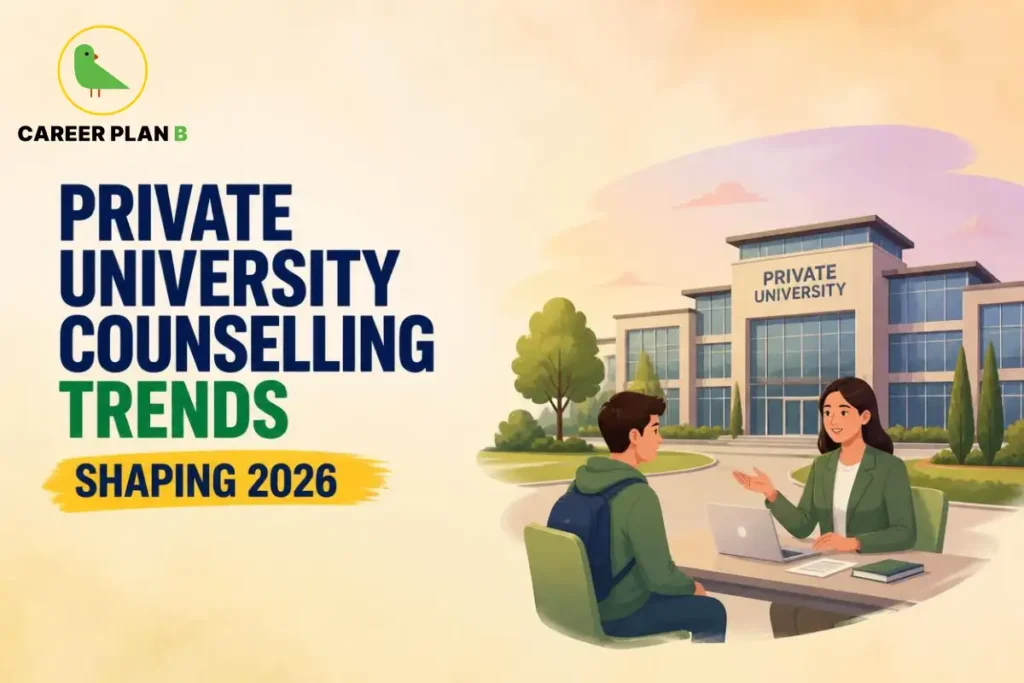
Introduction
It’s 11 pm, and Ananya is sitting cross legged on her bed, laptop glowing, twenty three browser tabs open. Ashoka or Jindal? Liberal arts or a professional degree? Should she trust the counsellor her school recommended, or is that advice already outdated? Somewhere in that pile of tabs is an answer, but right now it just feels like noise.
If this sounds familiar, you are not alone. Private university counselling has changed dramatically in the last few years, and 2026 is proving to be a turning point. Gone are the days when a counsellor simply told students where their marks could get them in. Today’s private university counselling is smarter, more personal, and shaped by tools and insights that didn’t exist even five years ago. In this blog, we will walk through the biggest trends redefining how students and parents approach this journey, and what it means for anyone standing at that same crossroads Ananya found herself in.
Why University Counselling Looks Different in 2026
Remember when choosing a university mostly came down to rank lists and word of mouth? That world is fading fast.
Three forces have reshaped the landscape. First, the aftershocks of pandemic era learning gaps pushed universities to look beyond grades alone. Second, artificial intelligence entered the admissions process, both for universities screening applicants and for students researching options. Third, competition for private university seats in India has intensified, with more students applying to more institutions than ever before.
So what does a student actually do with all this change swirling around them? That is exactly where modern private university counselling steps in, not as an optional extra, but as a genuine necessity.
The Top Trends Reshaping Private University Counselling
Personalized, Data Driven Guidance Over One Size Fits All Advice
The biggest shift in university counselling trends 2026 is the move away from generic advice. A counsellor telling every student with good marks to “try for the top ranked college” simply doesn’t work anymore. Today’s counselling for students draws on psychometric data, interest patterns, and academic history to build a path that fits the individual, not the average.
Think of it like tailoring versus buying off the rack. A ready made suit might fit reasonably well, but a tailored one fits exactly right. That is the difference personalized career guidance makes when a student is choosing between fifteen possible majors and three cities.
Early Career Assessment Tests Becoming the Norm
Ask any counsellor working in college admission counselling today, and they will tell you the same thing: students who take assessment tests early, ideally in grade 9 or 10, make far more confident decisions later. These tests are not about predicting a career with certainty. They are about revealing patterns in how a student thinks, solves problems, and engages with the world.
Ashoka University, for instance, uses a holistic evaluation approach for its undergraduate admissions that looks well beyond marks, considering essays, interviews, and overall fit with the programme.
For Personalized Guidance
Focus on Skill Based and Interest Based Admissions
Marks still matter, but they are no longer the only currency. Universities are increasingly interested in what a student can actually do and what genuinely excites them. This has pushed private university admissions to weigh essays, portfolios, extracurricular depth, and interviews far more heavily than they did a decade ago.
O.P. Jindal Global University follows a holistic and merit based admission process that varies by programme, reflecting this broader shift toward evaluating the whole applicant rather than a single score.
Hybrid Counselling: Online Plus In Person Support
A student in a small town today has the same access to expert career counselling for students as someone in a metro city, thanks to hybrid models. Video consultations, digital assessment tools, and in person sessions now work together, meaning geography is no longer the barrier it once was.
Parents Becoming Active Participants
Here’s something that has quietly but firmly changed: parents are no longer bystanders in this process. They are asking sharper questions, sitting in on counselling sessions, and wanting to understand the reasoning behind every recommendation. Good counsellors have adapted by making the process more transparent and collaborative, involving parents as partners rather than keeping them at arm’s length.
Old Approach vs 2026 Approach
| Aspect | Traditional Counselling | Private University Counselling in 2026 |
|---|---|---|
| Basis of advice | Marks and rank lists | Assessment data, interests, and skills |
| Delivery | Mostly in person | Hybrid, online and in person |
| Parent involvement | Minimal | Active and collaborative |
| Admission focus | Academic scores | Holistic profile including essays and interviews |
| Timing | Often starts in grade 11 or 12 | Increasingly starts by grade 9 or 1 |
What This Means for Students Applying in 2026
So how should a student actually use all of this? Here are the practical takeaways.
- Start early. Waiting until grade 12 to think seriously about universities limits your options. Early exploration, even informal, gives you room to adjust course.
- Take an assessment seriously. A good career assessment test isn’t a gimmick. It gives you language for strengths you may not have named yet.
- Research beyond rankings. Visit official university websites directly rather than relying only on aggregator sites, since admission criteria and deadlines change frequently.
- Involve your parents early, not as a formality, but as genuine collaborators in the decision.
- Build a profile, not just a mark sheet. Essays, projects, and interests now carry real weight in private university admissions.
Consider a student like Rohan, a science stream student who always assumed engineering was his only path because that’s what his marks suggested. A single assessment session revealed a strong pull toward design and storytelling. Two years later, he is pursuing a liberal arts degree with a design minor, a path he would never have found without personalized guidance nudging him to look closer at himself before looking at brochures.
How Career Plan B Helps
Career Plan B helps students navigate important academic and career decisions through a personalized approach that focuses on their individual strengths, interests, and long-term aspirations:
- Personalized Career Counselling: Helps students understand their strengths, interests, academic goals, and future aspirations so they can make informed decisions about courses, universities, and career pathways.
- Psycheintel & Career Assessment Tests: Provides data-backed insights into aptitude, personality traits, interests, and learning styles, helping students identify academic pathways and career options that best match their natural abilities.
- Admission & Academic Profile Guidance: Supports students in strengthening their academic profile, understanding admission requirements, and planning strategically for higher education opportunities.
- Academic & Career Alignment: Helps students connect their subject choices, course preferences, and university options with their long-term goals, ensuring every academic decision has a clear purpose.
- Career Roadmapping: Creates a structured, step-by-step plan that connects present academic choices with future education, skill development, and career aspirations, giving students a clear direction for the years ahead.
- End-to-End Guidance: Assists students throughout their academic journey so every decision is informed, intentional, and aligned with their future ambitions.
For Latest Information
Frequently Asked Questions
1. Is private university counselling worth the cost for every student?
Not every student needs extensive counselling, but those facing genuine confusion about streams, majors, or career direction often find it saves far more time and stress than it costs.
2. What is the right age to start university counselling?
Most experts suggest starting exploratory conversations around grade 9 or 10, well before board exam pressure peaks, so decisions aren’t rushed.
3. How is private counselling different from school counselling?
School counsellors often manage large groups with limited time per student. Private counselling for students typically offers more depth, individualized assessments, and ongoing support through the application process.
4. Are career assessment tests actually reliable?
When designed well and interpreted by trained professionals, these tests reveal genuine patterns in interest and aptitude, though they work best as one input among several, not a final verdict.
5. Do I need counselling if I already know which university I want?
Even with a clear goal, counselling can help strengthen your application, prepare for interviews, and create a backup plan in case circumstances change.
Conclusion
Private university counselling in 2026 looks nothing like it did even five years ago, and that’s a good thing. From personalized assessments to hybrid support systems and genuinely holistic admissions, students today have more thoughtful, individualized guidance available than any generation before them.
If you are somewhere in that maze of open tabs and unanswered questions, know that clarity is closer than it feels. Reach out to a trusted counsellor, involve your parents in the conversation, and give yourself the time to explore before deciding. The right path isn’t always the obvious one, but with the right support, it becomes a lot easier to find.