Careerplanb · July 25, 2026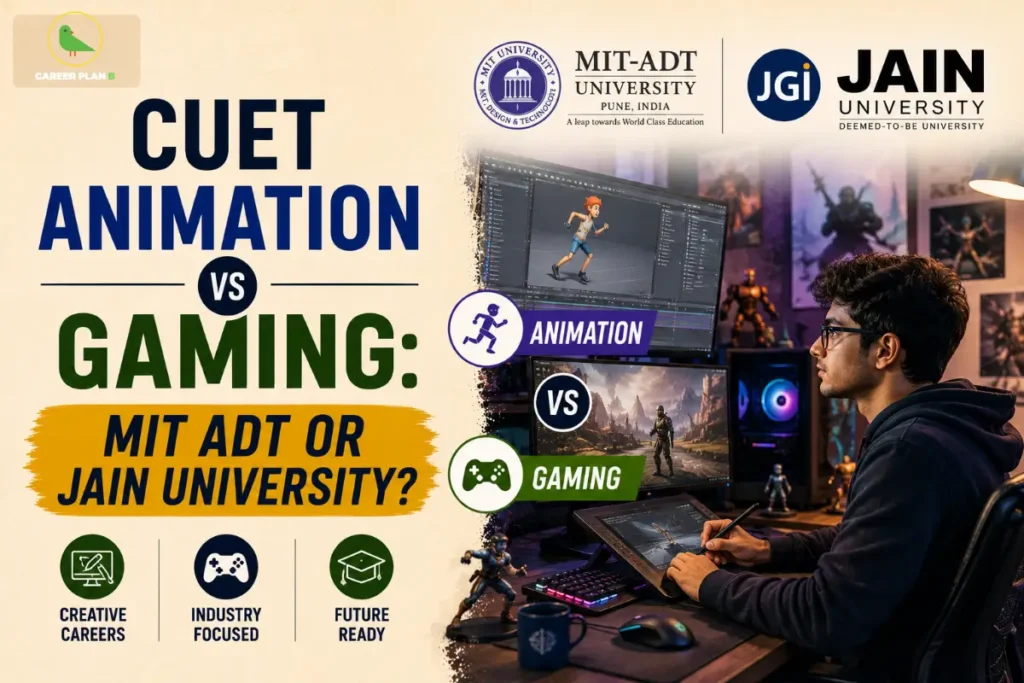
Introduction
It’s 11 pm, and somewhere in a small room lit only by a laptop screen, a student is scrolling between two browser tabs. One says “Animation Design.” The other says “Game Design.” Both look exciting. Both feel right. And yet, only one can be picked.
If this sounds familiar, you’re not alone. Every year, thousands of students who’ve just wrapped up their board exams and entrance tests find themselves stuck in the same spot, weighing CUET animation vs gaming as their next big decision. It’s not just about picking a course anymore. This CUET animation vs gaming dilemma is really about picking the next four years of your life, and maybe even your career after that.
What’s the Real Difference Between Animation and Gaming Careers?
Let’s clear the air first, because these two fields often get mixed up.
Animation is about bringing stories to life through movement. Think of a character blinking, walking, or expressing sadness on screen. It’s rooted in art, storytelling, and emotion.
Gaming, on the other hand, is about building interactive worlds. It combines design with logic, coding, and problem-solving. A game designer doesn’t just draw a character. They decide how that character moves when a player presses a button, how the level responds, and how the whole experience feels.
Both fields overlap in places like 3D modelling and visual storytelling, but the core skill sets pull in different directions. One asks you to be a storyteller with a pencil. The other asks you to be a storyteller with logic and code.
MIT ADT University: A Closer Look
MIT Art, Design and Technology University in Pune has built a solid name for itself in design education, and its animation and game design programmes are no exception.
Animation Design at MIT ADT
The B.Des in Animation Design is a four-year undergraduate programme offered under the MIT Institute of Design. Students here work on personality animation, storyboarding, visual scripting, and both 2D and 3D animation techniques. There’s a strong focus on design thinking, not just software skills, which means graduates walk out understanding not only how to animate, but why a scene works the way it does.
Game Design at MIT ADT
MIT ADT also offers a dedicated B.Des in Game Design, sitting right alongside its design programmes. This course leans into the creative side of games, covering game mechanics, level design, and interactive storytelling, while still building a foundation in the technical tools the industry uses.
| Aspect | Animation Design | Game Design |
|---|---|---|
| Duration | 4 years | 4 years |
| Entrance | MITID-DAT | MITID-DAT |
| Focus | Storytelling, character animation, VFX | Game mechanics, interactivity, design |
You can check current programme details directly on the official MIT ADT University site and the MIT Institute of Design page.
Confused about your next steps? Get a personalized roadmap tailored to your career goals.
Jain University: A Closer Look
Jain (Deemed-to-be University) in Bangalore takes a slightly different route, offering both animation and gaming as BSc programmes under its School of Computer Science and IT.
BSc Animation at Jain
Jain’s BSc Animation programme focuses on 3D modelling, texturing, lighting, and real-time production pipelines. What stands out here is the inclusion of generative AI tools in the coursework, something that’s becoming increasingly relevant as studios adopt AI-assisted workflows for concept art and asset creation.
BSc Gaming at Jain
The BSc Gaming programme at Jain covers game mechanics, level design, and UI/UX for games, with hands-on training using engines like Unity and Unreal. Students also get exposure to AI-driven game development, multiplayer systems, and immersive technologies like AR and VR.
| Aspect | BSc Animation | BSc Gaming |
|---|---|---|
| Duration | Typically 4 years (Hons/Hons with Research) | Typically 4 years (Hons/Hons with Research) |
| Entrance | JAIN Entrance Test | JAIN Entrance Test |
| Focus | 3D animation, VFX, AI-assisted workflows | Game design, real-time engines, immersive tech |
Details on eligibility, curriculum, and admission timelines are available on Jain University’s official animation page and its gaming programme page.
MIT ADT vs Jain University: Side-by-Side Snapshot
| Factor | MIT ADT University | Jain University |
|---|---|---|
| Location | Pune, Maharashtra | Bangalore, Karnataka |
| Degree type | B.Des (Design-focused) | BSc (Science-focused, tech-heavy) |
| Animation strength | Strong on storytelling and character work | Strong on 3D pipelines and AI tools |
| Gaming strength | Creative, design-led approach | Technical, engine-heavy approach |
| Ideal for | Students who lean toward art and narrative | Students who lean toward tech and systems |
How Do You Know Which One Fits You?
Here’s a question worth sitting with: do you get more excited sketching a character’s expressions, or do you get more excited figuring out how a level should be built so a player never gets bored?
There’s no wrong answer, but your answer says a lot. If you’re someone who fills notebook margins with doodles and loves watching how a scene is framed in a film, animation will likely feel natural. If you’re the one tweaking settings in a video game just to see what happens, or you enjoy solving little logic puzzles, gaming might be where you thrive.
It also helps to think about how you learn. MIT ADT’s design-first approach suits students who want strong grounding in visual storytelling before diving deep into technology. Jain’s science-based structure, with its emphasis on real-time engines and AI tools, suits students who are comfortable mixing creativity with a more technical mindset.
Career Paths After Animation vs Gaming Degrees
Animation graduates often move into roles like character animator, VFX artist, storyboard artist, or motion graphics designer, working across film, television, advertising, and streaming platforms. Gaming graduates typically step into roles such as game designer, level designer, technical artist, or gameplay programmer, finding opportunities across mobile gaming, esports, and AAA game studios.
The good news is that the industry itself is expanding quickly, so both paths lead to genuine, growing career options if you commit to building your skills.
How Career Plan B Helps
Career Plan B helps students choose between Animation and Gaming through a personalized approach that connects their interests, abilities, and long-term career goals:
- Personalized Career Counselling: Helps students understand their strengths, interests, creative abilities, academic goals, and future aspirations so they can choose the pathway that best fits them.
- Psycheintel & Career Assessment Tests: Provides data-backed insights into aptitude, personality traits, interests, and learning styles, helping students determine whether Animation, Gaming, or another creative field aligns better with their natural abilities.
- Admission & Academic Profile Guidance: Supports students in strengthening their academic profile, understanding programme eligibility requirements, and preparing strategically for admissions to creative courses and universities.
- Course & Career Alignment: Helps students compare Animation and Gaming programs based on curriculum, skill requirements, career opportunities, industry trends, and long-term goals, ensuring every decision supports their future aspirations.
- Career Roadmapping: Creates a structured, step-by-step plan that connects course selection with university admissions, portfolio development, skill building, and long-term career aspirations in the creative industry.
- End-to-End Guidance: Assists students throughout the planning and admission journey so every academic decision is informed, intentional, and aligned with their future ambitions.
For Latest Information
Frequently Asked Questions
1. Is CUET required for admission to MIT ADT or Jain University’s animation and gaming courses?
No. Both universities conduct their own entrance processes. MIT ADT uses the MITID-DAT for its design programmes, while Jain University conducts its own JAIN Entrance Test. CUET is generally not the admission route for these specific private and deemed university programmes, though many students appear for it alongside other exams during the same admission season.
2. Which is more in demand right now, animation or gaming, in India?
Both are growing fast. Gaming has seen a sharp rise due to mobile gaming and esports, while animation continues to grow through OTT platforms and international outsourcing projects. Neither is clearly “ahead” of the other long term.
3. Can I switch from animation to gaming later in my career, or vice versa?
Yes, and it happens often. Many skills like 3D modelling, texturing, and storytelling are shared between the two fields, so a switch is very possible with some additional upskilling.
4. What skills should I build before joining either course?
For animation, basic sketching and observation skills help a lot. For gaming, a curiosity about how games are built, along with basic logical thinking, gives you a head start.
5. Is a portfolio important for admission to these programmes?
Yes, for design-focused programmes like those at MIT ADT and Jain University’s animation and game design tracks, having some sketches, digital art, or small projects ready can strengthen your application, even if it’s not always mandatory at the entrance stage.
Conclusion
At the end of the day, the CUET animation vs gaming question isn’t really about which college has a better campus or a longer list of software tools. It’s about which world pulls you in more, the one where you build characters and emotions, or the one where you build systems and interactions.
Take a breath, revisit what excites you when no one’s watching, and let that guide your choice. Whether it’s MIT ADT or Jain University, animation or gaming, the right decision is the one that keeps you curious four years from now, not just today.