Team6 · July 16, 2026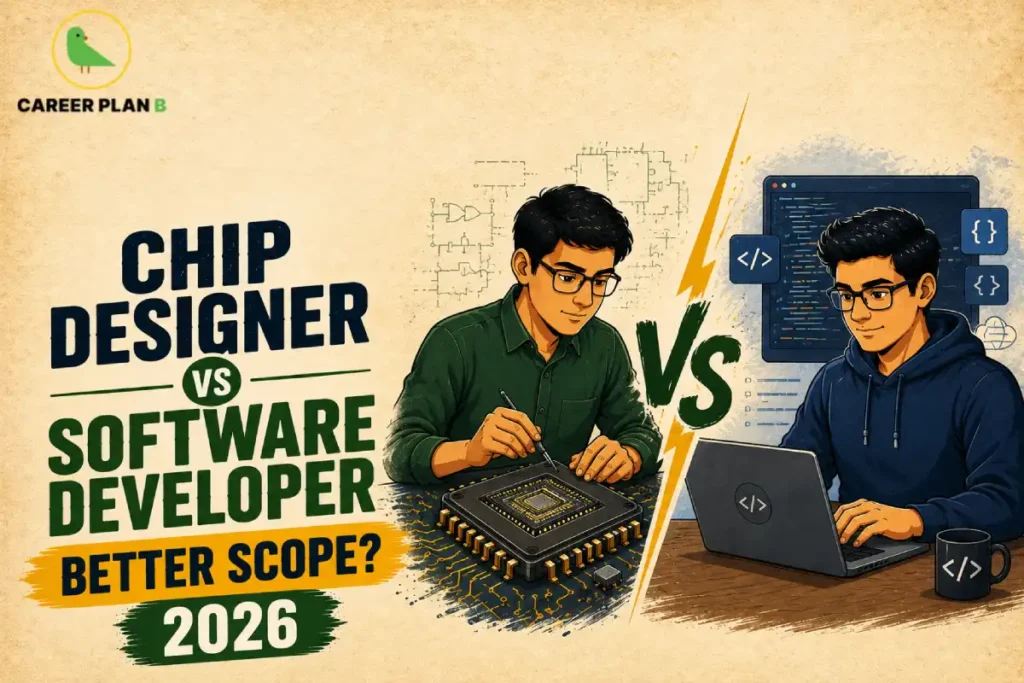
Introduction
Think about the last time you used your smartphone. One engineer designed the chip that powers every function inside it. Another engineer built the app you were using. Both are indispensable. Both are brilliantly rewarded. But which one has a better career ahead?
The debate of Chip Designer vs Software Developer is one of the most relevant career conversations in Indian engineering today. India is simultaneously home to a $250 billion IT industry dominated by software talent and an emerging semiconductor ecosystem backed by a government investment of ₹76,000 crore under the Semicon India Programme. Two powerful forces pulling talented engineers in two different directions.
Whether you are an ECE student trying to decide your specialisation, a B.Tech graduate evaluating your options, or a working engineer considering a pivot, this blog gives you a clear, honest, and data-backed comparison of both careers across salaries, future scope, required skills, and long-term growth.
By the end, you will know exactly which path aligns with your strengths and ambitions.
Who Is a Chip Designer?
A chip designer, also called a VLSI engineer or semiconductor design engineer, creates the integrated circuits (ICs) that power every electronic device on the planet.
Their work spans the entire chip development lifecycle: writing RTL (Register Transfer Level) code to define chip behaviour, performing physical design and layout, running verification and simulation, and overseeing chip testing before manufacturing.
Chip designers work in industries including semiconductors, consumer electronics, automotive technology, defence systems, space technology, and telecommunications. Every processor, graphics card, and communication chip in existence was built by a chip designer.
Who Is a Software Developer?
A software developer designs, builds, tests, and maintains the applications and systems that run on top of hardware. They write the code that makes devices useful from mobile apps and web platforms to operating systems and enterprise software.
Software developers work across virtually every industry: IT services, fintech, e-commerce, healthcare technology, SaaS, artificial intelligence, and cloud computing. Their work is largely hardware-independent, making the field highly versatile and accessible.
India’s software development ecosystem is among the largest in the world, employing millions of engineers across service giants, product startups, and global tech MNCs.
Chip Designer vs Software Developer Role Comparison
| Parameter | Chip Designer | Software Developer |
|---|---|---|
| Primary Focus | Designing integrated circuits and semiconductor chips | Building software applications and systems |
| Core Skills | Verilog/VHDL, EDA tools, RTL design, physical design | Python, Java, JavaScript, system design, cloud |
| Key Industries | Semiconductors, defence, automotive, space | IT services, fintech, AI/ML, e-commerce |
| Tools Used | Cadence, Synopsys, Mentor Graphics, MATLAB | VS Code, Git, AWS, Docker, Kubernetes |
| Work Environment | Hardware-software integration, lab and desk | Primarily software and cloud-based |
| Entry Barrier | Higher requires specialised ECE/VLSI knowledge | Moderate accessible to multiple engineering branches |
The core difference in VLSI chip design vs software engineering is depth vs breadth. Chip design is a highly specialised niche with fewer but extremely well-paid professionals. Software development is a broader field with a massive volume of opportunities.
Salary Comparison: Chip Designer vs Software Developer in India
Salary is one of the most decisive factors in the chip designer vs. software developer debate. Here is how both roles compare in India.
Chip Designer Salary in India
| Experience Level | Average Annual Salary (INR) |
|---|---|
| Fresher (0–2 years) | ₹4 LPA – ₹8 LPA |
| Mid-Level (3–6 years) | ₹12 LPA – ₹22 LPA |
| Senior (7+ years) | ₹25 LPA – ₹50 LPA+ |
Top companies hiring chip designers in India include Qualcomm, Intel, Nvidia, Texas Instruments, Samsung Semiconductor, Micron, and Marvell, all of which have significant design centres in Bengaluru, Hyderabad, and Pune.
Software Developer Salary in India
| Experience Level | Average Annual Salary (INR) |
|---|---|
| Fresher (0–2 years) | ₹3.5 LPA – ₹9 LPA |
| Mid-Level (3–6 years) | ₹10 LPA – ₹20 LPA |
| Senior (7+ years) | ₹22 LPA – ₹45 LPA+ |
Top companies hiring software developers in India include Google, Amazon, Microsoft, Flipkart, Swiggy, PhonePe, TCS, and Infosys. Product-based companies consistently pay more than service-based firms.
Quick Verdict: Software development offers a wider salary range at the fresher level, making early entry easier. However, chip designer salary in India grows steeply with experience, and senior chip designers at top semiconductor MNCs often out-earn their software counterparts significantly.
For verified salary benchmarks and job listings in both fields, refer to the National Career Service (NCS) Portal by the Ministry of Labour and Employment.
Salary Abroad: Chip Designer vs Software Developer
Both roles command impressive international salaries. Here is a country-wise comparison:
| Country | Chip Designer Salary | Software Developer Salary | Official Reference |
|---|---|---|---|
| USA | $1,10,000 – $1,70,000/yr | $1,00,000 – $1,60,000/yr | U.S. Bureau of Labor Statistics |
| Canada | CAD 90,000 – CAD 1,30,000/yr | CAD 85,000 – CAD 1,25,000/yr | Gov. of Canada Job Bank |
| Australia | AUD 95,000 – AUD 1,40,000/yr | AUD 90,000 – AUD 1,35,000/yr | Australian Gov. Job Outlook |
| Germany | €65,000 – €95,000/yr | €60,000 – €90,000/yr | Federal Employment Agency Germany |
Internationally, chip designers hold a slight salary advantage over software developers largely because of the scarcity of qualified professionals in the field. The chip designer career scope in India for those targeting global roles is particularly strong.
Future Scope Chip Design in India
The future of chip design in India has never looked more promising, and it is backed by serious government commitment.
The India Semiconductor Mission (ISM), established under the Ministry of Electronics and Information Technology (MeitY), is spearheading India’s ambition to become a global semiconductor design and manufacturing hub.
Under the Semicon India Programme, the government has committed ₹76,000 crore to attract semiconductor fabs, display fabs, and chip design ecosystems to India. Companies like Micron Technology, Applied Materials, CG Power, and Kaynes Semicon have already committed investments.
Emerging areas driving chip designer career scope in India include AI and machine learning chips, automotive-grade ICs, 5G communication chips, and edge computing processors. Every one of these requires skilled VLSI and chip design engineers.
India currently produces only a fraction of the chip designers the industry needs. That supply-demand gap translates directly into exceptional career opportunities for the engineers who enter this field today.
Future Scope Software Development in India
India’s software developer career growth story in India is well established, but it is also rapidly evolving.
India’s IT industry contributes over 7.5% to the national GDP and employs more than 5 million professionals, according to industry data. The sector continues to grow driven by cloud computing, AI, SaaS, and digital transformation projects globally.
However, the landscape is shifting. Generative AI tools are automating significant portions of routine coding work, making specialised skills in AI/ML development, cloud-native architecture, DevOps, and cybersecurity far more valuable than general coding abilities.
The software developers who will thrive in the next decade are those who evolve beyond writing basic code to designing intelligent, scalable systems. Software developer career growth in India remains strong, but it increasingly rewards those who continuously upskill.
Emerging areas include large language model (LLM) integration, cloud-native development, Web3 applications, and AI-augmented software engineering.
Have Any Doubts?
Chip Designer vs Software Developer: Which Should You Choose?
Here is the honest answer to which is better, chip design or software development: it depends entirely on who you are.
Choose Chip Design if:
- Electronics, circuits, and hardware-software integration genuinely excite you
- You enjoy deep, specialised work over broad, generalist roles
- You want to be part of India’s historic semiconductor transformation
- You are prepared to invest in a steep but highly rewarding learning curve
- You are targeting premium roles at global semiconductor MNCs
Choose Software Development if:
- You prefer working in a purely software environment
- You want faster and easier entry into the job market
- You enjoy building products that millions of people interact with directly
- You want a broader range of industries and company types to choose from
- You are comfortable with rapid, continuous upskilling as technology evolves
The Bigger Picture: In VLSI chip design vs software engineering, these two fields are increasingly converging. AI chips need chip designers to build them and software engineers to program them. The most valuable engineers of the next decade may well be those who understand both worlds, hardware and software, together.
How Career Plan B Helps
Choosing between a chip designer vs a software developer is not a decision to make based on trends alone. It requires honest self-assessment of your aptitude, interests, and long-term goals.
Career Plan B helps engineering students and professionals make this exact decision with clarity and confidence. Their PsycheIntel career assessment tests evaluate your natural strengths to determine whether chip design or software development is the better fit for your profile. Through personalised career counselling, their experts map your academic background, whether ECE, CSE, or EEE, to the right specialisation and career path. For students considering an MS or M.Tech. in VLSI Design, Semiconductor Engineering, or Computer Science from universities in the USA, Germany, or Canada, Career Plan B provides targeted admission and academic profile guidance. Their Career Roadmapping service then delivers a step-by-step action plan from your current academic position to your first role in chip design or software development.
For Latest Information
Frequently Asked Questions (FAQs)
1. Is chip design better than software development as a career in 2025?
Both are excellent careers with strong futures. Chip design offers higher specialisation, premium salaries at senior levels, and massive growth driven by India’s semiconductor mission. Software development offers a broader job market, faster entry, and strong growth, especially in AI and cloud. The right choice depends on your interests and strengths.
2. What is the starting salary of a chip designer in India?
Freshers in chip design typically earn between ₹4 LPA and ₹8 LPA. Engineers from top institutes or with strong project experience in Verilog, physical design, or verification can command ₹8 LPA to ₹12 LPA at leading semiconductor MNCs.
3. Is chip design harder than software development?
Chip design has a steeper initial learning curve as it requires specialised knowledge of digital electronics, HDL programming, and EDA tools. Software development is more accessible at the entry level. However, both fields become highly complex at senior levels in their own ways.
4. Which field has more jobs in India in 2025?
Software development currently has a significantly higher volume of job openings in India. However, the chip designer career scope in India is growing rapidly with new semiconductor design centres opening across Bengaluru, Hyderabad, and Pune.
5. Can a software developer transition into chip design?
It is possible but requires significant upskilling in digital electronics, Verilog or VHDL, and EDA tools. Software developers with a strong electronics background from their B.Tech are best positioned for this transition.
6. What degree do I need to become a chip designer?
A B.Tech in Electronics and Communication Engineering (ECE) or Electrical and Electronics Engineering (EEE) is the standard entry point. An M.Tech in VLSI Design or an MS in Semiconductor Engineering significantly accelerates career growth and salary prospects.
Conclusion
The Chip Designer vs Software Developer debate does not have a single winner, and that is actually great news. Both careers are future-proof, well-compensated, and at the heart of the technological revolution reshaping our world.
Chip design offers rare expertise, premium salaries, and a front-row seat to India’s semiconductor revolution. Software development offers scale, speed, and an enormous job market that spans every industry on the planet.
Your choice should be driven by what genuinely excites you: circuits and silicon, or code and systems. Both paths lead to remarkable careers.
If you are still unsure which side of the equation you belong on, Career Plan B is here to help you find out through expert counselling, career assessments, and a personalised roadmap built around your unique strengths.
The chip and the software together power the world. The only question is which one are you going to build?