Team Career Plan B · July 16, 2026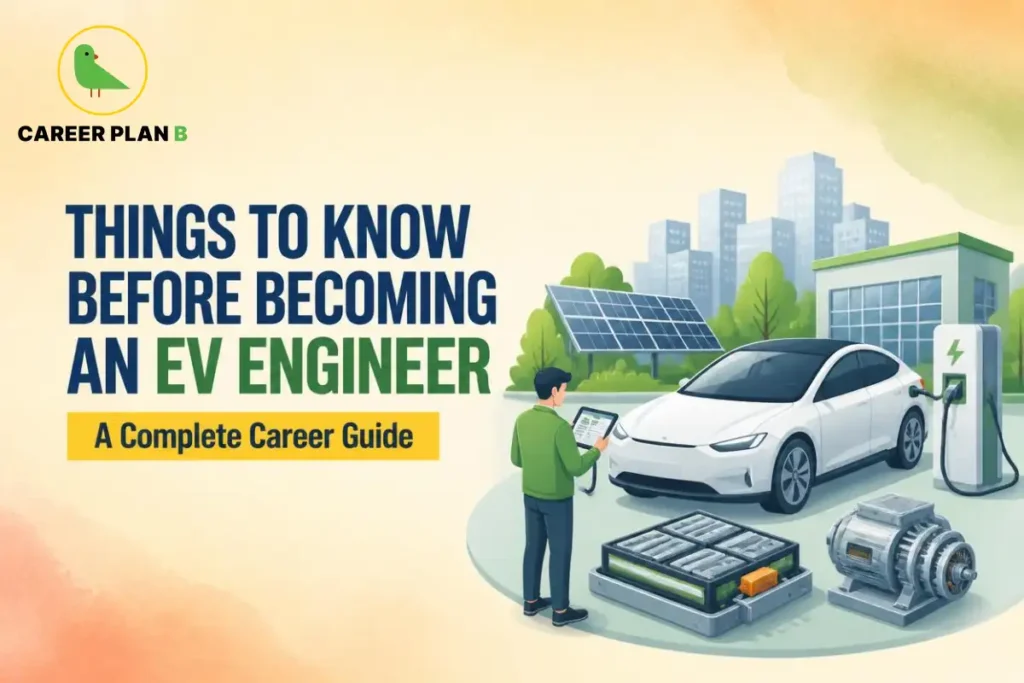
Introduction
Electric vehicles are no longer a niche experiment on Indian roads. They’re becoming part of everyday traffic, backed by government initiatives like NITI Aayog’s e-AMRIT portal, which was launched to accelerate India’s shift toward electric mobility. But here’s the real question: if you’re considering this field, do you actually know what the job involves?
There are several important things to know before becoming an EV engineer, and most of them go beyond what a typical mechanical engineering course teaches. This blog breaks down what the role really looks like, why India’s EV sector is growing so quickly, and what skills you’ll need to build a lasting career in it.
What Does an EV Engineer Actually Do?
An EV engineer isn’t simply a mechanical engineer who works on electric cars instead of petrol ones. It’s a genuinely different discipline that blends mechanical, electrical, and software engineering.
Where a traditional automobile engineer might focus on engines, transmissions, and fuel systems, an EV engineer works with battery packs, electric motors, power electronics, and the software that manages all of it. This is one of the biggest differences newcomers underestimate: EV powertrain engineering isn’t a smaller version of engine design; it’s a completely separate area of expertise built around electricity instead of combustion.
Why Is India’s EV Sector Growing So Fast?
Why is everyone suddenly talking about electric vehicle industry opportunities in India? A big part of the answer lies in coordinated government support.
NITI Aayog’s e-AMRIT portal, launched at COP26 in collaboration with the UK government, serves as a central information hub for India’s electric mobility transition, covering everything from EV policies to charging infrastructure and subsidies. Alongside this, the FAME scheme (Faster Adoption and Manufacturing of Hybrid and Electric Vehicles), run by the Department of Heavy Industries, has provided incentives for EV adoption and supported the sanctioning of thousands of charging stations across Indian states.
This kind of sustained government backing is exactly why the sector isn’t a short-term trend. It’s being built into India’s long-term transportation and manufacturing strategy.
Key Things to Know Before Becoming an EV Engineer
If you’re serious about this career, here are the realities worth understanding early on.
You’ll Need to Learn Battery and Electrochemistry Basics
Battery packs are the heart of any EV. Understanding how cells are arranged, how they’re cooled, and how a battery management systems engineer keeps a pack safe and efficient is fundamental, even if you don’t specialise entirely in batteries.
Power Electronics and Motor Control Matter Just as Much as Mechanical Design
Electric motors and the electronics that control them are central to EV performance. If mechanical design was the heart of traditional automobile engineering, power electronics is the heart of EV engineering.
Software and Embedded Systems Are Core, Not Optional
Modern EVs run on software, from battery monitoring to motor control to charging communication. Engineers who resist learning embedded systems and coding basics will find their options limited as the field matures.
EV Safety Standards Are Still Evolving in India
Because electric mobility is relatively new at scale, safety standards, testing protocols, and certifications are actively being developed and refined. Staying updated on evolving standards, rather than relying on fixed rules, is part of the job.
Charging Infrastructure Is Its Own Specialisation
Not every EV engineer works on the vehicle itself. A growing number focus entirely on EV charging infrastructure engineer roles, designing and maintaining the charging networks that make widespread EV adoption possible.
Have Any Doubts?
Skills That Set EV Engineers Apart
Here’s how core skills shift when you move from traditional automobile engineering into EV-focused roles:
| Traditional Skill | EV Engineering Skill Needed |
|---|---|
| Engine and fuel system design | Battery pack design and thermal management |
| Transmission systems | Motor control and power electronics |
| Mechanical CAD | Embedded systems and firmware basics |
| Fuel efficiency optimisation | Energy efficiency and range optimisation |
Building electric vehicle engineering skills doesn’t mean discarding mechanical fundamentals. It means layering electrical and software expertise on top of a solid engineering base.
Is EV Engineering a Stable Long-Term Career?
Is this just a passing phase or a genuine long-term career path? Based on current government direction, it looks like the latter.
With continued policy support through schemes like FAME and ongoing investment in charging infrastructure and battery manufacturing, India’s EV sector is being positioned as a core part of the country’s transport future, not a temporary trend. For engineers entering the field now, this means there’s real long-term demand, along with the advantage of growing into the industry as it matures.
How Career Plan B Helps
Trying to figure out if EV engineer career India roles are right for you? Career Plan B offers personalised career counselling to help you understand where you’d fit best, whether that’s battery systems, power electronics, or charging infrastructure. Through Psycheintel and Career Assessment Tests, we assess your aptitude for this hybrid mechanical-electrical-software field. Our Admission and Academic Profile Guidance helps you choose the right specialisation, while Career Roadmapping keeps your learning path aligned with where the industry is heading.
For Latest Information
Frequently Asked Questions
- What are the key things to know before becoming an EV engineer?
You’ll need to understand battery systems, power electronics, motor control, and embedded software, in addition to core mechanical engineering fundamentals.
- Is EV engineering different from mechanical engineering?
Yes. While it builds on mechanical fundamentals, EV powertrain engineering focuses heavily on electrical systems, battery technology, and software, which are less emphasised in traditional mechanical courses.
- Do EV engineers need coding skills?
A working understanding of embedded systems and basic coding is increasingly important, especially for battery management and motor control roles.
- What government initiatives support India’s EV sector?
NITI Aayog’s e-AMRIT portal and the Department of Heavy Industries’ FAME scheme are two major initiatives supporting EV adoption, infrastructure, and manufacturing in India.
- What is a battery management systems engineer responsible for?
This role focuses on monitoring and managing battery health, safety, charging behaviour, and thermal performance within an EV’s battery pack.
- Are there specialised roles beyond vehicle design in EV engineering?
Yes. Roles like EV charging infrastructure engineer focus entirely on building and maintaining the charging networks that support EV adoption, separate from vehicle-focused roles.
Conclusion
There are several things to know before becoming an EV engineer, and most of them come down to one core idea: this field demands a broader skill set than traditional automobile engineering alone. With strong government backing through initiatives like e-AMRIT and FAME, India’s EV sector offers real long-term potential for engineers willing to build skills across mechanical, electrical, and software domains.
Ready to explore whether EV engineering fits your strengths? Connect with Career Plan B to plan your next step.