Careerplanb · July 25, 2026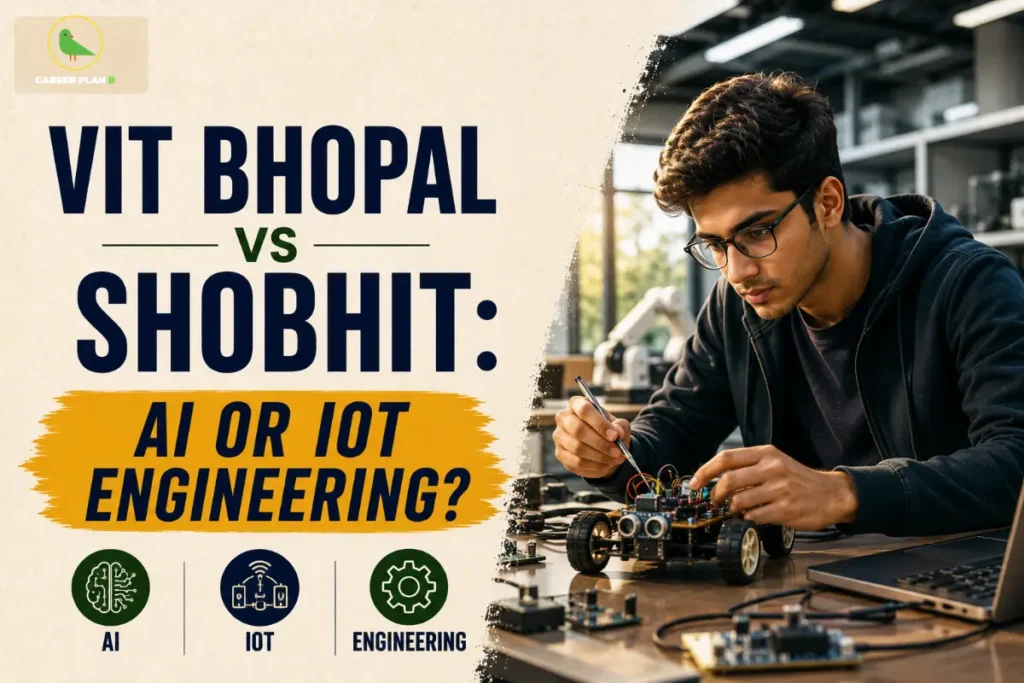
Introduction
It was 11 pm, and Ananya still had four browser tabs open. One showed VIT Bhopal’s Artificial Intelligence page. Another showed Shobhit University’s IoT program. Her parents were waiting for an answer at breakfast, and she didn’t have one yet. If this sounds familiar, you are not alone. Every year, thousands of Class 12 students sit exactly where Ananya sat, torn between VIT Bhopal vs Shobhit University, unsure whether AI or IoT will actually shape a better future.
This comparison, VIT Bhopal vs Shobhit University, is not just about which college looks better on paper. It is about understanding what each program actually teaches, where it can take you, and which one matches the way you think and work. By the end of this blog, you will know exactly how these two paths differ, and hopefully, sleep a little easier than Ananya did that night.
The Two Roads: VIT Bhopal and Shobhit University at a Glance
Think of these two universities as two different trains heading toward the same destination, a strong engineering career, but taking very different routes to get there.
VIT Bhopal is part of the VIT group, one of India’s well known private university networks, spread across a 200 acre campus. It runs its Artificial Intelligence programs under the School of Computing Science and Engineering, with labs built specifically for coding, robotics, and high performance computing.
Shobhit Institute of Engineering and Technology, Meerut, known widely as Shobhit University, is a NAAC ‘A’ Grade accredited Deemed-to-be University established in 2006. It offers Internet of Things as one of six specializations under its Computer Science and Engineering program, backed by an AICTE funded Idea Lab and an MSME Technology Business Incubator.
Both are recognised, both are serious about engineering education. The real difference lies in what they specialise in and how they get you there.
What Does VIT Bhopal Offer in Artificial Intelligence?
A Campus Built Around AI and Machine Learning
At VIT Bhopal, Artificial Intelligence is not a side elective, it is treated as its own ecosystem. The university offers B.Tech Computer Science and Engineering with a specialisation in Artificial Intelligence and Machine Learning, and B.Tech Electronics and Communication Engineering with a specialisation in Artificial Intelligence and Cybernetics. Students also get access to dedicated coding labs, a high performance computing lab for research projects, and a robotics lab, all housed under the School of Computing Science and Engineering.
The program pushes students toward certification courses and projects in computer vision, data science, and machine learning, alongside the core curriculum. That means by the time you graduate, you are not just carrying a degree, you are carrying a portfolio of real work.
How Do You Get In?
Admission to VIT Bhopal’s engineering programs happens through VITEEE, the university’s own entrance examination. Applications for the 2026-27 academic year are open, and the exam typically runs in phases between April and May. If AI genuinely excites you, and you enjoy the idea of building intelligent systems from scratch, this route deserves serious thought.
For Personalized Guidance
What Does Shobhit University Offer in IoT Engineering?
Where Hardware Meets the Internet
IoT sits at an interesting crossroads, part hardware, part software, part networking. At Shobhit University, this specialisation is offered under B.Tech Computer Science and Engineering, alongside options like Data Science, Cyber Security, and Cloud Computing. What makes this university’s approach distinct is its emphasis on industry linked learning, supported by functional MOUs, an AICTE-funded Idea Lab, and a patent portfolio that has been recognised among India’s top five by the government’s CGPDTM.
If you are someone who likes tinkering with sensors, building smart devices, or imagining how your city’s traffic lights could talk to each other, IoT might feel less like a subject and more like a playground.
How Do You Get In?
Shobhit University uses SUNET, the Shobhit University National Entrance and Scholarship Test, as its unified admission pathway for the 2026-27 session. It is a computer based test, and the process includes registration, the entrance exam, and counselling before you step onto campus.
AI or IoT: Which One Actually Fits You?
Here’s a question worth sitting with for a moment. Do you enjoy working with data, patterns, and predictions, or do you get more excited building something you can physically hold and switch on?
That single question often decides more than any ranking list ever could. Here’s a side by side look to make the comparison easier:
| Factor | VIT Bhopal (AI) | Shobhit University (IoT) |
|---|---|---|
| Core focus | Machine learning, data science, cognitive computing | Sensors, embedded systems, connected devices |
| Entrance exam | VITEEE | SUNET |
| Annual specialisation fee | Tiered by VITEEE rank, tuition portion | Approximately ₹1,80,000 per annum |
| Ideal for students who | Enjoy algorithms, data, and abstract problem solving | Enjoy hardware, networks, and tangible builds |
| Common career roles | ML engineer, AI researcher, data scientist | IoT engineer, embedded systems developer, solutions architect |
Neither path is objectively better. A student who loves debugging neural networks will feel out of place in a hardware lab, and a student who loves wiring circuits might find pure data theory dry. That is exactly why this decision needs more than a Google search, it needs self awareness.
Fees, Campus, and the Practical Side of Things
Money and location matter, even when passion is the deciding factor. VIT Bhopal’s AI specialisation fees vary depending on your VITEEE rank, with hostel costs added separately. Shobhit University keeps its structure simpler, with the CSE IoT specialisation priced at around ₹1,80,000 annually, plus a refundable security deposit and optional hostel charges.
Location plays its own role too. VIT Bhopal sits in Madhya Pradesh, while Shobhit University’s Meerut campus is roughly 70 kilometres from Delhi, which some NCR based families find more convenient for weekend visits.
How Career Plan B Helps
Career Plan B helps students compare universities and specializations through a personalized approach that connects their academic choices with their strengths, interests, and long-term career goals:
- Personalized Career Counselling: Helps students understand their strengths, interests, academic goals, and future aspirations so they can choose the university and specialization that best align with their ambitions.
- Psycheintel & Career Assessment Tests: Provides data-backed insights into aptitude, personality traits, interests, and learning styles, helping students identify academic pathways and specializations that best match their natural abilities.
- Admission & Academic Profile Guidance: Supports students in strengthening their academic profile, understanding programme eligibility requirements, and planning strategically for university admissions.
- University & Specialization Alignment: Helps students compare universities and specializations based on curriculum, academic fit, learning environment, industry exposure, career opportunities, eligibility requirements, and long-term goals, ensuring every decision supports their future aspirations.
- Career Roadmapping: Creates a structured, step-by-step plan that connects university and specialization selection with skill development, internships, higher education opportunities, and long-term career aspirations, giving students a clear direction throughout their academic journey.
- End-to-End Guidance: Assists students throughout the planning and admission process so every academic decision is informed, intentional, and aligned with their future ambitions.
For Latest Information
Frequently Asked Questions
1. Is AI a better career choice than IoT?
Not necessarily better, just different. AI suits students drawn to data and algorithms, while IoT suits those who enjoy hardware and connected systems. Career growth exists strongly in both fields.
2. Which entrance exam is required for VIT Bhopal and Shobhit University?
VIT Bhopal uses VITEEE, while Shobhit University uses SUNET, its own national entrance and scholarship test.
3. Can I switch from IoT to AI later in my career?
Yes. Many IoT professionals move into AIoT roles, combining artificial intelligence with connected devices, since the two fields increasingly overlap.
4. Does Shobhit University offer AI programs too?
Yes, alongside IoT, Shobhit University’s Computer Science and Engineering department also offers a specialisation in Artificial Intelligence and Machine Learning.
5, Is hostel accommodation compulsory at either university?
No, hostel accommodation is optional at both VIT Bhopal and Shobhit University, and charges apply separately for students who choose to stay on campus.
Conclusion
Ananya eventually closed her laptop that night, but not before writing one line in her notebook: choose the problem you want to spend your next four years solving, not just the college name. That single sentence captures what this entire comparison comes down to. Whether it is VIT Bhopal’s AI ecosystem or Shobhit University’s IoT specialisation, both paths lead somewhere meaningful, provided they match who you are as a learner.
So take a breath, revisit what excites you about engineering in the first place, and let that answer guide your decision. The right choice was never about picking the more popular name, it was always about picking the path that feels like yours.