Team Career Plan B · July 17, 2026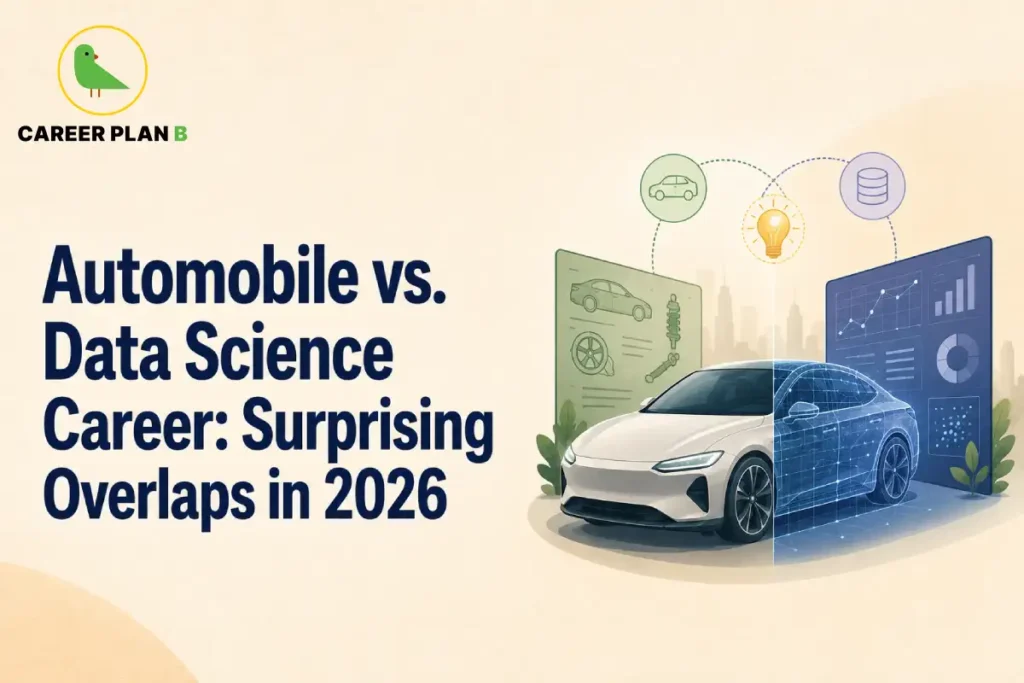
Introduction
If you’re a student trying to decide between an automobile vs. data science career, you’re probably picturing two completely different worlds: one full of engines and gearboxes, the other full of code and algorithms. But here’s the twist: modern cars generate more data than ever before, and the line between these two industries is blurring fast. Today’s vehicles have hundreds of sensors constantly collecting information, and someone needs to make sense of it all. So, which path should you choose, and do you really have to pick just one? Let’s break it down.
What Does an Automobile Engineer Actually Do?
Automobile engineering has traditionally focused on designing, building, and maintaining vehicles everything from engines and transmissions to safety systems and aerodynamics. The automobile engineering career scope in India has expanded well beyond mechanical work. Engineers today work on electric vehicle (EV) systems, hybrid powertrains, emission control, and vehicle safety testing. Core industries hiring automobile engineers include manufacturing, R&D, and after-sales service across major automotive hubs like Pune, Chennai, and Gurugram.
What Does a Data Scientist Actually Do?
Data science, on the other hand, is about extracting insights from large volumes of information. A data science career in India typically involves statistics, programming (mostly Python and R), machine learning and data visualization. Data scientists work across sectors: finance, healthcare, e-commerce, and increasingly, the automotive world. Their job is to find patterns in data that help companies make better decisions, predict outcomes, or automate processes.
Where the Two Fields Are Colliding
Here’s where things get interesting. The data-driven automotive industry is one of the fastest-growing intersections of engineering and technology.
Connected Cars and Data Science
Modern cars are essentially rolling computers. Connected cars and data science go hand in hand. GPS tracking, infotainment systems, and driver behaviour monitoring all generate continuous streams of data that companies use to improve vehicle design and user experience.
Predictive Maintenance and Sensor Analytics
Sensors in engines, brakes, and tyres now predict failures before they happen. This is a growing category of automotive data analytics jobs, where engineers with data skills analyze sensor readings to schedule maintenance proactively, saving costs and preventing breakdowns.
Autonomous Driving and Machine Learning
Self-driving technology relies heavily on machine learning models trained on massive datasets from cameras, radar, and lidar. This is one of the clearest examples of career overlap in engineering fields, where automobile knowledge and data science skills are equally essential.
Electric Vehicles and Battery Data Optimization
EV battery management systems constantly monitor charge cycles, temperature, and degradation. Engineers who understand both automotive systems and data analytics are in high demand to optimize battery life and performance.
For Personalized Guidance
Automobile vs Data Science: Quick Comparison
| Factor | Automobile Engineering | Data Science |
|---|---|---|
| Typical Degree | B.Tech/B.E. in Automobile or Mechanical Engineering | B.Tech/B.Sc. in CS, IT, Statistics, or related field |
| Entry Route | JEE Main/Advanced, state CETs | Same engineering entry, or specialized data science programs |
| Avg. Starting Salary (India) | ₹4-7 LPA | ₹6-10 LPA |
| Top Recruiters | Tata Motors, Mahindra, Bosch, Maruti Suzuki | TCS, Infosys, automotive R&D data teams, tech companies |
| Growth Outlook | Steady, boosted by EV and connected vehicle demand | High demand across nearly every industry |
| Key Skills Needed | Mechanical design, thermodynamics, CAD tools | Python, statistics, machine learning, SQL |
Which Career Should You Choose?
This is often the real question behind which career is better after 12th, and honestly, there’s no one-size-fits-all answer. Ask yourself:
- Do you enjoy working with physical machines and hands-on design, or do you prefer working with numbers and patterns on a screen?
- Are you more comfortable with math and coding, or with mechanics and physics?
- Do you want to work in a hybrid role that blends both, like automotive data analytics?
If you’re drawn to both, that’s actually good news; the automotive industry increasingly needs engineers who understand vehicle systems and can also work with data.
How Career Plan B Helps
Choosing between an automobile vs data science career doesn’t have to be a guessing game. Career Plan B offers personalized career counselling to help you understand where your strengths truly lie. Through Psycheintel and career assessment tests, admission and academic profile guidance, and structured career roadmapping, Career Plan B helps students confidently choose a path or even a hybrid one that fits their interests and future goals.
For Latest Information
Frequently Asked Questions
- Can an automobile engineer switch to a data science career later?
Yes. Many automobile engineers upskill in Python, statistics, and machine learning to move into automotive data roles or broader data science positions.
- Is data science a good fit for someone interested in cars?
Absolutely. Roles in connected vehicles, autonomous driving, and EV battery analytics combine both interests directly.
- Which field has better long-term growth in India?
Both fields are growing, but data science currently has broader demand across industries, while automobile engineering is seeing strong growth specifically due to EV adoption.
- Do I need to choose one over the other right after 12th?
Not necessarily. You can start with either engineering discipline and specialize later, since many colleges now offer electives bridging both fields.
- What entrance exams apply to these careers?
Most students enter through JEE Main/Advanced and state-level engineering entrance exams for undergraduate programmes and GATE for postgraduate studies in either field.
Conclusion
The automobile vs data science career debate isn’t as black and white as it seems. The automotive industry is becoming increasingly data-driven, and professionals who understand both worlds have a real advantage. Whether you lean mechanical or analytical, there’s a growing space where these careers meet. Take the time to explore your strengths, and don’t hesitate to seek guidance; the right career roadmap can make all the difference.