Careerplanb · July 17, 2026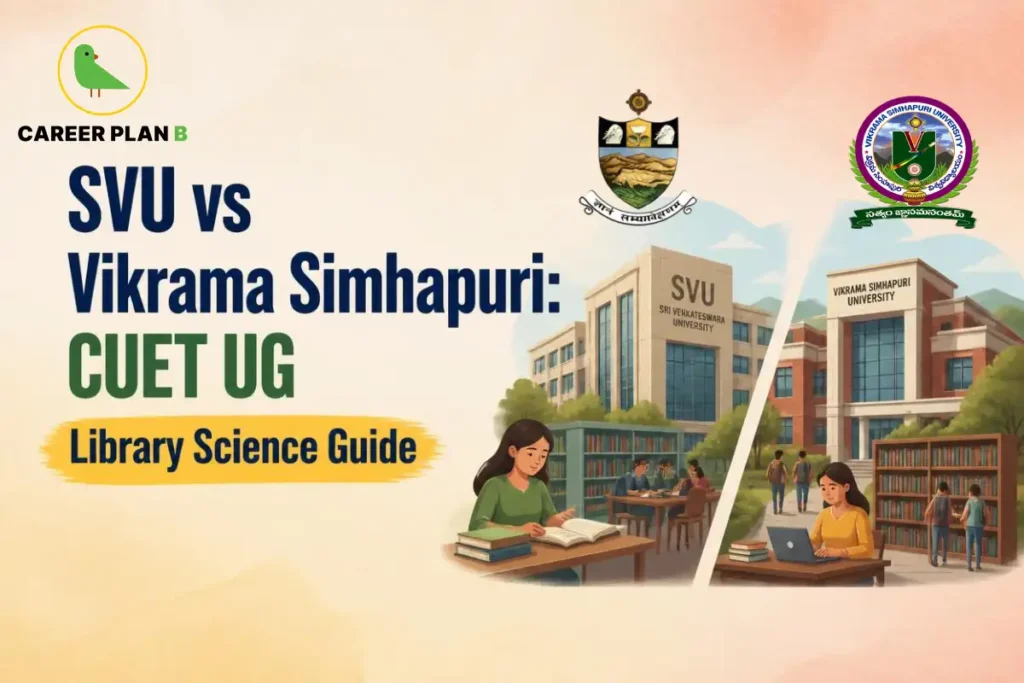
Introduction
Every year, around exam season, a familiar scene plays out in thousands of homes across Andhra Pradesh. A student sits with a laptop open to two browser tabs, one university on each side, and a CUET UG scorecard that suddenly feels heavier than it should. If you’re chasing a career in library and information science, this comparison of CUET UG Library Science options at two well-known universities, Sri Venkateswara University and Vikrama Simhapuri University, might be exactly the conversation you need right now.
This isn’t going to be a dry list of facts thrown at you. It’s the story of two universities with more history between them than most students realise, and what that history means for your CUET UG Library Science journey. By the end, you’ll know which questions to ask, which website to trust, and which path might actually fit your goals.
A Tale of Two Universities That Were Once One
Here’s something most guides won’t tell you upfront. Sri Venkateswara University, based in Tirupati, and Vikrama Simhapuri University, based in Nellore, share roots. Before 2008, colleges across the Nellore region were affiliated with SVU. Then the Andhra Pradesh government carved out a new university for the Nellore district, and Vikrama Simhapuri University was born, taking over 127 colleges that once looked up to SVU for guidance.
Why does this matter to you? Because SVU had decades of head start to build its academic departments, including one in Library and Information Science that goes back further than most of our parents’ college days. VSU, on the other hand, is still a relatively young institution finding its footing. Neither fact makes one university “better” outright, but it shapes what you’ll actually experience on campus.
Where Does SVU Stand in Library Science?
Picture a classroom in 1974, students learning classification systems that librarians still use today. That’s when SVU’s Department of Library and Information Science was officially established, starting with a one year B.L.I.Sc. programme. Over the decades, the department expanded, adding a one year M.L.I.Sc. course in 1985 and eventually a two year integrated M.L.I.Sc. programme in 1996.
Generations of alumni from this department have gone on to work as librarians, information officers, and documentation scientists across government and private institutions. According to the university, students also receive career counselling support and hands on internship opportunities at libraries connected to premier institutions.
If you’re someone who wants a subject with a proven track record, faculty who have supervised decades of research, and a department that has clearly weathered the test of time, this history matters more than it might seem.
What About Vikrama Simhapuri University?
Now here’s where honesty matters more than sales talk. While Vikrama Simhapuri University offers a wide spread of undergraduate and postgraduate programmes and runs its own library facilities on campus, I could not confirm a dedicated, actively running Library and Information Science department listed on its official website at the time of writing.
That doesn’t mean opportunities don’t exist. VSU governs numerous affiliated colleges across the Sri Potti Sreeramulu Nellore district, and some of these colleges may offer library science coursework independently. If this course is something you genuinely want to pursue at or through VSU, the smartest move is to check directly with the university’s admissions office or its official portal before you finalise anything. Don’t take a random blog’s word for it, including this one.
For Personalized Guidance
How Does CUET UG Fit Into All This?
This is the part students often get confused about, so let’s slow down here.
CUET UG (Common University Entrance Test for Undergraduate programmes), conducted by the National Testing Agency, is your entry ticket into most central and several state universities for undergraduate degrees. It tests you across languages, a domain subject, and a general aptitude section.
Here’s the twist that catches many aspirants off guard. Library and Information Science, in the traditional Indian academic system, is usually offered as a professional course you take after completing your bachelor’s degree, not as a standalone undergraduate degree straight after Class 12. So your CUET UG score typically decides which undergraduate college and course (BA, BSc, BCom, and so on) you get into first. The library science specialisation, whether BLISc or the integrated MLISc route, generally comes next, often through the university’s own entrance process or eligibility criteria.
Think of CUET UG as choosing which train station you begin your journey from. The destination, a career in library and information science, is reached later, but the station you pick shapes how smooth that later journey feels.
Comparing SVU and VSU: A Side by Side Look
| Aspect | Sri Venkateswara University (SVU) | Vikrama Simhapuri University (VSU) |
|---|---|---|
| Established | 1954 | 2008 |
| Location | Tirupati, Andhra Pradesh | Nellore, Andhra Pradesh |
| Library Science Department | Established in 1974, offers B.L.I.Sc. and integrated M.L.I.Sc. | No confirmed dedicated department found on the official website; verify with affiliated colleges |
| CUET Consideration | Considers CUET scores for UG and PG admission from 2026 | Admission largely through entrance exams like VSUPGCET for PG courses; confirm CUET UG applicability |
| Accreditation | NAAC A+ grade | NAAC A grade |
| Campus Facilities | Modern library, e-resources, research centres | Central library, hostels, modern classrooms |
Numbers and grades matter, but so does the feel of a place. If you can, try visiting both campuses or speaking with current students before making your final call.
Why Should You Even Consider a Career in Library Science?
You might be wondering if this field is still relevant when everything is going digital. Actually, that’s exactly why it’s growing. Libraries today aren’t just rooms full of books; they are becoming digital knowledge hubs, data management centres, and research support systems. Library and information science professionals today work as digital archivists, metadata specialists, and knowledge managers, not just as the person stamping due dates on a card.
Students who choose this path often find opportunities in:
- Educational institutions and university libraries
- Government archives and public library systems
- Corporate knowledge management teams
- Research organisations and think tanks
- Digital content and documentation roles in IT companies
If organising information, helping people find what they need, and working at the intersection of technology and knowledge sounds appealing, this field deserves a serious look.
Which Factors Should Actually Decide Your Choice?
Instead of picking a university because a friend mentioned it or because it “sounds bigger,” ask yourself these questions.
- Does the university have an active, well-established department for the specific course I want?
- What do current CUET UG requirements say for that university’s programmes this year?
- What is the placement history and alumni network like in this specific field?
- Is the campus location practical for me, considering hostel and travel needs?
- Can I verify all of this directly on the university’s own official website?
That last point is not a small detail. Third party admission blogs, however well meaning, sometimes carry outdated or incorrect information. Always cross check admission details, eligibility, and deadlines on the university’s own site before you apply.
How Career Plan B Helps
Career Plan B helps students compare universities for Library Science through a personalized approach that connects their academic choices with their strengths, interests, and long-term career goals:
- Personalized Career Counselling: Helps students understand their strengths, interests, academic goals, and future aspirations so they can choose the university and Library Science programme that best aligns with their ambitions.
- Psycheintel & Career Assessment Tests: Provides data-backed insights into aptitude, personality traits, interests, and learning styles, helping students identify whether Library Science and related academic pathways best match their natural abilities.
- Admission & Academic Profile Guidance: Supports students in strengthening their academic profile, understanding programme eligibility requirements, and planning strategically for university admissions.
- University & Programme Alignment: Helps students compare universities and Library Science programmes based on curriculum, academic fit, learning environment, career opportunities, eligibility requirements, and long-term goals, ensuring every decision supports their future aspirations.
- Career Roadmapping: Creates a structured, step-by-step plan that connects university selection with skill development, internships, higher education opportunities, and long-term career aspirations in Library and Information Science.
- End-to-End Guidance: Assists students and parents throughout the planning and admission process so every academic decision is informed, intentional, and aligned with the student’s future ambitions.
For Latest Information
Frequently Asked Questions
1. Is CUET UG compulsory for Library Science admission at SVU or VSU?
CUET UG is generally required for undergraduate admission into affiliated colleges of these universities. Since Library Science courses like BLISc often follow after a bachelor’s degree, it’s important to check each university’s current admission notification for exact eligibility.
2. Which university has a stronger reputation for Library Science, SVU or VSU?
Based on available information, SVU has a much longer, well documented history in this specific department, established in 1974, while VSU’s offerings in this exact field are less clearly documented on its official website.
3. Can I pursue Library Science directly after Class 12?
Traditionally, no. Most Library Science programmes in India, including BLISc, require you to first complete a bachelor’s degree in any discipline before applying.
4. What career options open up after a Library Science degree?
Graduates typically find roles as librarians, information officers, documentation officers, digital archivists, and knowledge managers across educational, government, and corporate sectors.
5. How do I confirm the latest CUET UG admission process for these universities?
Always check the official websites, svuniversity.edu.in for SVU and simhapuriuniv.ac.in for Vikrama Simhapuri University, along with the official CUET portal at cuet.nta.nic.in for exam related updates.
Conclusion
Choosing between SVU and Vikrama Simhapuri University for your library science journey isn’t about picking the “correct” answer, because there often isn’t just one. It’s about matching your goals, your comfort with the unknown, and your appetite for a well-trodden path versus a newer one, with what each university genuinely offers today.
Take the time to verify details directly from official sources, talk to people who’ve walked this road before you, and trust that a thoughtful decision now will serve you far better than a rushed one. Your CUET UG score got you to this crossroads. What you do next is entirely up to you, and that’s a good thing.