Team Career Plan B · July 20, 2026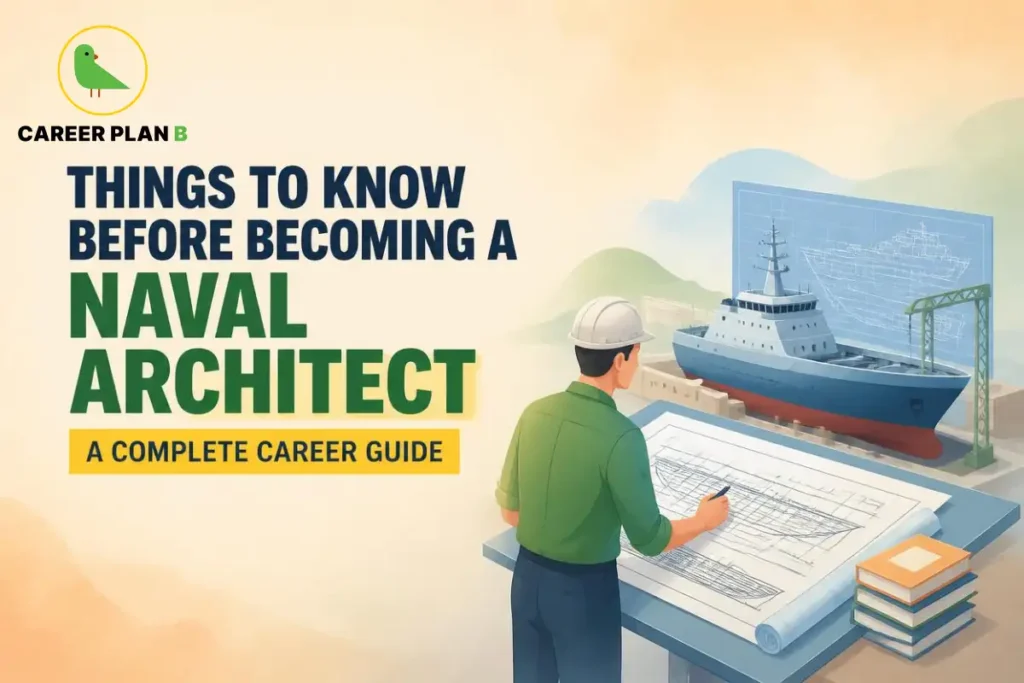
Introduction
Long before a ship’s engine ever fires up, someone has already spent months figuring out its shape, its balance, and whether it will actually float the way it’s supposed to. That’s the work of a naval architect, and it’s exactly why understanding the things to know before becoming a naval architect matters so much before you commit years of study to this field. This career gets confused with marine engineering more often than it should, given how different the two actually are day to day. This blog walks through what a naval architect really does, how this role differs from marine engineering, what you need to study to get there, the skills the job demands, whether the pay justifies the effort, and what the lifestyle genuinely looks like once you’re working.
What Does a Naval Architect Actually Do?
A naval architect’s job starts long before a ship is built; it starts with a design. They’re responsible for the hull shape, stability calculations, structural strength, and hydrodynamics that determine how a vessel will behave in water. Every curve of a ship’s hull is a deliberate engineering decision meant to balance speed, fuel efficiency, cargo capacity, and safety. This work involves extensive use of design software, mathematical modelling, and simulation to predict how a ship will perform before a single piece of steel is cut. It’s less about fixing machinery and more about solving complex structural and physics-based problems on paper and screen, long before the vessel touches water.
Naval Architect vs Marine Engineer: What’s the Real Difference?
This is where most confusion happens, and it’s worth clearing up directly. A naval architect vs marine engineer comparison really comes down to design versus operation. Naval architects design the ship’s shape, structure, and stability. Marine engineers keep the ship running once it’s built, including the engines, propulsion, and onboard systems. Think of it like the difference between an architect who designs a building and the engineers who install and maintain its electrical and plumbing systems. Both are essential, but their day-to-day work, skill sets, and even career paths look quite different once you dig into them.
What Should You Study, and What’s the Eligibility?
To pursue this path, a strong foundation in physics and mathematics at the higher secondary level is essential, since the core coursework leans heavily on structural mechanics, hydrodynamics, and applied physics. In India, the Indian Maritime University, a central university under the Ministry of Ports, Shipping and Waterways, offers dedicated programmes in naval architecture and ocean engineering, including postgraduate and doctoral study at its Visakhapatnam campus. Entrance typically involves competitive exams similar to those for other engineering disciplines, so building strong fundamentals early matters more than chasing shortcuts. This is a genuinely research-heavy field, and the naval architecture eligibility requirements reflect that from the start.
What Skills Does This Career Actually Demand?
Beyond formal coursework, a few specific skills tend to separate students who thrive in this field from those who struggle:
- Proficiency in CAD and specialized naval design software
- Strong grasp of physics fundamentals, especially fluid mechanics and structural analysis
- Attention to detail, since small calculation errors can affect a ship’s stability
- Comfort with mathematical modeling and simulation tools
- Patience for iterative design work, since ship designs go through many revisions
These aren’t optional extras; they’re the actual daily toolkit of a working naval architect.
Is the Pay and Job Scope Worth It?
It’s a fair question, especially given how specialized this field is. Naval architect salary ranges tend to be solid, particularly for those working with major shipyards, classification societies, or specialized design consultancies. Since relatively few people pursue this specific specialization compared to broader engineering fields, demand often outpaces supply for genuinely skilled naval architects. Career scope extends across commercial shipbuilding, defense shipyards, offshore engineering firms, and classification societies that certify vessel safety and design standards. For anyone serious about a career in ship design, this relatively niche field tends to offer more specialized, less crowded career paths than some broader engineering branches.
Have Any Doubts?
What’s the Lifestyle Really Like?
Here’s a common misconception worth correcting early: naval architects generally don’t spend months at sea the way marine engineers do. Most of the work happens in design offices, shipyards, or research facilities, with occasional site visits during construction phases. It’s a far more land-based, office-orientated career than people often assume when they hear “ship” and “sea” in the same sentence. This makes it an appealing option for students who want to work in the maritime industry without the extended time away from home that comes with sailing careers, while still engaging deeply with ships and marine engineering principles.
How Career Plan B Helps
Are you weighing whether naval architecture and ocean engineering genuinely fit your strengths? Career Plan B offers personalized career counselling and PsycheIntel assessment tests to help you understand if this design-focused, detail-driven field suits you, along with admission guidance and career roadmapping tailored to specialized engineering paths like this one.
For Latest Information
Frequently Asked Questions
- Is naval architecture the same as marine engineering?
No. Naval architects design a ship’s hull shape, stability, and structure, while marine engineers maintain and operate the systems that keep a built ship running.
- Do naval architects need to know how to swim or work at sea?
Not typically. Most naval architecture work happens in design offices and shipyards rather than onboard vessels at sea.
- What subjects matter most for this career?
Physics and mathematics are essential, since the coursework heavily involves structural mechanics, hydrodynamics, and applied engineering principles.
- Is this a good career choice compared to more common engineering branches?
It’s a specialized, less crowded field with strong demand relative to supply, making it a solid option for students genuinely interested in ship design rather than general engineering.
- Where do naval architects typically work after graduating?
Common employers include shipyards, classification societies, offshore engineering firms, and specialized ship design consultancies.
Conclusion
Naval architecture asks for genuine dedication to physics, design software, and iterative problem-solving, but it rewards that effort with a specialized, land-based career deeply tied to the maritime world. Understanding the real difference between designing ships and operating them is the first step to knowing if this path is actually right for you. If detailed design work and structural problem-solving genuinely excite you more than hands-on machinery, this naval architecture course in India could be exactly the direction worth exploring further.