Team Career Plan B · July 20, 2026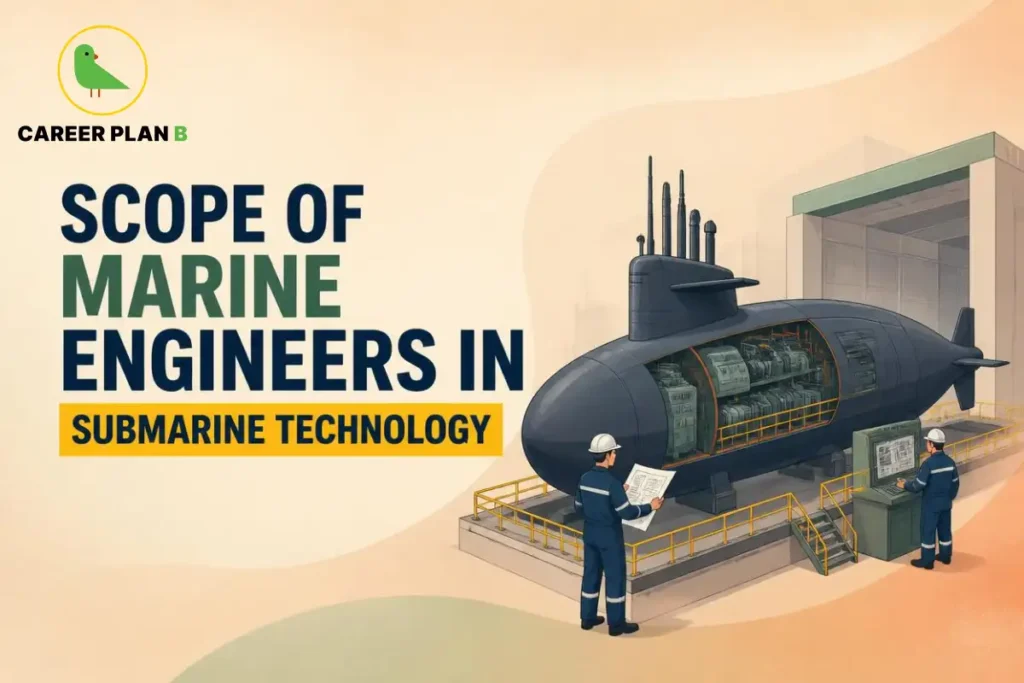
Introduction
A submarine has to do something no other vessel attempts: survive crushing water pressure, remain undetected for weeks, and keep an entire crew alive without surfacing. This is exactly why the scope of Marine Engineers in Submarines technology stands apart from almost every other branch of maritime engineering, since nothing about a submarine’s engineering can afford to be ordinary. With India actively expanding its submarine fleet through major indigenous manufacturing programmes, this specialized field is opening up in ways it hasn’t for decades. This blog explains what makes submarine engineering so different from standard ship engineering, what marine engineers actually do in submarine design and operation, where India’s indigenous submarine programme currently stands, what skill set this specialization apart, and whether it holds up as a genuine long-term career path.
Why Is Submarine Engineering So Different from Ship Engineering?
A surface ship deals with waves and weather. A submarine deals with immense water pressure at depth, the complete absence of natural light or air, and the need to remain hidden from detection systems designed specifically to find it. This changes almost every engineering assumption that applies to standard shipbuilding. Submarines rely on pressure hulls engineered to withstand depths that would crush an ordinary vessel, along with closed-loop life-support systems that generate breathable air and manage waste without any external exchange for extended periods. Every system on board also needs extraordinarily high reliability, since there’s no possibility of pulling into port if something fails mid-mission. This is what makes underwater vessel engineering one of the most demanding disciplines within the broader maritime field.
What Role Do Marine Engineers Play in Submarine Design and Operation?
Marine engineers working on submarines handle propulsion systems that differ significantly from those on surface ships, including diesel-electric systems paired with air-independent propulsion technology that allows a submarine to stay submerged far longer without surfacing to recharge batteries. They’re also responsible for onboard air and water management systems, power distribution for weapons and sensors, and continuous system maintenance under conditions where even minor errors carry serious consequences. This is precision engineering under some of the highest stakes in the entire maritime field. A marine engineer in submarine design roles needs to think through failure scenarios far more rigorously than in commercial shipbuilding, since a malfunction at depth doesn’t offer the same margin for correction that a surface vessel would.
India’s Push Toward Indigenous Submarine Development
India has been steadily building toward self-reliance in submarine manufacturing. According to the Ministry of Defence, Project 75, which delivered six Kalvari-class submarines built with French collaboration, saw its final vessel, INS Vagsheer, commissioned in January 2025, marking the completion of that programme’s first phase. The Ministry has also been advancing Project 75(I), a follow-on initiative launched through an official request for proposal in 2021, aimed at indigenously constructing six next-generation submarines fitted with fuel-cell-based air-independent propulsion systems, advanced sensors, and modern weaponry, with indigenous content mandated to rise progressively across the six vessels. This kind of sustained, multi-decade investment reflects exactly why a indigenous submarine programme at this scale creates such consistent demand for skilled marine engineers within India’s defense manufacturing ecosystem.
Skills That Set Submarine Engineers Apart
Given how specialized this work is, a distinct skill set tends to separate engineers suited for submarine technology from those working in more conventional marine roles:
- Deep understanding of pressure hull design and structural integrity under extreme depth conditions
- Expertise in closed-loop life-support and air management systems
- Familiarity with air-independent propulsion and advanced battery or fuel-cell technology
- Willingness to undergo rigorous security clearance given the sensitive nature of defense projects
- Extremely high attention to detail, since system failures at depth carry far greater risk than on surface vessels
These requirements go well beyond standard marine engineering training, which is part of why this niche remains so specialized and, for the right candidate, so valuable.
Have Any Doubts?
Is This a Viable Long-Term Career Path?
Given how sustained India’s investment in submarine manufacturing has been across multiple decades and successive programmes, this looks less like a short-term opportunity and more like a durable, structurally supported career path. The Ministry of Defence‘s broader push toward self-reliance in defense manufacturing continues to prioritize submarine construction specifically, given the strategic importance of underwater capability in regional maritime security. For engineers with the right specialization, submarine engineering careers offer a rare combination: genuinely cutting-edge technical work, strong government backing, and comparatively little competition given how few people pursue this specific niche within marine engineering.
How Career Plan B Helps
Submarine engineering is one of the most specialized and least understood branches within marine engineering, and most students have no clear sense of what it actually takes to enter this field or whether their strengths genuinely align with such demanding, high-precision work. Career Plan B offers personalized career counselling and PsycheIntel career assessment tests specifically designed to help you evaluate whether this intense, detail-driven specialization suits your temperament before you commit years of study toward it. Their academic profile guidance and career roadmapping services can also help you understand the specific coursework, certifications, and entry points that lead toward naval submarine careers, so you’re building the right foundation from the very beginning rather than discovering gaps later in your education.
For Latest Information
Frequently Asked Questions
- Is submarine engineering a separate degree or a specialization within marine engineering?
It’s generally a specialization built on a marine or naval architecture foundation, often developed further through defense sector training and on-the-job experience.
- Do I need security clearance to work in submarine technology?
Yes, most roles in this field involve sensitive defense projects and require thorough security clearance and background verification.
- Is this field only available through government or navy jobs?
Most opportunities exist through public sector shipyards and defense contractors working on government submarine programmes, alongside direct technical roles within the Navy.
- Is India’s submarine programme actually expanding or winding down?
It’s expanding. Government sources confirm continued investment through successive programmes aimed at building indigenous submarine manufacturing capacity over the coming decade.
- What makes submarine engineering harder than standard marine engineering?
The extreme demands of pressure, life support, and system reliability at depth make submarine engineering considerably more technically demanding than standard surface vessel engineering.
Conclusion
Submarine engineering asks more of a marine engineer than almost any other specialization in the field, from mastering pressure hull design to managing life-support systems where there’s no room for error. With India’s sustained investment in indigenous submarine manufacturing through successive government programmes, this niche offers genuine long-term career scope rather than a passing opportunity. For students drawn to high-stakes, precision-driven engineering work, this is a field worth taking seriously early. The engineers who build the specialized expertise this work demands now are likely to find themselves at the centre of India’s underwater defense capability for years to come.