Team6 · August 12, 2026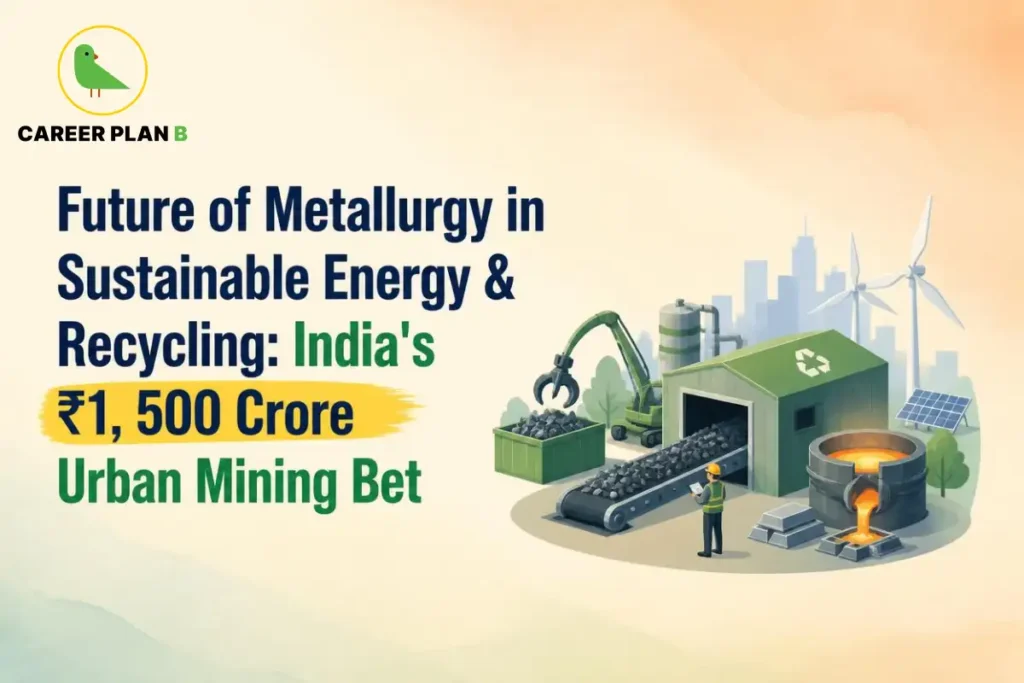
Introduction
Against a modest target of 270 kilotonnes of annual recycling capacity, India’s Critical Mineral Recycling scheme has already attracted industry commitments totalling 850 kilotonnes, with 58 companies formally approved to participate by April 2026. This gap between target and actual industry interest sits right at the heart of understanding the future of metallurgy in sustainable energy & recycling, a shift most engineering students haven’t fully registered yet. Many students still associate metallurgy purely with traditional steel-making and mining, completely missing how central this branch has become to renewable energy supply chains and India’s emerging circular economy. This blog explains, in genuine depth, why this shift is happening, exactly where metallurgists fit into it, and what it means for your career.
Why Sustainable Energy in India Now Depends on Metallurgical Expertise
The Scale of India’s Critical Minerals Problem
To understand why metallurgy matters so much here, it helps to confront India’s raw material dependency honestly. India currently has effectively zero domestic lithium refining capacity, while China refines roughly 74 per cent of global lithium, 35 per cent of nickel, and 80 per cent of cobalt worldwide. This isn’t a minor supply chain inconvenience; it’s a structural vulnerability sitting underneath every solar panel, EV battery, and wind turbine India hopes to manufacture domestically. Consequently, closing this gap depends fundamentally on metallurgical expertise capable of extracting, refining, and processing these materials, whether from virgin ore or, increasingly, from recycled sources.
Why Urban Mining Is Becoming a National Priority
This is precisely why the government has moved so decisively on recycling policy. According to the Press Information Bureau, the Ministry of Mines approved 58 companies as eligible participants under the Critical Mineral Recycling Incentive Scheme by April 2026, with a total outlay of ₹1,500 crore under the broader National Critical Mineral Mission. This scheme specifically targets recovery from e-waste, spent lithium-ion batteries, catalytic converters, and industrial scrap, formally recognizing what the industry calls ‘urban mining’ as a legitimate, incentivized pathway to mineral security. Therefore, National Critical Mineral Mission funding isn’t confined to traditional mining exploration; a meaningful share is now flowing directly into recovery and refining infrastructure that depends on metallurgical science.
Where Metallurgists Fit Into the Circular Economy
Recovering Metals From E-Waste and Spent Batteries
Metallurgists working in this space handle the actual technical process of recovering valuable metals from discarded electronics and batteries, using techniques like hydrometallurgy and pyrometallurgy to extract lithium, cobalt, nickel, and rare earth elements from what would otherwise be waste. This work matters enormously given how little of India’s e-waste currently gets processed formally, with collection rates for e-waste sitting around just 10 per cent and under 5 per cent for batteries, according to TERI’s research on this sector. Consequently, enormous quantities of recoverable metal currently leak into informal, often unsafe, processing channels instead of returning to India’s supply chain through proper urban mining India infrastructure.
Why This Work Requires Genuine Metallurgical Skill, Not Just Waste Sorting
It’s worth being clear that this isn’t simple waste sorting; NITI Aayog’s own analysis of a 10,000-tonne battery recycling plant shows that effective mineral recovery depends heavily on battery chemistry, metal content, and recovery efficiency, variables that require genuine metallurgical understanding to optimize. Extracting usable, battery-grade lithium or cobalt from a mixed waste stream is a considerably more technically demanding process than simply separating metal from plastic, which is exactly why this space needs trained metallurgists rather than purely mechanical sorting operations.
Is This Genuinely a Growing Career Path or Still Early-Stage?
Is this a real, stable career direction or still too experimental to bet a career on? The evidence points toward genuine, accelerating momentum. Industry commitments already stand at more than three times the government’s original recycling capacity target, and officials have publicly expressed confidence that India could become Asia’s leading hub for critical mineral recycling by 2030. However, honesty matters here too: much of India’s current recycling activity still runs through the informal sector, using inefficient methods that pose health hazards to workers, meaning the formal, technically rigorous side of this industry is still actively being built out right now rather than fully mature. This actually works in favour of engineering students entering the field today, since genuine expertise remains comparatively scarce relative to where this sector is heading.
Renewable Energy’s Own Metallurgical Demands
Beyond recycling specifically, renewable energy technology itself creates substantial metallurgical demand. Solar panels, wind turbines, and battery storage systems all depend on specialized metals and alloys, and as these systems reach end-of-life, someone needs to handle their decommissioning and material recovery responsibly. A circular economy approach specifically targeting these end-of-life renewable energy systems could reduce India’s demand for newly mined primary minerals by roughly 18 per cent by 2030, according to WRI India’s research, underscoring just how much metallurgical scope in renewable energy now extends beyond simply building new equipment into managing its entire lifecycle.
Skills Metallurgists Need for This Emerging Space
Hydrometallurgy and Pyrometallurgy for Secondary Recovery
Succeeding in this field increasingly requires deep familiarity with extraction techniques suited specifically to secondary, recycled feedstock rather than virgin ore alone. Hydrometallurgical processes, which use aqueous chemistry to dissolve and recover metals, and pyrometallurgical processes, which use high-temperature smelting, each suit different waste streams and battery chemistries, meaning genuinely skilled metallurgists need working knowledge of both approaches.
Understanding Extended Producer Responsibility and Compliance
Beyond pure technical extraction skills, this space increasingly requires understanding regulatory frameworks like the E-Waste Management Rules and Battery Waste Management Rules, both of which establish Extended Producer Responsibility obligations that shape how materials flow through India’s recycling ecosystem. Metallurgists who understand this compliance landscape alongside their technical extraction skills are considerably better positioned within circular economy careers India-wide than those with purely technical training alone.
Have Any Doubts?
Career Roles and Growth Path
| Career Stage | Typical Role | Where You Might Work |
|---|---|---|
| Entry-Level | Junior Metallurgist (Recycling) | Approved recyclers under NCMM incentive scheme |
| Mid-Level | Process Engineer / Extraction Specialist | Battery recycling plants, critical mineral processing parks |
| Senior-Level | Recycling Operations Lead / R&D Manager | Large recyclers, government-backed processing hubs |
Given that 58 companies have already been approved under this scheme with a pledged investment of roughly ₹5,000 crore and given India’s stated ambition to become a global recycling hub by 2030, professionals who build genuine sustainable metallurgy career expertise now are positioned for strong, sustained demand as this formal sector continues scaling.
How Career Plan B Helps
Career Plan B helps students make informed career decisions in emerging engineering fields through personalized guidance, assessments, and structured career planning. Choosing a specialization like sustainable metallurgy, critical mineral recycling, or renewable energy materials requires understanding your interests, technical strengths, and long-term career goals.
Personalized Career Counselling: Provides expert guidance to help students explore opportunities in metallurgical engineering, battery recycling, critical minerals, renewable energy materials, and circular economy industries based on their skills and career aspirations.
Psychometric & Career Assessment Tests: Helps identify individual strengths, personality traits, technical interests, and suitable career paths in areas such as metallurgy, materials science, sustainable manufacturing, research, and advanced energy technologies.
Career Roadmapping: Creates a step-by-step career plan covering degree selection, specialization options, skill development, internships, certifications, higher education, and industry opportunities in sustainable metallurgy and critical mineral technologies.
Admission & Academic Profile Guidance: Helps students choose the right engineering courses, colleges, and specialization paths while improving their academic profile for careers in emerging fields like battery recycling, urban mining, renewable energy materials, and circular economy solutions.
Get In Touch With Us
Frequently Asked Questions
Q1. Is critical mineral recycling a genuine career path for metallurgists in India?
Yes, backed by ₹1,500 crore in government incentives and 58 already-approved companies, this represents a genuinely growing, policy-supported career direction.
Q2. What’s the difference between traditional metallurgy and urban mining?
Traditional metallurgy extracts metals from virgin ore, while urban mining recovers metals from secondary sources like e-waste and spent batteries, requiring somewhat different technical approaches.
Q3. Which companies are hiring for recycling-focused metallurgical roles?
The 58 companies approved under the Critical Mineral Recycling Incentive Scheme, spanning battery recycling and e-waste processing, represent the current core of this hiring landscape.
Q4. Does renewable energy actually need metallurgists, or just electrical engineers?
Yes, metallurgists play a genuine role in both manufacturing renewable energy components and managing end-of-life material recovery from decommissioned systems.
Q5. Is this a stable, long-term career bet?
Yes, particularly given the National Critical Mineral Mission’s multi-year timeline through FY 2030-31 and India’s stated ambition to become a global recycling hub by 2030.
Conclusion
Understanding the Future of Metallurgy in Sustainable Energy & Recycling makes it clear that this branch is expanding well beyond its traditional steel and mining roots into a genuinely strategic role within India’s clean energy and circular economy ambitions. As the National Critical Mineral Mission continues scaling recycling capacity and renewable energy systems begin reaching end-of-life in greater numbers, metallurgists who build expertise in secondary recovery and regulatory compliance are positioned to play a central role in this transformation. This represents a real opportunity for engineering students who want their technical training to align directly with one of India’s most urgent, currently underserved industrial priorities.
If you’d like help figuring out how to position yourself for this specific, emerging career direction, a conversation with a Career Plan B counsellor can help you plan the right path forward.