Team5 · July 31, 2026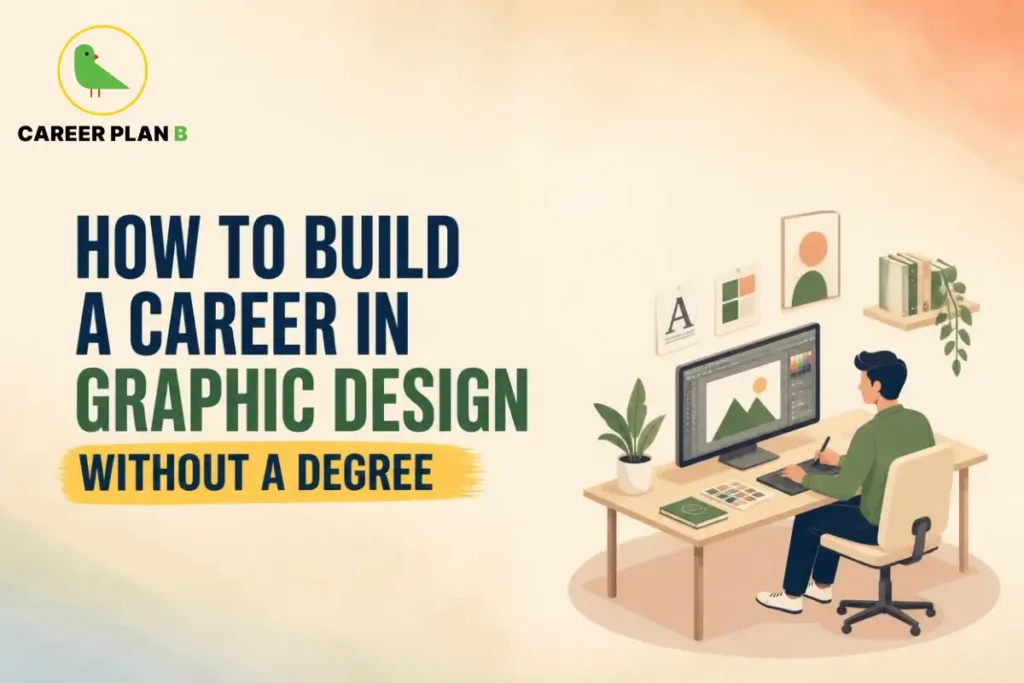
Introduction
A graphic design career without a degree sounds risky to most parents and even some students. The field genuinely runs on a different logic than most other careers, though. Employers and clients evaluate your actual work first, not your degree certificate.
That doesn’t mean a degree has no value. It means the degree isn’t the only route in. For many designers, it isn’t even the fastest one. This guide covers how to build a real graphic design career without a degree, step by step. It walks through portfolio building, credible certifications, and genuine client work.
Why Graphic Design Rewards Skill Over Credentials
Design differs from fields like medicine or law, where you need a formal degree to practise. Nobody checks your degree before hiring you to design a logo or a social media campaign.
This is exactly why a graphic design career without a degree works. Clients and employers evaluate a portfolio directly. It shows your actual capability far more clearly than a transcript ever could. A designer with three strong, well-explained projects consistently beats a designer with a degree and no visible work.
Step One: Build Genuine Visual Communication Fundamentals
Before touching software, spend real time on the fundamentals: typography, colour theory, layout principles, and visual hierarchy. Skipping this step is the most common mistake among self-taught designers.
SWAYAM offers free, credit-eligible courses in Visual Arts and Communication Design. It’s India’s national online education platform under the Ministry of Education. Faculty from premier institutions deliver these courses, and they cost nothing to audit. This makes SWAYAM a genuinely strong starting point for a graphic design career without a degree.
Step Two: Learn the Core Design Tools Properly
Once your fundamentals are solid, move to industry-standard tools like Adobe Illustrator, Photoshop, and Figma. Learn these tools through structured practice, not passive tutorial-watching alone.
Set yourself small, real briefs instead of generic tutorial exercises. Design a poster for a fictional event. Build a logo concept for a made-up brand. Or recreate an existing design to understand its structure. This active practice builds far more usable skill than simply following a video.
Step Three: Add Government-Recognised Certifications
A graphic design career without a degree benefits significantly from formal, verifiable certifications. This holds true even without a full academic qualification behind them.
NIELIT, the National Institute of Electronics and Information Technology, is a Government of India autonomous body. It offers certifications in Digital Photography, Multimedia and Web Design, and related digital creative fields. These carry real weight for government and PSU-adjacent design work. A formal credential matters more there than in purely private, portfolio-driven hiring.
NSDC and PMKVY under Skill India also offer free and subsidised skill certifications. These cover Media and Entertainment sector skills, including graphic design and digital content creation. Empanelled training centres across India deliver these programs.
Step Four: Build a Portfolio That Actually Gets You Hired
Your portfolio matters more than every other step combined. Include only your three to five strongest pieces, not everything you’ve ever made. Add a short note next to each piece explaining the problem it solved.
Take on real, if small, projects early. Design social media graphics for a local business. Create a poster for a college event. Or offer a free logo redesign to a friend’s small venture. Document your process, not just your final output. Many clients and employers want to understand how you think, not only what you produced.
Step Five: Start Freelancing to Build Real Client Experience
Freelancing is where a graphic design career without a degree genuinely takes shape. It gives you real client feedback and a growing portfolio of paid, professional work.
Once your freelance income grows meaningfully, consider formalising it through Udyam Registration. The Ministry of Micro, Small and Medium Enterprises maintains this system. This free, single-page process gives you access to government tenders and collateral-free loans. It also gives you formal recognition as a registered business, useful once your design work grows beyond occasional small projects.
Building Your Skills, Step by Step
| Stage | What to Focus On | Where to Learn It |
|---|---|---|
| Fundamentals | Typography, colour theory, layout, visual hierarchy | SWAYAM courses in Visual Arts and Communication Design |
| Tools | Adobe Illustrator, Photoshop, Figma | Structured practice with real, self-set briefs |
| Certification | Government-recognised design credentials | NIELIT, NSDC, and PMKVY under Skill India |
| Portfolio | 3-5 strong, well-explained projects | Self-initiated work plus small real client projects |
| Client experience | Freelance work, formalised once it grows | Freelance platforms, later Udyam Registration |
What Employers and Clients Actually Look For
Without a degree, you need to work slightly harder to signal credibility upfront. That said, the signals themselves are straightforward. A well-organised portfolio with clear explanations matters most.
Genuine client testimonials or referrals matter almost as much. They show someone else already trusted your work. A relevant certification adds a layer of formal verification too, even a short one. This matters particularly for larger companies or government-adjacent roles.
For Personalized Guidance
Common Mistakes to Avoid
Many self-taught designers skip fundamentals and jump straight into tools. This produces technically competent but visually weak work. Others overload their portfolio with too many mediocre projects instead of a few genuinely strong ones.
A third common mistake is avoiding client work out of fear. Some designers stay in “practice mode” indefinitely instead of testing real feedback. A graphic design career without a degree only becomes real once actual clients or employers engage with your work.
How Career Plan B Helps
Building a graphic design career without a degree still benefits from a clear, structured plan. Career Plan B helps you build that plan through:
- Personalized Career Counselling to map your creative strengths honestly.
- PsycheIntel Career Assessment Tests to confirm design genuinely fits your aptitude.
- Career Roadmapping to sequence your skills, certifications, and portfolio building.
- Admission & Academic Profile Guidance if you later choose to add formal design education.
For Latest Information
Frequently Asked Questions
1. Can I really get hired as a graphic designer without any degree in India?
Yes, particularly in freelance, agency, and startup settings where portfolio quality matters more than credentials. Larger corporate or government-adjacent roles may still prefer a formal design qualification alongside your portfolio.
2. How long does it take to build a graphic design career without a degree?
Most self-taught designers need six months to a year of consistent practice. This includes fundamentals, tool practice, and small projects, before their portfolio is strong enough for paid client work. Progress depends heavily on consistency.
3. Are NIELIT design certifications worth doing if I’m self-taught?
Yes, especially if you’re targeting government, PSU, or larger corporate design roles. They add formal, verifiable proof of your technical skill alongside your self-built portfolio.
4. Should I do a short course instead of skipping design education entirely?
A short, focused course often works well alongside self-teaching, whether through SWAYAM, NIELIT, or a private platform. It’s not the same as a full degree. It does add structure and formal recognition without years of commitment.
Conclusion
A graphic design career without a degree is genuinely achievable, but it demands real discipline. Start with solid fundamentals, then move to deliberate tool practice. Add a few credible certifications, build a strong portfolio, and take on actual client work to prove it all out.
Start with free resources like SWAYAM for fundamentals. Add a NIELIT or NSDC certification for formal credibility. Then let your portfolio do the heavy lifting from there.
Ready to build your graphic design career without a degree, but not sure where to start? Structured career counselling at Career Plan B can help you plan the right sequence for your specific goals.