Careerplanb · July 23, 2026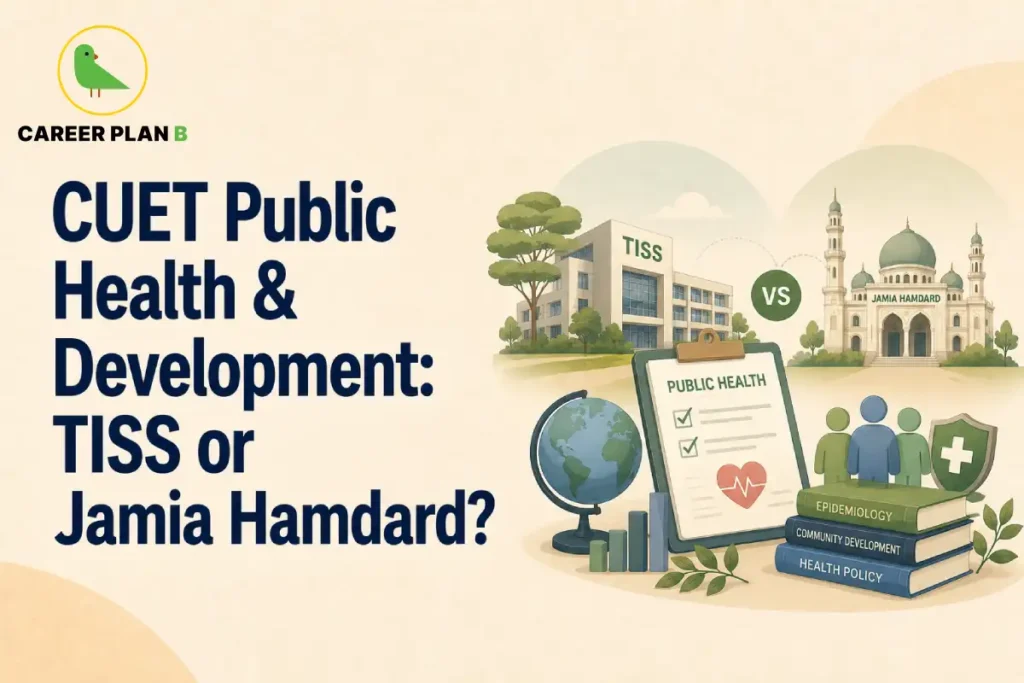
Introduction
Priya had two tabs open on her laptop and neither of them was closing anytime soon. One said Tata Institute of Social Sciences. The other said Jamia Hamdard. Her CUET score had done its job, but now came the harder part, the part no exam prepares you for: choosing where to actually spend the next two years of your life.
If you’re reading this after scoring well in your entrance test, you already know that CUET Public Health and Development Studies has quietly become one of the most sought after combinations for students who want to build a career around health, equity, and real world impact. This blog walks you through both institutes honestly, so you don’t have to guess your way through it like Priya did at 1am with too many browser tabs open.
Why Public Health Is Suddenly Everyone’s Favourite Career Conversation
Ask any student today why they’re drawn to public health and you’ll hear some version of the same story. The last few years changed how young India thinks about health systems, government policy, and community wellbeing. It’s no longer just a “doctor or nothing” conversation. Public health sits at the crossroads of medicine, sociology, policy, and grassroots work, and that mix is exactly what’s pulling in students who want more than a desk job.
But here’s a question worth sitting with: do you want to work inside health systems, shaping policy and administration, or do you want to work with communities, understanding health through the lens of development and social justice? Your answer to that quietly decides a lot about which institute suits you.
For Personalized Guidance
What CUET Public Health and Development Studies Actually Means for You
CUET PG has simplified something that used to be messy. A few years back, institutes ran separate entrance exams, and students juggled multiple applications, multiple fees, multiple stress cycles. Now, CUET Public Health and Development Studies programmes can be accessed largely through one common test, which means your preparation effort now opens more doors at once.
That’s good news. It also means more competition, since a single score is now your gateway to some of the country’s most respected institutes. So the real decision making starts after your result, not before it.
TISS: The Institute That Built India’s Development Studies Legacy
Tata Institute of Social Sciences doesn’t need much of an introduction if you’ve spent time researching development studies in India. Founded in 1936, it’s often credited as one of Asia’s oldest institutions for professional social work education, and its influence on India’s social sector runs deep.
What TISS Actually Offers
TISS runs several programmes relevant to public health and development, and it helps to know the difference before you apply.
- MA in Social Work (Public Health), which trains students to work with vulnerable and underserved communities through a rights based approach, blending epidemiology, research, and health advocacy.
- Master of Public Health programmes, including specialisations like Health Administration and Health Policy, Economics and Finance, both structured as two year, research heavy courses with a field practicum built in.
- MA in Development Studies, which leans more into policy, governance, and the wider social and economic forces that shape development outcomes.
You can check programme details directly on the official TISS admissions portal at admissions.tiss.ac.in, where eligibility, CUET PG paper codes, and application timelines are updated regularly.
What Makes TISS Classrooms Different
TISS students will tell you the same thing in almost the same words: the fieldwork changes you. The institute’s Centre for Population, Health and Development, under its School of Development Studies, actively works on demographic research, reproductive health, and tribal health and development, giving students access to real ongoing research rather than just textbook theory.
If you’re someone who wants to sit with communities, understand lived realities, and think in terms of policy and justice, TISS speaks your language.
Jamia Hamdard: Where Medicine Meets Public Health
Jamia Hamdard takes a noticeably different route to public health. Instead of approaching it through social work and development, it approaches public health through its medical sciences backbone, primarily via the Hamdard Institute of Medical Sciences and Research, known as HIMSR.
The MPH Route Through HIMSR
The Master of Public Health at Jamia Hamdard is run by the Department of Community Medicine at HIMSR, and it’s recognised by the UGC. It’s built around the idea that public health professionals need a strong grounding in epidemiology, biostatistics, and health systems, much like their medical counterparts.
You can find the current admission process, eligibility, and application windows on the official Jamia Hamdard website at jamiahamdard.ac.in, and specific MPH course details on the HIMSR page dedicated to the Masters in Public Health programme.
Who Actually Thrives Here
If your background or interest leans toward the sciences, clinical exposure, or hospital and health system administration, Jamia Hamdard’s structure will feel familiar and comfortable. Many students here come from medicine, allied health sciences, or biology backgrounds, and the programme reflects that orientation throughout.
TISS or Jamia Hamdard? A Side by Side Look
Sometimes a table says what three paragraphs can’t.
| Factor | TISS | Jamia Hamdard |
|---|---|---|
| Core Approach | Social work, public policy, and development-focused approach | Medical and clinical public health approach |
| Best Suited For | Students interested in community work, policy, and social justice | Students with a science or medical background |
| Programme Style | Fieldwork-intensive and research-driven | Clinically grounded with a strong focus on epidemiology |
| Career Direction | NGOs, policy think tanks, and government health systems | Hospital administration, community medicine, and health services |
| Campus Culture | Strong social sciences identity with an activism-rooted culture | Medical institute environment with structured clinical training |
So, Which One Should You Actually Pick?
There’s no universally right answer here, only the right answer for you. Ask yourself honestly: do you get more excited reading about health policy reform, or about how disease patterns spread through a population? Do you see yourself in a village panchayat meeting discussing maternal health, or in a hospital administration office reviewing patient data systems?
Neither path is better. They simply lead to different versions of a public health career, and knowing your own inclination now will save you a lot of second guessing later.
How Career Plan B Helps
Career Plan B helps students choose the right Public Health programme through a personalized approach that connects their academic choices with their strengths, interests, and long-term career goals:
- Personalized Career Counselling: Helps students understand their strengths, interests, academic goals, and future aspirations so they can choose the university and Public Health programme that best aligns with their ambitions.
- Psycheintel & Career Assessment Tests: Provides data-backed insights into aptitude, personality traits, interests, and learning styles, helping students identify whether Public Health and related healthcare fields best match their natural abilities.
- Admission & Academic Profile Guidance: Supports students in strengthening their academic profile, understanding programme eligibility requirements, interpreting their academic profile and entrance performance, and planning strategically for university admissions.
- Career Roadmapping: Creates a structured, step-by-step plan that connects university selection with skill development, internships, research experience, higher education opportunities, and long-term career aspirations in public health, epidemiology, health policy, healthcare management, and related fields.
For Latest Information
Frequently Asked Questions
1. Is CUET PG compulsory for admission into TISS and Jamia Hamdard public health programmes?
For most postgraduate programmes at TISS, yes, CUET PG scores are now the primary basis for admission. At Jamia Hamdard, requirements vary by course, so it’s worth checking the specific programme page before assuming.
2. Can a non-medical student apply for Jamia Hamdard’s MPH?
Yes, though preference is often given to candidates from medical, allied health, or related science backgrounds. Non-medical students with strong relevant coursework can still be eligible, depending on the year’s criteria.
3. Which institute is better for a career in health policy?
TISS generally has stronger positioning here, given its long standing focus on development studies, governance, and policy research.
4. Does TISS only accept social work background students?
No. TISS programmes welcome students from varied academic backgrounds, though a genuine interest in social issues and community work definitely helps you settle in faster.
5. How different are the fieldwork expectations between the two institutes?
TISS places heavy emphasis on community fieldwork and practicum as a core part of learning. Jamia Hamdard’s MPH leans more toward clinical and epidemiological training within structured academic settings.
Conclusion
Priya, by the way, picked TISS in the end. Not because it was the “better” institute, but because she realised she cared more about the people behind the statistics than the statistics themselves. Your reasons might look completely different, and that’s exactly the point.
Whichever path you lean toward, remember that CUET Public Health and Development Studies isn’t just a score or a form you submit once. It’s the start of a career built around real people, real systems, and real change, so choose the institute that matches the version of that career you actually want to live.