Team6 · August 12, 2026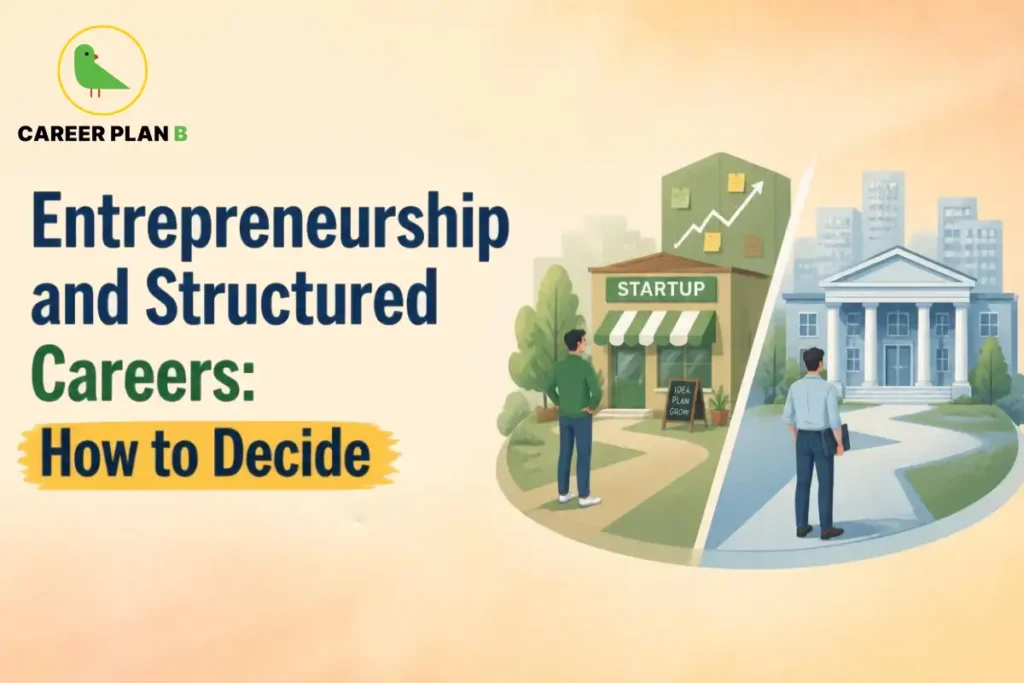
Introduction
Should you build something of your own, or build a career within an existing structure?
This is one of the most consequential decisions many students eventually face. It shapes not just your income path, but your daily work life and risk exposure for years.
This guide covers how to decide between entrepreneurship and structured career paths in India. You will find both sides clearly, backed by official data on each route.
Why Does This Decision Feel So High-Stakes?
Entrepreneurship and structured careers often get framed as opposites, each with strong advocates. This can make the decision feel more binary and permanent than it actually is.
Official data on both paths can help ground this decision in reality rather than narrative. India’s startup ecosystem and structured skilling routes have both matured considerably in recent years.
The Case for Entrepreneurship
There are genuine, well-supported reasons entrepreneurship appeals to many students today.
Entrepreneurship Reason 1: Real Institutional Support Now Exists
Starting a company in India is no longer purely a personal risk. The Startup India initiative reflects this shift directly. It is led by the DPIIT and has recognised over 2.07 lakh startups as of December 2025.
These recognised startups have collectively generated more than 21.9 lakh direct jobs. This scale reflects genuine, structural backing, not just isolated success stories.
Entrepreneurship Reason 2: Funding and Compliance Support Have Improved
DPIIT recognition unlocks tax exemptions, easier compliance, and access to schemes like the Startup India Seed Fund. This significantly lowers the traditional barriers to starting a venture.
Programs like the Fund of Funds for Startups also channel capital toward early-stage ventures through registered investment funds. This reduces some of the historical funding uncertainty entrepreneurship once carried. Collateral-free loans through schemes like the Credit Guarantee Scheme add another layer of practical support.
Entrepreneurship Reason 3: Autonomy and Direct Ownership of Outcomes
Entrepreneurship offers a level of control over decisions and direction that structured roles rarely match. For students motivated by building something specific, this autonomy can be a genuine driver.
This also means outcomes, both success and failure, are more directly tied to your own decisions.
The Case for Structured Career Paths
Structured paths offer equally real, well-supported advantages.
Structured Path Reason 1: Predictable Skill Development and Progression
Structured careers, including apprenticeships under the National Apprenticeship Promotion Scheme (NAPS), offer defined skill-building stages. This predictability helps students build competence steadily, without the added pressure of running a venture simultaneously. Clear milestones also make it easier to measure progress along the way.
Structured Path Reason 2: Lower Immediate Financial Risk
Structured roles typically offer steady income from the start, unlike most early-stage ventures. This matters significantly for students without a financial cushion to absorb early losses.
Government-backed guidance through the National Career Service (NCS) also supports this path with structured job matching and counselling.
Structured Path Reason 3: Verified Data on Success Rates
Only a fraction of overall startup funding actually reaches early-stage ventures, with most capital flowing to already-established companies. This suggests entrepreneurship’s high upside also carries genuinely higher variance and risk than structured roles typically do. Structured paths, by contrast, offer more predictable outcomes tied to skill progression rather than market timing.
How to Decide Which Path Fits You
This decision works best through honest, structured self-assessment.
- Assess your risk tolerance honestly. Consider your financial situation and ability to absorb early setbacks.
- Evaluate your motivation source. Determine whether you are drawn to building something specific, or prefer steady progression.
- Check your access to support systems. Strong networks or savings can meaningfully de-risk entrepreneurship.
- Consider a hybrid approach. Structured roles can also build skills and capital before a later entrepreneurial attempt.
- Revisit this decision periodically. This choice is rarely permanent, and circumstances can shift meaningfully over time.
This turns an overwhelming binary choice into a structured, personal evaluation.
Have Any Doubts?
Benefits, Challenges, and What the Data Says
Both paths now have genuine institutional backing in India, unlike a decade ago. Startup India’s scale and NAPS’s structured apprenticeship growth both reflect real, verified support.
However, entrepreneurship carries measurably higher variance, given how much startup funding concentrates in already-established ventures. Structured paths offer more predictable, but often more capped, outcomes by comparison.
Challenges include the emotional pressure of choosing under social or family expectation, rather than genuine personal fit. This pressure can push students toward a path that looks impressive rather than one that actually suits them.
The Outlook for Both Entrepreneurship and Structured Career Beyond 2026
Startup India’s continued growth and NAPS’s expanding apprenticeship numbers suggest both paths will keep strengthening in parallel. Neither route shows signs of becoming less viable going forward.
This suggests the right choice depends far more on individual fit than on which path is objectively “better” nationally. Both routes are likely to remain credible, well-supported options for years to come.
How Career Plan B Helps
Understanding which path genuinely fits your risk tolerance and goals can feel overwhelming without guidance. Career Plan B simplifies this through:
- Personalised Career Counselling: evaluating your genuine fit for entrepreneurship or structured career paths
- Psycheintel Career Assessment Tests: clarifying your risk tolerance and core career motivations
- Admission and Academic Profile Guidance: exploring structured, skill-building routes that also support future entrepreneurship
- Structured Career Roadmapping: a clear plan reflecting your specific decision, not a generic path
For Latest Information
Frequently Asked Questions
Q1.Is entrepreneurship genuinely well-supported in India today?
Yes. Startup India has recognised over 2.07 lakh startups and generated more than 21.9 lakh direct jobs as of December 2025.
Q2.Is a structured career path a safer choice financially?
Generally, yes. Structured roles typically offer steadier income compared to early-stage entrepreneurial ventures.
Q3.Can I combine both paths over time?
Yes. Many professionals build skills and savings through structured roles before pursuing entrepreneurship later.
Q4.Does most startup funding actually reach early-stage ventures?
No. A relatively small share of total funding goes to early-stage startups, with more flowing to established companies.
Q5.Is this decision permanent once made?
No. Circumstances, skills, and goals can shift, making this a revisitable rather than one-time decision.
Q6.How do I know which path genuinely suits me?
Assess your risk tolerance, financial situation, and core motivation honestly before deciding either way.
Conclusion
Choosing between entrepreneurship and a structured career path depends on genuine personal fit, not which option sounds more impressive.
Startup India’s institutional backing makes entrepreneurship more viable than ever. Structured paths through NAPS and NCS offer steady, predictable progression instead. Neither path is objectively superior nationally.
Start by honestly assessing your risk tolerance and motivation, then choose the path that genuinely fits your situation.
Ready to figure out which path genuinely fits you? Talk to a Career Plan B counsellor and get a personalised roadmap today.