Team5 · August 7, 2026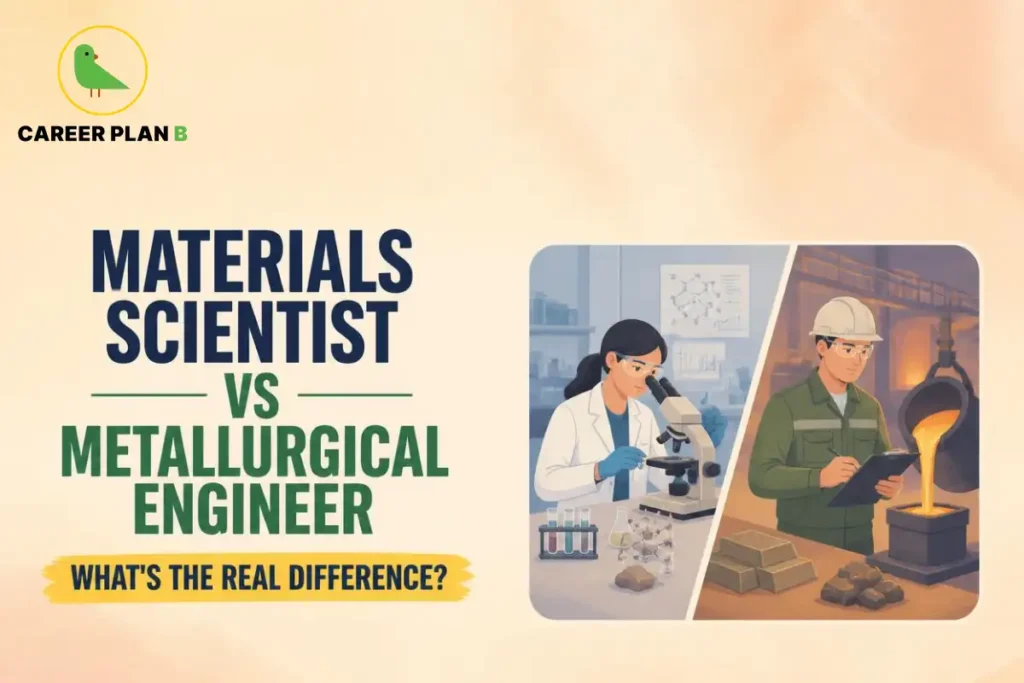
Introduction
Most Indian institutes actually combine these into a single degree, “Metallurgical and Materials Engineering”, which blurs the line before students even start comparing them as separate career choices. This is exactly why Materials Scientist vs Metallurgical Engineer: What’s the Difference? deserves a careful, honest answer, since students often research these as if they’re two entirely distinct career paths, without realizing how much they overlap by design in India specifically. Understanding where genuine differences exist, and where they genuinely don’t, matters considerably more than picking based on which title sounds more impressive. This blog breaks down what actually distinguishes these two roles, how India’s degree structure shapes this distinction, and where each path leads in practice.
What’s the Core Difference Between These Two Roles?
Metallurgical Engineer: A Metals-Focused Materials Specialist
A metallurgical engineer specializes specifically in the manufacture, refinement, and improvement of metals and metallic materials, developing products that are stronger, lighter, more durable, and more energy-efficient. This work involves extracting metals from ores or recycled materials, designing alloys with specific desired properties, and producing components from selected metals for practical, everyday applications. Notably, industry sources often describe a metallurgist as essentially a metals-focused material scientist, which already hints at how closely these two roles genuinely relate rather than sitting entirely apart.
Materials Scientist: A Broader Study of Structure, Properties, and Behavior
A materials scientist, by contrast, investigates the structure and properties of a considerably wider range of substances, including metals, ceramics, polymers, composites, and nanomaterials, developing novel materials that meet specific mechanical, electrical, and chemical requirements. This broader materials science scope means materials scientists might work on anything from computer chips and aircraft wings to golf clubs and bioelectronics, whereas metallurgical engineers stay concentrated specifically on metallic systems. Therefore, the genuine distinction here isn’t about depth versus superficiality; it’s about breadth of material type, metals specifically versus materials broadly.
Why India’s Degree Structure Blurs This Distinction Further
Is this really a meaningful career choice in India, or largely an academic distinction that doesn’t matter in practice? The honest answer leans toward the latter, at least at the undergraduate level. Most top Indian institutes, including IIT Bombay, IIT Madras, IIT Kharagpur, and NIT Trichy, offer this specifically as one combined B.Tech programme, called Metallurgical and Materials Engineering, rather than splitting it into two separate degrees. A smaller number of institutes, like IIT Delhi, offer a distinctly separate “Materials Engineering” programme, but even here, the curriculum overlap with traditional metallurgy remains considerable. This means most students entering this field in India aren’t actually choosing between two competing careers at the undergraduate stage; they’re choosing one combined degree that covers both, with specialization typically happening later through postgraduate study or on-the-job focus.
Eligibility and Entry Paths for Both
Undergraduate Entry Requirements
Both paths share the same undergraduate eligibility in India, requiring Class 12 with Physics, Chemistry, and Mathematics, generally with a minimum of 50 to 60 per cent aggregate marks, followed by entrance exams like JEE Main or JEE Advanced. Programmes need approval from the All India Council for Technical Education (AICTE), the Government of India’s apex technical education regulator, and since most colleges teach this as one combined programme, your metallurgical engineering eligibility and materials science eligibility are effectively identical at entry.
Postgraduate Routes Through GATE
Genuine specialization typically begins at the postgraduate level, where students can pursue an M.Tech specifically in metallurgical engineering, materials science, or related specializations like physical metallurgy, computational materials science, or surface engineering. Admission requires a valid GATE score, and you can verify official exam details through the GATE official website, maintained by the IIT hosting the exam that year. This is genuinely where the paths start diverging meaningfully, since your choice of postgraduate specialization shapes whether you end up working predominantly with metals or across a broader range of materials.
Have Any Doubts?
Where Each Path Actually Leads in Terms of Work
Typical Metallurgical Engineer Roles and Industries
Metallurgical engineers typically find roles as process engineers, welding engineers, quality control specialists, or plant equipment engineers, working across steel, automotive, aerospace, and defence manufacturing where metallic components dominate. Companies producing or working extensively with metals and alloys, from Tata Steel to Hindustan Aeronautics, represent the natural employer base for this metallurgical engineering career India pathway.
Typical Materials Scientist Roles and Industries
Materials scientists, meanwhile, find themselves working across a wider net, including semiconductor manufacturing, biomedical devices, polymer and composite development, and nanomaterials research, alongside traditional metals work when their specialization includes it. Top recruiters span both traditional heavy industry, including Larsen & Toubro and Reliance Industries, and increasingly, government research bodies like DRDO and CSIR laboratories that need broader materials scientist career India expertise. You can track official PSU recruitment activity for both career tracks through the Department of Public Enterprises, which oversees India’s central public sector undertakings.
Salary Comparison: Materials Scientist vs Metallurgical Engineer
| Career Stage | Metallurgical Engineer | Materials Scientist |
|---|---|---|
| Entry-Level | ₹3–6 LPA | ₹3–6 LPA |
| Mid-Level | ₹6–12 LPA | ₹6–12 LPA |
| Senior-Level | ₹12–20+ LPA | ₹12–20+ LPA (Higher in Semiconductor & Research Roles) |
It’s genuinely worth noting how similar these figures look at nearly every career stage, reinforcing that metallurgical engineer salary India and materials engineer salary India ranges largely converge, since both roles draw from the same combined degree programme at most Indian institutes. Where meaningful divergence does appear is at the senior level in specialized sectors like semiconductor materials research, where materials scientists with broader, non-metal expertise can command a premium.
Career Roles and Growth Path
| Career Stage | Metallurgical Engineer | Materials Scientist |
|---|---|---|
| Entry-Level | Graduate Engineer Trainee / Metallurgist | Research Associate / Junior Materials Engineer |
| Mid-Level | Quality Control Engineer / Welding Engineer | Materials Characterisation Scientist |
| Senior-Level | Senior Metallurgist / Plant Equipment Engineer | Principal Scientist / Materials R&D Lead |
How Career Plan B Helps
Career Plan B helps students and professionals make informed decisions about metallurgy and materials science careers through personalized guidance, assessments, and structured career planning.
Personalized Career Counselling: Provides expert guidance to help students choose between metallurgy-focused and materials science career paths based on their interests, skills, and goals in industries like steel, aerospace, semiconductors, defence, and advanced materials.
Psychometric & Career Assessment Tests: Helps identify students’ technical strengths, problem-solving abilities, and career preferences to understand whether they are better suited for industrial metallurgy roles, research-oriented materials science, or innovation-driven careers.
Career Roadmapping: Creates a step-by-step career plan covering engineering specialization, GATE preparation, postgraduate options, research opportunities, internships, and skill development required for a successful career in metallurgical and materials engineering.
Admission & Academic Profile Guidance: Helps students select the right colleges, courses, and specialization pathways while improving their academic profile for opportunities in IITs, NITs, research organisations, and industries related to metallurgy and materials science.
Get In Touch With Us
Frequently Asked Questions
- Is a metallurgist the same as a materials scientist?
Not exactly, but they’re closely related a metallurgist is essentially a materials scientist who specializes specifically in metals rather than the broader range of materials.
- Do Indian colleges offer these as separate degrees?
Most top institutes combine them into one “Metallurgical and Materials Engineering” B.Tech, though a few, like IIT Delhi, offer a separate, broader Materials Engineering program.
- Which one has broader industry scope?
Materials science generally offers a broader scope, spanning semiconductors, biomedical devices, and nanomaterials alongside metals, while metallurgical engineering stays more metals-concentrated.
- Can a metallurgical engineer work as a materials scientist later?
Yes, this is a natural transition, typically achieved through postgraduate specialization or research experience that broadens expertise beyond purely metallic materials.
- Which pays more, materials science or metallurgical engineering?
Salaries largely converge at most career stages, though materials scientists in specialized sectors like semiconductor research can command a premium at senior levels.
Conclusion
Answering Materials Scientist vs Metallurgical Engineer: What’s the Difference? ultimately reveals that these aren’t two competing careers so much as two points on the same spectrum, with metallurgy representing the metals-focused end and materials science representing the broader, more diverse end. In India specifically, most students enter through the same combined undergraduate degree, only genuinely specializing toward one direction or the other at the postgraduate level or through their career choices afterward. Rather than agonizing over which title to pursue from Class 12 onwards, it’s worth focusing on building strong materials fundamentals first, then letting your genuine interests guide whether you specialize toward metals specifically or a broader materials portfolio later.
If you’d like help figuring out which specialization direction fits your interests best, a conversation with a Career Plan B counsellor can help you plan your next steps with real clarity.