Careerplanb · November 2, 2026
Introduction
Neha sat with her CUET information bulletin open on one tab and a government job vacancy notice open on another, wondering if the two had anything to do with each other. That confusion is common. Every year, lakhs of class 12 students choose their CUET subjects for government jobs without realising how much this one decision can shape the next five to ten years of their career. The right combination doesn’t guarantee a rank, but it does build the foundation that most successful aspirants quietly rely on.
This blog walks you through exactly that: which subjects actually help, why they matter, and how to choose CUET subjects for government jobs without second-guessing yourself later. Think of this less as a rulebook and more as a conversation with someone who’s already mapped this road.
Why Your CUET Subject Choice Matters More Than You Think
Here’s a question worth sitting with: would you rather study something that guarantees a college seat, or something that also builds the base for the exam you actually want to clear one day?
Most government job exams in India, from UPSC Civil Services to SSC CGL, don’t demand a specific degree. But they do reward familiarity. A student who has studied Political Science, Economics, History, or Public Administration at the undergraduate level enters exam preparation already knowing the language of governance, policy, and society. The other student starts from zero. That head start is exactly why CUET subject selection deserves more thought than it usually gets.
The Common University Entrance Test, conducted by the National Testing Agency, no longer restricts students to their class 12 stream. A science student can choose Political Science. A commerce student can pick History. This flexibility is precisely what makes the decision both exciting and a little overwhelming.
What Changed: CUET’s No-Restriction Rule
For 2026, the University Grants Commission removed subject restrictions entirely, meaning students can select any CUET domain subject regardless of what they studied in class 12. This single change is quietly reshaping how students plan for competitive exams. It means a student who studied Physics and Chemistry in school can still walk into a Political Science or Economics honours programme, subjects that align beautifully with government exam syllabi.
If this applies to you, it’s worth asking: which subjects will actually work in your favour later, not just this year?
For Personalized Guidance
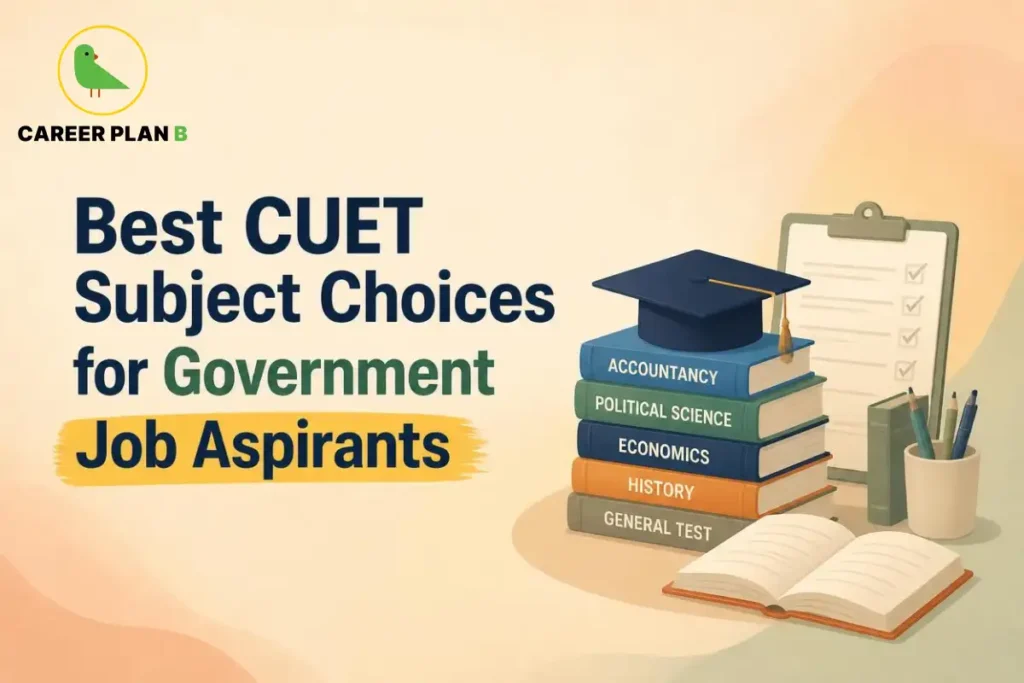
The Subjects That Matter Most for Government Job Aspirants
Let’s break this down properly. Not every CUET domain subject carries equal weight for government exam preparation. Some build direct overlap with syllabi; others build indirect but valuable skills like reasoning, writing, and comprehension.
1. Political Science
This is often the single most useful subject for anyone eyeing UPSC, State PSCs, or judicial services. It covers the Constitution, political theory, governance structures, and international relations, all of which show up repeatedly in General Studies papers.
2. Economics
Budget analysis, economic surveys, monetary policy, and government schemes are recurring themes in almost every competitive exam. A student who has studied Economics at graduation doesn’t need to relearn these concepts from scratch during exam prep.
3. History
History builds a sense of continuity, how past events shape present policy. It’s directly useful for UPSC’s history papers and indirectly useful for the general awareness sections in SSC and banking exams.
4. Public Administration
Fewer students choose this, but it maps almost one-to-one with the governance and polity portions of most government exams. It also tends to have a smaller, more manageable syllabus compared to some other options.
5. Sociology
Understanding social structures, caste, gender, and public policy through a sociological lens gives students an edge in essay writing and ethics papers, sections where rote learning alone doesn’t help.
6. Mathematics or Statistics
For students aiming at exams like SSC CGL’s Junior Statistical Officer post, or roles requiring quantitative aptitude, a background in Mathematics or Statistics becomes a direct qualification advantage rather than just a general skill.
Here’s a quick comparison to make the picture clearer:
| CUET Subject | Most Relevant Exams | Why It Helps |
|---|---|---|
| Political Science | UPSC Civil Services, State PSC, Judiciary | Provides strong overlap with topics such as the Constitution, governance, public administration, and Indian polity. |
| Economics | UPSC Civil Services, RBI Grade B, Banking Examinations | Builds understanding of economic policies, government schemes, budgeting, and the Economic Survey. |
| History | UPSC Civil Services, SSC Examinations | Improves general awareness and strengthens analytical and descriptive answer-writing skills. |
| Public Administration | UPSC Civil Services, State PSC | Offers a concise syllabus closely aligned with governance, administrative systems, and public policy. |
| Sociology | UPSC Civil Services (Essay & Ethics) | Develops analytical thinking and a deeper understanding of social structures and contemporary issues. |
| Mathematics / Statistics | SSC CGL (JSO), Railway Recruitment Examinations | Essential for quantitative aptitude and technical roles requiring mathematical and statistical proficiency. |
Should You Choose a Single Subject or a Combination?
This is where most students get stuck. Should you go all in on one subject, or spread your bets across a smart combination?
A combination often works better than betting everything on one subject. Pairing Political Science with Economics, for instance, covers both polity and economic policy, two pillars of almost every government exam syllabus. Similarly, History with Public Administration builds both narrative understanding and administrative logic.
There’s no universal formula here. A student aiming purely for judicial services might lean harder into Political Science and Law-adjacent electives, while someone eyeing banking exams might prioritise Economics and Mathematics instead.
A Quick Story: Two Students, Two Paths
Consider two students who appeared for CUET in the same year. One chose Political Science and Economics, largely because a family member suggested it made sense for future government exams. The other chose subjects based purely on which college and course sounded impressive to relatives.
Three years later, the first student walked into UPSC preparation already comfortable with concepts like federalism, fiscal policy, and constitutional amendments. The second student spent the first six months of coaching simply catching up on basics the first student already knew. Neither path is wrong, but one clearly had a head start built quietly during undergraduate years.
Common Mistakes Students Make While Choosing Subjects
- Choosing a subject only because friends are choosing it
- Ignoring the subject-exam overlap entirely and picking based on “scoring potential” alone
- Assuming science students cannot switch to humanities-based subjects for CUET
- Not checking whether the target university even offers the subject combination
How to Actually Decide: A Simple Framework
Ask yourself three questions before finalising your CUET subjects for government jobs:
- Which government exam or field genuinely interests you, UPSC, SSC, banking, judiciary, or something else?
- Which subjects overlap most with that exam’s syllabus?
- Which university and course combination realistically fits your CUET score range?
Once you have honest answers to these, the subject choice tends to become far less confusing.
How Career Plan B Helps
Career Plan B helps students choose the right CUET subjects by connecting their academic decisions with long-term career aspirations, including pathways that may lead to government careers:
- Personalized Career Counselling: Helps students understand their strengths, interests, academic goals, and future aspirations so they can choose subject combinations that align with their preferred courses, universities, and long-term career plans.
- Psycheintel & Career Assessment Tests: Provides data-backed insights into aptitude, personality traits, interests, and learning styles, helping students identify academic pathways and career options that best match their natural abilities.
- Admission & Academic Profile Guidance: Supports students in strengthening their academic profile, understanding university eligibility requirements, and planning strategically for future admissions.
- Subject & Course Alignment: Helps students map their CUET subject choices to the eligibility criteria of their target courses and universities while considering how those academic choices support their broader career objectives.
- Career Roadmapping: Creates a structured, step-by-step plan that connects subject selection with university admissions, skill development, higher education opportunities, and long-term career aspirations, giving students a clear direction from the outset.
- End-to-End Guidance: Assists students throughout the planning and admission journey so every academic decision is informed, intentional, and aligned with their future ambitions.
For Latest Information
Frequently Asked Questions
Q1. Can a science student choose Political Science or Economics in CUET?
Yes. With the subject restrictions removed, students from any stream can select any CUET domain subject, regardless of what they studied in class 12.
Q2. Is a specific degree mandatory for government jobs like UPSC or SSC?
No. Most government exams only require a bachelor’s degree from a recognised university, in any discipline. However, certain subjects offer stronger syllabus overlap.
Q3. Which CUET subject is best for UPSC preparation specifically?
Political Science, History, and Public Administration are generally considered the strongest choices due to their direct overlap with the General Studies papers.
Q4. Does choosing the “right” subject guarantee success in government exams?
No single subject guarantees success. It builds a head start and familiarity, but consistent preparation and practice remain equally important.
Q5. Can I switch my subject combination later if I change my exam goal?
Switching mid-course is difficult once electives are locked in, which is why it helps to think through your long-term goal before finalising CUET subjects.
Conclusion
Choosing CUET subjects for government jobs isn’t about predicting the future perfectly. It’s about giving yourself a reasonable, informed head start instead of leaving everything to exam-time cramming. Political Science, Economics, History, and Public Administration consistently show up as strong, exam-aligned choices, but the real answer depends on which government career path genuinely excites you.
Take a little time before you fill that CUET form. Talk to seniors, read a few syllabi, and be honest about what interests you rather than what sounds impressive. The subject you choose today will quietly sit beside you through every government exam you attempt tomorrow, so choose it like it matters, because it does.