Team6 · October 30, 2026
Introduction
Smart manufacturing is no longer a buzzword; it is the next industrial revolution, already reshaping factory floors, supply chains, and entire economies across the world.
Robots assembling components with millimetre precision. AI systems predicting machine failures before they happen. Fully automated plants operating around the clock with minimal human intervention. The question every engineering student and professional is quietly asking is, ‘Where exactly do I fit in all of this?’
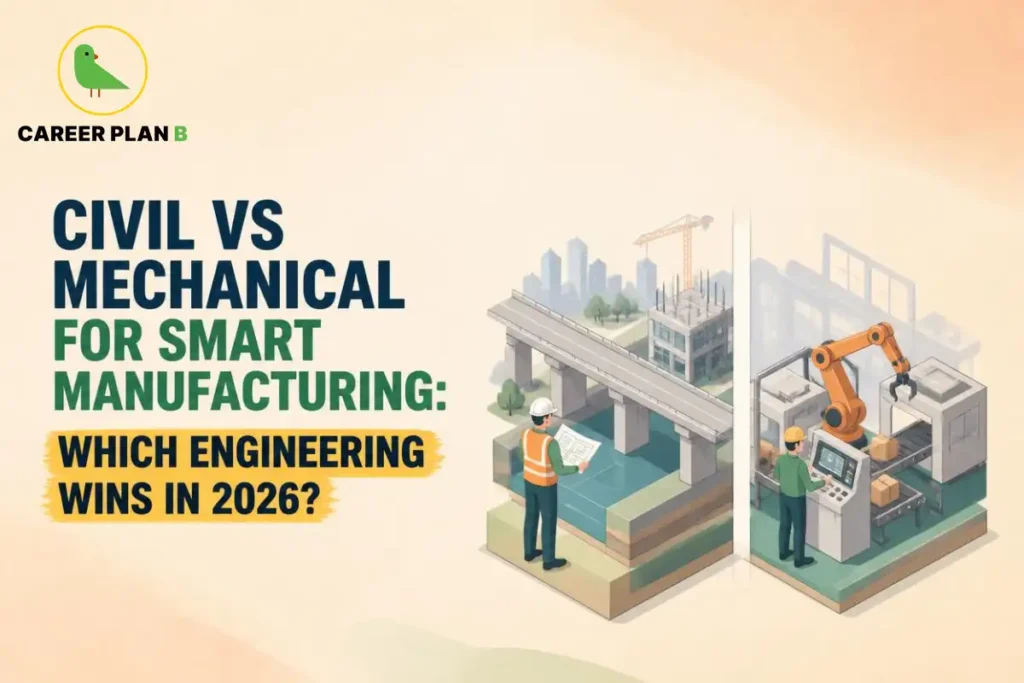
When it comes to civil vs mechanical for smart manufacturing, both disciplines play critical roles but in very different ways. Mechanical engineers drive the machines, systems, and automation that power smart factories. Civil engineers build and plan the physical infrastructure those factories stand on and operate within. Understanding this distinction is the key to making the right career decision.
The global smart manufacturing market is projected to reach $658 billion by 2031, growing at a compound annual rate of over 15%. Both civil and mechanical engineers stand to benefit enormously, but the nature and scale of those opportunities differ significantly.
This blog gives you an honest, data-backed comparison of both disciplines within the smart manufacturing landscape, so you can make your career choice with confidence.
What Is Smart Manufacturing and Why Does It Matter?
Before comparing the two disciplines, it is important to understand the landscape they are both entering.
Smart manufacturing refers to the use of advanced digital technologies, artificial intelligence, the Internet of Things (IoT), robotics, digital twins, and big data analytics to create highly automated, efficient, and flexible production systems. It is the centrepiece of what is widely known as Industry 4.0 for engineers, the fourth industrial revolution.
Key characteristics of smart manufacturing include:
- Interconnected machinery and sensors sharing real-time data
- AI-driven predictive maintenance reducing downtime
- Flexible production lines that adapt rapidly to demand changes
- Sustainable, energy-efficient factory design and operations
- Human-machine collaboration replacing purely manual processes
The implications for smart manufacturing career options are enormous. Both civil and mechanical engineers are needed but at different stages and in different capacities.
The US National Institute of Standards and Technology (NIST) is a leading authority on smart manufacturing standards and technology development.
Role of Civil Engineers in Smart Manufacturing
Many people underestimate the role of civil engineering in manufacturing, but the truth is that no smart factory exists without civil engineering expertise underpinning it.
Industrial Site Planning and Development
Every manufacturing facility begins with a site. Civil engineers conduct feasibility studies, soil investigations, environmental impact assessments, and master planning before a single structural element is designed. Poor site planning leads to costly delays and long-term operational inefficiencies.
Structural Design of Manufacturing Facilities
Smart factories house heavy machinery, overhead cranes, vibration-sensitive equipment, and complex utility systems. Civil engineers design the structural frameworks of reinforced concrete floors capable of bearing heavy dynamic loads, steel-framed buildings with precise tolerance requirements, and foundations engineered for industrial conditions.
Manufacturing Infrastructure Engineering
Civil engineers manage the broader infrastructure ecosystem that makes smart factories function: access roads, loading bays, drainage and waste management systems, water supply and treatment, utility corridors, and fire safety infrastructure. This is manufacturing infrastructure engineering at its most practical.
Sustainable Factory Design
Green building certification, energy-efficient building envelopes, rainwater harvesting, and sustainable construction practices are increasingly mandatory for modern manufacturing facilities. Civil engineers lead these efforts, often pursuing LEED certification for industrial facilities.
Role of Mechanical Engineers in Smart Manufacturing
If civil engineers build the shell of smart manufacturing, mechanical engineers power its heart.
Mechanical engineering in smart manufacturing is where the technological excitement of Industry 4.0 is most directly felt. Mechanical engineers design, integrate, and optimise the machines, automation systems, and production processes that define a smart factory.
Robotics and Automation Design
Mechanical engineers design robotic arms, conveyor systems, automated assembly lines, and precision machining equipment the physical mechanisms that execute manufacturing processes with speed and accuracy beyond human capability.
Predictive Maintenance Systems
Using sensor data and mechanical analysis, mechanical engineers design condition monitoring systems that detect wear, vibration anomalies, and performance degradation in industrial machinery, enabling predictive maintenance that dramatically reduces costly unplanned downtime.
Energy Systems and Thermal Engineering
Smart manufacturing demands energy efficiency. Mechanical engineers design HVAC systems, compressed air networks, cooling systems, and energy recovery solutions that keep manufacturing operations efficient and sustainable.
Digital Twin Development for Production Systems
Mechanical engineers are central to creating digital twins of production systems, virtual replicas that simulate manufacturing processes and allow engineers to optimise performance without disrupting real operations.
Civil vs Mechanical Head-to-Head in Smart Manufacturing
Here is a direct comparison of how both disciplines sit within the smart manufacturing landscape:
| Factor | Civil Engineering | Mechanical Engineering |
|---|---|---|
| Primary Role | Factory infrastructure and site development | Machinery, automation, and production systems |
| Industry 4.0 Involvement | Supporting (smart building systems, sustainable infrastructure) | Core (robotics, automation, digital twins) |
| Project Phase | Pre-construction and construction | Design, commissioning, and ongoing operations |
| Global Demand | High driven by manufacturing expansion | Very high, driven by automation and Industry 4.0 |
| Remote Work Flexibility | Limited largely site-based | Moderate design and simulation roles offer more flexibility |
| Career Mobility | Strong internationally | Strong internationally, especially in manufacturing hubs |
Salary Comparison: Civil vs Mechanical in the Manufacturing Sector
Understanding civil vs mechanical engineering salaries within manufacturing helps set realistic career expectations.
United States
| Level | Civil Engineer | Mechanical Engineer |
|---|---|---|
| Entry Level | USD 58,000 – 72,000 | USD 65,000 – 82,000 |
| Mid-level | USD 80,000 – 105,000 | USD 90,000 – 120,000 |
| Senior Level | USD 110,000 – 140,000 | USD 120,000 – 160,000 |
According to the US Bureau of Labour Statistics, the median annual salary for civil engineers is $95,890, while mechanical engineers earn a median of $99,510, a relatively small gap that narrows further at senior levels.
Both fields rank among the best engineering for future jobs globally, with strong government-backed employment projections in manufacturing, infrastructure, and technology sectors alike.
Industry 4.0 How Each Discipline Fits In
Industry 4.0 for engineers is not a single domain; it is a layered ecosystem where different engineering disciplines contribute at different levels.
Where Mechanical Engineering Dominates:
- Robotics and automated assembly systems
- Smart sensor integration into machinery
- Additive manufacturing (3D printing) system design
- CNC programming and precision manufacturing technology
- Digital twin development for production lines
Where Civil Engineering Adds Critical Value:
- Design and construction of smart factory buildings
- Sustainable and energy-efficient industrial facility development
- Infrastructure for automated logistics and warehousing facilities
- Structural adaptation of existing factories for Industry 4.0 upgrades
- Planning and construction of manufacturing special economic zones and industrial parks
The honest picture is that mechanical engineering sits closer to the technological core of smart manufacturing, while civil engineering provides the essential foundation literally and structurally that makes everything else possible.
Have Any Doubts?
Global Demand: Which Is Hired More in Smart Manufacturing?
United States
The US Department of Commerce’s manufacturing strategy prioritises domestic production expansion and smart factory development, creating strong demand for both civil and mechanical engineers.
Germany
Germany, the birthplace of Industry 4.0, has an acute shortage of mechanical engineers in its advanced manufacturing sector. Civil engineers are equally in demand for industrial construction projects.
India
India’s Production Linked Incentive (PLI) scheme and National Manufacturing Policy are driving massive investment in factory construction and manufacturing technology, creating strong demand for both disciplines.
Australia
Jobs and Skills Australia identifies both civil and mechanical engineering as in-demand occupations, particularly in the resources, energy, and advanced manufacturing sectors.
European Union
The EU’s industrial strategy emphasises smart manufacturing and green industrial transition, with sustained investment in both factory infrastructure and advanced production technology across member states.
How to Decide Between Civil and Mechanical for Your Manufacturing Career?
There is no single correct answer to the civil vs mechanical for smart manufacturing question. The right path depends entirely on your strengths, interests, and long-term career vision.
Choose Civil Engineering in Manufacturing if you:
- Enjoy large-scale project planning, site development, and structural design
- Are drawn to sustainable building and green industrial infrastructure
- Want strong international career mobility across multiple sectors
- Prefer working at the project development and construction phase
Choose Mechanical Engineering in Smart Manufacturing if you:
- Are excited by robotics, automation, and intelligent machinery
- Want to work at the cutting edge of Industry 4.0 technology
- Enjoy problem-solving within production and manufacturing systems
- Are drawn to the digital twin, AI, and IoT applications transforming industry
Professional Registrations Worth Pursuing in Either Field:
- American Society of Civil Engineers (ASCE)
- Engineers Australia
- Engineering Council UK (CEng)
How Career Plan B Helps
Choosing between civil and mechanical engineering for a smart manufacturing career is a decision that deserves more than a quick internet search. Career Plan B offers personalised career counselling, Psycheintel assessments, and structured career roadmapping that help engineers identify their strengths, align them with industry demand, and build a clear path forward. Whether you are a student choosing your specialisation or a professional planning your next move into smart manufacturing, Career Plan B provides the expert guidance to make your decision with clarity and confidence.
For Latest Information
Frequently Asked Questions (FAQs)
1. Is mechanical engineering more relevant than civil engineering in smart manufacturing?
Mechanical engineering is more directly embedded in the technological core of smart manufacturing. However, civil engineering remains essential for industrial infrastructure, factory construction, and sustainable facility development. Both disciplines are genuinely needed.
2. Can a civil engineer work in a smart manufacturing company?
Yes, civil engineers are employed in manufacturing companies for facility planning, construction management, infrastructure maintenance, and industrial site development. Roles exist at every stage of a manufacturing facility’s lifecycle.
3. Which engineering field has better salary growth in manufacturing?
Mechanical engineers in advanced manufacturing and automation roles tend to earn slightly higher salaries at senior levels. However, civil engineers working on large industrial construction projects or internationally can match these figures, particularly in high-demand markets.
4. What skills do civil engineers need to work in smart manufacturing?
Structural design for industrial facilities, sustainable building certification, project management, BIM proficiency, and knowledge of industrial safety and environmental regulations are the most valuable skills for civil engineers entering the manufacturing sector.
5. Which countries offer the best opportunities for both civil and mechanical engineers in smart manufacturing?
Germany, the USA, Japan, South Korea, India, and Australia are currently the strongest markets for engineers in smart manufacturing, offering well-established industrial sectors and sustained government investment in manufacturing technology and infrastructure.
Conclusion
The smart manufacturing revolution needs both disciplines, and it needs them working together.
Civil vs mechanical for smart manufacturing is ultimately not a competition. It is a collaboration. Civil engineers build the intelligent factories of the future. Mechanical engineers fill those factories with the machines and automation systems that define Industry 4.0. Neither can succeed without the other.
The real question is not which field is better, but which one is better for you, based on your skills, your passions, and the kind of work that genuinely energises you.
Make that choice thoughtfully because the smart manufacturing revolution is already hiring.