Careerplanb · August 1, 2026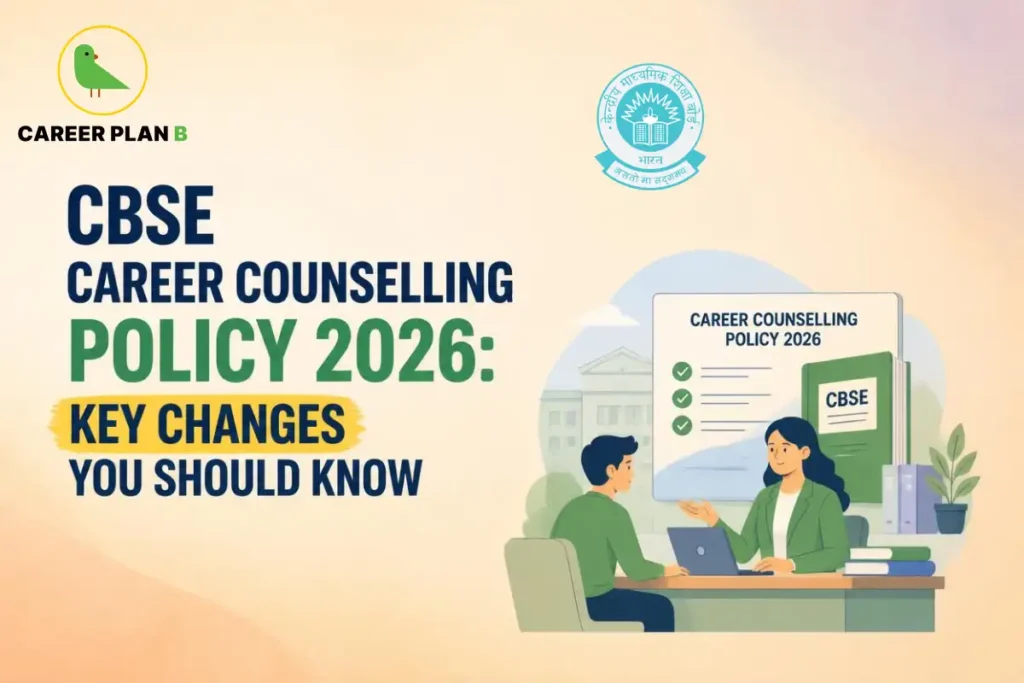
Introduction
For years, career guidance in Indian schools was treated as something extra — a workshop here, a career fair there, if the school had the time and budget for it. Most students figured out their path through trial, error, or whatever their parents’ friends recommended. That’s changing now. The CBSE career counselling policy, introduced through a circular in January 2026, has made career counselling a mandatory part of every affiliated school, not an optional add-on.
This is a big shift. It means schools can no longer treat career guidance as a “nice to have.” It has to be built into how the school runs, with trained professionals, defined ratios, and clear timelines. If you’re a parent, student, or educator trying to make sense of what this actually means in practice, here’s a clear breakdown.
What Exactly Did CBSE Change?
The CBSE new counselling guidelines 2026 come from an amendment to Clause 2.4.12 of the CBSE Affiliation Bye-Laws, 2018, which already required every Secondary and Senior Secondary school to appoint a full-time Counsellor and Wellness Teacher. The January 2026 circular builds on this base clause and splits what used to be one vague responsibility into two clearly defined roles:
- Clause 2.4.12.1 requires every school to appoint a Counselling and Wellness Teacher — a socio-emotional counsellor focused on students’ mental and emotional health.
- Clause 2.4.12.2 separately requires a Career Counsellor, whose job is to guide students on academic and professional choices.
Earlier, a single counsellor was often expected to handle both jobs. In practice, that meant neither got done well. Emotional support and career guidance need different skills — one is about helping a student cope, the other is about helping a student choose. Splitting the two roles is CBSE’s way of admitting that expecting one person to do both wasn’t working.
For Personalized Guidance
Why Separating the Roles Matters
Think of it like asking one doctor to be both your therapist and your career advisor. They might mean well, but they can’t be excellent at both. A school career counsellor mandate that treats these as distinct professional tracks means students finally get someone whose sole focus is their academic and career direction — someone trained in psychometric evaluation, higher education mapping, and understanding the job market, not just crisis support.
The Numbers Behind the Mandate CBSE New Counselling Guidelines 2026
Policy is only as good as its details, so here’s what schools actually need to comply with:
| Requirement | Detail |
| Counsellor-to-Student Ratio | 1 counsellor for every 500 students (Classes 9–12) |
| Training Requirement | 50 hours of CBSE-recognised training |
| Implementation Window | Two academic years from the January 2026 circular |
| Existing Staff | Teachers already providing counselling services can continue, provided they complete the required training within the specified timeline. |
This ratio and training requirement apply to both the Wellness Counsellor and the Career Counsellor roles separately — meaning larger schools may need more than one of each, depending on enrolment across Classes 9 to 12. Schools can track updates on these norms directly through the CBSE official website, where circulars and affiliation notifications are published as they’re issued.
Why Now? The Story Behind the Policy
This mandate didn’t appear out of nowhere. It followed a Public Interest Litigation filed before the Rajasthan High Court in July 2025, raising concerns about student mental health and the lack of structured career guidance in schools. During hearings later that year, the court sought responses from CBSE, the Rajasthan Board of Secondary Education, the University Grants Commission, and the state government.
CBSE’s response was to formally amend its affiliation norms. The move also aligns with the goals of the National Education Policy (NEP) 2020, which has long emphasised that guidance and wellbeing should be part of a student’s education, not something bolted on separately. In many ways, this CBSE career counselling policy is CBSE catching up to what NEP 2020 asked for years ago.
How Will Smaller Schools Cope? The Hub-and-Spoke Model
A fair question here: what about schools with limited resources or in smaller towns, where finding a qualified counsellor isn’t easy? CBSE has addressed this with a Hub-and-Spoke model. Larger, better-resourced schools act as “hub” schools and share counselling expertise and resources with nearby smaller “spoke” schools.
This is meant to prevent the mandate from becoming a paper rule that only well-funded urban schools can actually follow. Whether it works as intended will depend on how well schools coordinate but it’s a reasonable first attempt at solving a real access gap.
What This Means for Students and Parents
Does This Mean My Child’s School Already Has a Counsellor?
Not necessarily, and that’s important to understand. Schools have a two-year window to fully comply, so the rollout won’t be uniform. Some schools may already have appointed counsellors; others are still in the process of training existing staff or hiring new ones. It’s worth checking directly with your child’s school, or reviewing the affiliation norms on the CBSE website, to see where they stand.
What Changes for Students in Classes 9 to 12?
Practically, students in these classes should now have access to a designated person for academic and career questions not just a teacher squeezing in advice between classes. Over time, this should mean more structured guidance: understanding stream choices, entrance exams, college options, and career paths, backed by someone trained specifically for it.
That said, one counsellor per 500 students is still a lot of ground to cover. A career counselling for Class 9 to 12 system built into school life is a strong start, but it isn’t the same as individualised, one-on-one guidance.
How Career Plan B Helps
CBSE’s mandate is a welcome step, but a school counsellor managing hundreds of students can only go so deep.
Career Plan B fills that gap with Personalised Career Counselling built around each student, backed by the PsycheIntel Career Assessment to uncover genuine strengths and interests.
Add in Admission and Academic Profile Guidance and structured Career Roadmapping, and students get the individual attention a shared school counsellor simply can’t provide alone.
Get In Touch With Us
Frequently Asked Questions
- Is career counselling now compulsory in all CBSE schools?
Yes. Under the amended Clause 2.4.12 of the Affiliation Bye-Laws, all CBSE-affiliated schools must appoint a Career Counsellor, separate from the Wellness Counsellor role.
- What’s the difference between a wellness counsellor and a career counsellor?
A Wellness Counsellor focuses on students’ emotional and psychological wellbeing. A Career Counsellor focuses specifically on academic and career guidance. CBSE now treats these as two distinct roles rather than one combined job.
- When do schools need to comply by?
CBSE has given schools a two-academic-year window from the January 2026 circular to fully implement the mandate, including hiring and training counsellors.
- What qualifications must a CBSE career counsellor have?
Counsellors need relevant qualifications along with 50 hours of CBSE-recognised training. Existing teachers handling counselling duties can continue if they complete this training within the timeline.
- Can my school’s existing teacher become the career counsellor?
Yes, provided that teacher completes the required CBSE-recognised training and meets the qualification criteria within the stipulated period.
- Does this replace the need for outside career counselling?
Not entirely. School counsellors work across hundreds of students, which limits how personalised the guidance can be. Many families still choose dedicated career counselling services for deeper, individual support.
Conclusion
The CBSE career counselling policy marks a genuine shift in how Indian schools are expected to think about students’ futures. Career guidance is no longer something schools can skip or treat as optional; it’s now built into the system, with real ratios, training standards, and timelines behind it.
But a mandate is only the starting point. Real, personalised guidance — the kind that looks closely at a student’s individual strengths, interests, and goals — still matters just as much. If you want that deeper, one-on-one support alongside what your school offers, Career Plan B’s counselling and assessment services are built exactly for that. Reach out to explore how personalised guidance can complement what your school is now required to provide.
For Personalized Guidance