Deepti · August 11, 2026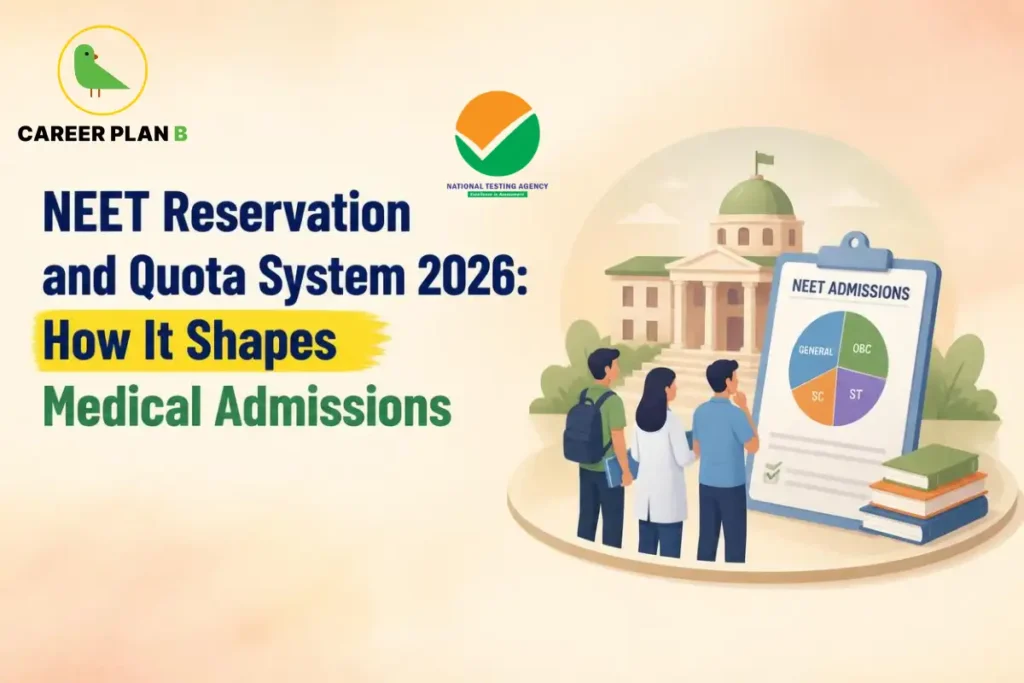
Introduction
Imagine topping NEET with a score you’re proud of, only to watch a government MBBS seat slip through your fingers because of how category quotas stack up. It’s one of the most common gut-punches for Indian aspirants, and most of them never saw it coming because nobody explained NEET reservation to them clearly beforehand.
Here’s the reality: India has just over 1 lakh MBBS seats chasing more than 20 lakh candidates every year. That single fact is why NEET reservation isn’t a footnote, it’s the difference between “I qualified” and “I got a seat.” All India Quota and State Quota split those seats in very different ways, and which bucket you fall into can swing your odds dramatically.
This post breaks down exactly how the NEET reservation policy works for 2026: category-wise percentages, the OBC creamy layer rule that quietly disqualifies more applicants than you’d expect, and what to actually do with this information before counselling begins.
Understanding NEET Reservation Quota in Admissions
NEET admissions split seats like this:
- 15% All India Quota (AIQ) — Managed centrally by the Medical Counselling Committee (MCC). Open to candidates nationwide.
- 85% State Quota — Handled by state authorities, often prioritizing local domicile holders.
These quotas decide seat allocation after NEET results. Why does this matter? Cutoffs and chances vary hugely by category and quota, which is exactly why understanding the NEET reservation quota structure early makes such a difference to your planning.
Category-Wise NEET Reservation Criteria in All India Quota (15%)
The AIQ follows uniform Government of India guidelines. Here’s the standard breakdown of NEET reservation categories for 15% AIQ seats in government medical colleges:
| Category | Reservation Percentage | Notes |
|---|---|---|
| Scheduled Caste (SC) | 15% | |
| Scheduled Tribe (ST) | 7.5% | |
| Other Backward Classes (OBC-NCL) | 27% | Non-Creamy Layer only |
| Economically Weaker Section (EWS) | 10% | |
| Persons with Disabilities (PwD) | 5% (horizontal) | Applies across all categories |
(Source: Consistent with GoI norms implemented via MCC; for the latest seat matrix and counselling details, refer to the official MCC website.)
The remaining ~40.5% falls under unreserved/general in AIQ, but overall reserved seats exceed 50% when combined.
PwD is horizontal, meaning a PwD candidate from any category (e.g., SC-PwD) gets priority within their vertical category. This same logic applies to SC ST reservation in NEET too, where a candidate’s disability status sits alongside, not instead of, their caste category.
Ever wondered why general category cutoffs hover 50–100 marks higher? This structure plays a big role.
Read more: Scholarship for Medical Students in India: Medical PG, NEET PG & Financial Aid Guide
For Personalized Guidance
NEET Counselling Reservation Policy 2026
Here’s the same breakdown laid out with the specific eligibility documents MCC checks during AIQ counselling, so you know exactly what to have ready.
| Category | Code | Reservation Percentage | Key Eligibility Requirement |
|---|---|---|---|
| Scheduled Caste | SC | 15% | Permanent Caste Certificate issued by competent authority |
| Scheduled Tribe | ST | 7.5% | Permanent Tribe Certificate issued by competent authority |
| Other Backward Classes | OBC-NCL | 27% | Candidate must belong to Non-Creamy Layer in the Central OBC list |
| Gen-Economically Weaker Section | GEN-EWS | 10% | Annual family income below ₹8 Lakhs and asset limits |
| Persons with Disabilities | PwD | 5% | Benchmark disability ≥40% verified by designated MCC board |
This table is a quick reference, not a substitute for the current year’s official notice. Requirements and certificate formats can be revised between counselling cycles, so always cross-check against the latest MCC bulletin before you apply.
OBC Creamy Layer vs Non-Creamy Layer
This is one of the most misunderstood parts of NEET reservation, and it directly determines whether an OBC candidate can actually use the 27% AIQ quota. Holding a caste certificate alone isn’t enough. Only candidates in the OBC Non-Creamy Layer (OBC-NCL) qualify for reservation benefits; those classified as “creamy layer” compete in the unreserved general pool instead.
Under the central Department of Personnel and Training’s (DoPT) guidelines, creamy layer status is decided by two separate tests, income and parental government rank, and either one can push a candidate out of NCL eligibility.
The income test: Family gross annual income from all sources, excluding salary and agricultural income, must stay below ₹8 lakh in each of the three consecutive financial years preceding your application. Even one year above the limit disqualifies you, it isn’t an average across the three years.
The parental rank test: If either parent is a directly recruited Group A (Class I) government officer, the candidate is automatically classified as creamy layer, regardless of actual salary. If both parents are directly recruited Group B officers, or one is promoted from Group B to Group A before age 40, the same applies. Children of Group C and D government employees are generally not affected by this rule and are assessed on income alone.
A few practical details worth knowing about NEET reservation for OBC candidates:
- The OBC-NCL certificate is separate from your basic caste certificate and must be obtained specifically for reservation purposes; it’s issued by your District Magistrate, SDM, or Tehsildar.
- It’s typically valid for one financial year (April to March), so timing your application close to your NEET counselling cycle matters.
- Your caste must appear on the Central List of OBCs. A state OBC list entry alone doesn’t automatically qualify you for the central 27% AIQ quota if it isn’t mirrored centrally.
- Name and detail mismatches across your Aadhaar, caste certificate, and income certificate are a common, avoidable reason for rejection. Double-check consistency before submitting.
Since this determination has real financial and legal weight, and interpretation has been refined by courts over time, always apply through your state’s official revenue department portal and consult the current DoPT circular rather than relying on a generic online explanation for your specific situation.
OBC Reservation in NEET UG AIQ: Document and Eligibility Checklist
For OBC reservation in NEET specifically under AIQ, the paperwork matters as much as your eligibility itself. Here’s what MCC actually verifies during document checks.
- Central List Requirement: The candidate’s caste must appear in the Central List of Other Backward Classes published by the National Commission for Backward Classes (NCBC). A state-level OBC certificate is not accepted for 15% AIQ counselling.
- Non-Creamy Layer Status: Annual family income from all sources must be less than ₹8 lakh.
- Validity Period: For the 2025–26 counselling cycle, the OBC-NCL certificate must be issued on or after April 1, 2025, adhering strictly to that financial year’s parameters. Confirm the exact validity window for your own admission year on the official MCC notice, since this date shifts every cycle.
- Format Compliance: The certificate must follow the Central Government’s prescribed OBC-NCL format, not a generic caste certificate template, or it risks rejection during document verification.
General Economically Weaker Section (GEN-EWS) – 10% Quota
GEN-EWS was introduced for General category candidates who don’t receive SC, ST, or OBC reservation benefits, but who still face genuine economic disadvantage. This is the category most searches around EWS reservation in NEET are really asking about.
Income and asset limits:
- Annual gross family income must be under ₹8,00,000.
- A family must not own 5 acres of agricultural land or more.
- A family must not own a residential flat of 1,000 sq. ft. or above.
- A family must not own a residential plot of 100 sq. yards or more in notified municipalities.
Certificate authority: Issued by a Tehsildar, Sub-Divisional Magistrate (SDM), or District Magistrate (DM) in the Central format.
Keep in mind that EWS eligibility looks at both income and assets together, not income alone. A family under the income limit but holding property above these thresholds would still not qualify, so read the certificate format carefully before applying.
Persons with Disabilities (PwD) – 5% Horizontal Reservation
Horizontal allocation: The 5% horizontal reservation applies within each category (UR-PwD, SC-PwD, ST-PwD, OBC-PwD, EWS-PwD), rather than as a separate standalone quota.
Benchmark disability: Candidates must have a certified benchmark disability of 40% or more, as specified under the Rights of Persons with Disabilities (RPwD) Act.
Mandatory assessment: Candidates must undergo a physical assessment and obtain a Disability Certificate from one of the MCC-designated Medical Assessment Boards, such as VMMC & Safdarjung Hospital Delhi, IPGMER Kolkata, Madras Medical College Chennai, or Grant Medical College Mumbai. Disability notes from local or private hospitals are not valid for MCC admission purposes.
Since the list of designated boards and exact procedure can change slightly each counselling cycle, confirm the current list and appointment process directly through the official MCC notice before scheduling your assessment.
How State Quota Reservations Vary
The 85% State Quota follows state-specific rules, often mirroring or exceeding central percentages based on local demographics. For example:
- Many states reserve 15–20% for SC, higher in some (e.g., Uttar Pradesh may adjust based on population). This is one reason SC ST reservation in NEET can look quite different depending on which state’s quota you’re applying under.
- OBC varies (often 27% or more in states with strong OBC policies).
- EWS is usually 10%.
- Additional benefits like domicile requirements or extra quotas for government school students exist in states like Tamil Nadu.
This variation means your home state can make a big difference, sometimes making it easier to access reserved categories locally. State OBC lists and creamy layer income limits can also differ from the central norms described above, so always confirm your specific state’s rules for state quota seats separately from the AIQ criteria through your state’s own counselling authority.
Positive Impacts of Reservation Systems
Reservations promote inclusion in medicine. Key benefits include:
- Increasing doctors from underrepresented groups, improving healthcare in rural and marginalized areas.
- Addressing historical inequities, creating a more diverse medical workforce.
- Reserved category graduates often go on to serve underserved communities, which supports overall public health equity.
These policies help bridge social gaps over generations.
Challenges and Criticisms
On the flip side:
- General category aspirants face higher cutoffs, often noticeably higher than reserved category cutoffs for the same seat pool.
- Intense competition intensifies; some feel it dilutes merit.
- Critics argue it can seem like reverse discrimination, though supporters highlight ongoing social needs.
It’s a balance: equity v/s merit- Many agree reservations remain necessary, but implementation debates continue.
How Career Plan B Helps
Figuring out which quota, category, and certificates actually apply to your situation is often more confusing than the exam itself. Here’s how personalised guidance can help.
- Personalized Career Counselling: One-on-one clarity on how your category and quota eligibility affect your realistic college and seat options.
- Psychometric & Career Assessment Tests: Assessments that help you plan beyond just the reservation math, toward the right specialisation fit.
- Career Road mapping: A clear plan connecting your category eligibility, certificates, and counselling strategy well before rounds begin.
- Admission & Academic Profile Guidance: Support in getting your certificates, documents, and category proofs in order before counselling starts.
Get In Touch With Us
Frequently Asked Questions
Q1. What is the difference between AIQ and State Quota in NEET?
AIQ is 15% of seats managed centrally by MCC and open to candidates nationwide, while the remaining 85% State Quota is handled by individual states, often with domicile preferences.
Q2. Who qualifies as OBC Non-Creamy Layer (OBC-NCL)?
Candidates whose family income and parental government rank fall within the DoPT’s defined limits qualify as Non-Creamy Layer. Those above either threshold are classified as creamy layer and compete in the general pool.
Q3. Is a state OBC certificate valid for AIQ counselling?
No, your caste must appear in the Central List of OBCs published by NCBC. A state-level OBC certificate alone is not accepted for 15% AIQ counselling.
Q4. What income and asset limits apply to the EWS category?
Annual family income must stay under ₹8 lakh, along with limits on agricultural land, residential flat size, and residential plot size in notified municipalities.
Q5. Where can PwD candidates get their disability certificate assessed for NEET counselling?
Only MCC-designated Medical Assessment Boards, such as those at VMMC & Safdarjung Hospital Delhi or Madras Medical College Chennai, can issue a valid disability certificate. Local or private hospital notes are not accepted.
Conclusion
NEET UG reservation isn’t just paperwork, it’s a structural factor that shapes your real odds long before counselling begins. Understanding how AIQ and State Quota split seats, what actually counts as Non-Creamy Layer, and which certificates each category requires can save you from last-minute surprises.
Since certificate formats, validity windows, and designated boards can shift slightly each cycle, always verify your specific eligibility against the current official notice before you apply. And if you’d like help mapping your category eligibility to a realistic counselling strategy, Career Plan B’s counsellors are here to walk you through it.