Team6 · September 5, 2026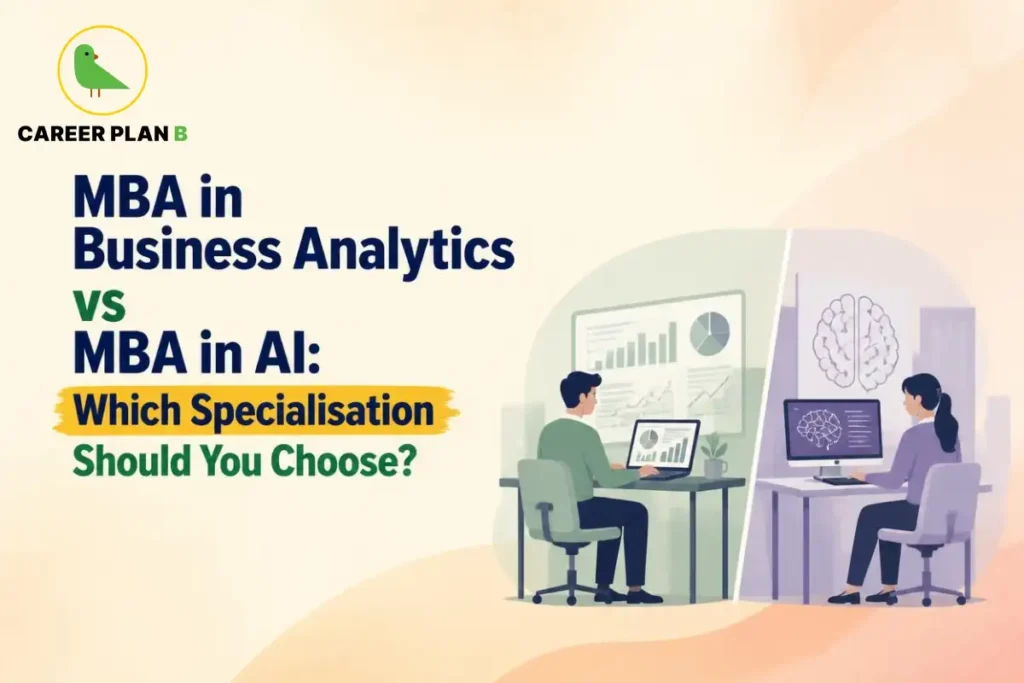
Introduction
Selecting the right management degree dictates your career trajectory in today’s tech-driven economy. Modern businesses rely heavily on data-driven strategies and automated machine systems. Therefore, candidates often compare an MBA in Business Analytics vs. an MBA in AI to decide their ideal academic path. Both fields offer incredible growth, strong salaries, and high industry demand. However, they cater to distinct skill sets and career ambitions.
Understanding the core focus of an MBA in Business Analytics alongside an MBA in AI helps you make a confident decision. Business analytics focuses on interpreting historical data to solve management problems. In contrast, artificial intelligence emphasises building predictive algorithms and autonomous systems for future operations. Consequently, evaluating MBA AI vs MBA Business Analytics requires examining your personal interests, technical aptitude, and long-term career goals.
Understanding the Core Focus: MBA AI vs MBA Business Analytics
To evaluate an MBA in Business Analytics vs. an MBA in AI, you must first examine their core objectives. While both degrees sit at the intersection of management and technology, their everyday applications differ significantly.
What is an MBA Business Analytics course?
An MBA Business Analytics course teaches students how to convert raw data into actionable business strategies. You learn statistical modelling, data visualisation, and quantitative decision-making. Moreover, this degree bridges the gap between technical data teams and corporate decision-makers. You gain expertise in tools like SQL, Tableau, R, and Python to analyse market trends.
What is an MBA AI course?
An MBA AI course focuses on integrating artificial intelligence, machine learning, and neural networks into organisational strategy. This programme prepares leaders to manage AI deployment, automation frameworks, and technological transformation. Additionally, students explore deep learning applications, natural language processing, and AI ethics. The curriculum trains you to lead complex automation projects across various corporate sectors.
Detailed Comparison: MBA in Business Analytics vs MBA in AI
| Feature | MBA in Business Analytics | MBA in AI |
|---|---|---|
| Primary Objective | Interpreting past and present data to improve decisions | Building predictive models and intelligent automation systems |
| Core Technical Tools | SQL, Tableau, Power BI, Excel, R, Python | Python, TensorFlow, PyTorch, Scikit-Learn, Cloud AI |
| Key Skills | Data visualisation, business intelligence, storytelling | Machine learning, algorithm design, AI ethics, automation |
| Target Role | Business Analyst, Data Strategy Manager | AI Product Manager, Automation Strategy Consultant |
| Ideal Candidate | Problem solvers who love data, statistics, and strategy | Tech enthusiasts who enjoy automation, coding, and future tech |
Core Difference Between MBA in AI and MBA in Business Analytics
The main difference between an MBA in AI and an MBA in Business Analytics lies in how technology is applied. Business analytics looks backward and inward to optimise existing business processes. Meanwhile, artificial intelligence looks forward to automating decisions and creating intelligent products. Furthermore, an AI vs Business Analytics MBA comparison highlights different mathematical approaches. Business analytics relies heavily on descriptive and inferential statistics. On the other hand, artificial intelligence uses advanced algorithms, deep learning, and computational modelling. Choosing between them depends on whether you prefer analysing business performance or building automated systems.
| Specialisation Track | Core Curriculum Modules | Target Professional Profile |
|---|---|---|
| MBA in Business Analytics | • Data Visualization • Statistical Modeling • Business Intelligence |
Strategic Thinkers & Data Analysts |
| MBA in AI | • Machine Learning • AI Product Design • Automation Strategy |
Tech Innovators & Automation Leads |
MBA AI vs Business Analytics Career Options and Growth
When comparing MBA AI vs. business analytics career options, both specialisations offer exceptional employment opportunities. However, the job profiles and industry expectations vary.
Career Paths for MBA in Business Analytics
Graduates holding an MBA in Business Analytics secure high-demand roles across consulting, finance, retail, and healthcare. Common job titles include:
- Business Intelligence Manager
- Data Analytics Consultant
- Supply Chain Analyst
- Operations Strategy Manager
Career Paths and MBA AI Career Scope
The MBA AI career scope is expanding rapidly as global enterprises adopt generative AI and automation. Organisations need leaders who understand both business operations and machine learning frameworks. Prominent roles include:
- AI Product Manager
- Enterprise Automation Consultant
- AI Ethics & Governance Manager
- Digital Transformation Director
Additionally, statutory bodies like the All India Council for Technical Education (AICTE) actively support technical education frameworks. Government portals like INDIAai (National AI Portal of India) also highlight the rising demand for skilled AI leaders in India.
Which is Better: an MBA in AI or Business Analytics?
Students frequently ask: which is better, an MBA in AI or business analytics? The answer depends entirely on your background and long-tail career aspirations.
| Evaluation Track | Key Decision Indicators | Industry Demand Hub |
|---|---|---|
| Choose Business Analytics | • Prefer working with structured business data • Want roles in management consulting • Stronger affinity for business strategy |
High Demand in Finance & Retail |
| Choose AI MBA | • Passionate about advanced coding & ML models • Target tech companies & innovation labs • Eager to lead automation & AI disruption |
High Demand in Tech & Automation |
An MBA in Business Analytics is ideal if you want a versatile degree with immediate applicability across every traditional industry. Conversely, an MBA in AI offers a future-proof edge if you are passionate about cutting-edge innovation, software, and enterprise automation. Therefore, examining an MBA AI and Business Analytics comparison helps you align your strengths with corporate needs.
MBA Specialisation Comparison: Evaluating Industry Demand
Performing a thorough MBA specialisation comparison shows that both fields offer excellent long-term rewards. Furthermore, choosing the best MBA specialisation for technology depends on market trends and personal interests.
Industry Adoption
Business analytics is fully integrated into modern corporate structures. Companies of all sizes use data analytics for daily decision-making. Meanwhile, artificial intelligence adoption is accelerating rapidly, creating new leadership roles for qualified managers.
Learning Curve
An MBA Business Analytics course usually requires a lower technical barrier to entry. It focuses on logic, business acumen, and accessible analytics software. In contrast, an MBA AI course may require a deeper comfort with technical concepts, algorithm logic, and software integration.
Hence, deciding which MBA specialisation is best for career growth comes down to your personal career baseline.
How Career Plan B Helps
Career Plan B helps MBA aspirants compare an MBA in Business Analytics vs. an MBA in AI, understand their career fit, and make informed decisions about specialisation, skills, and long-term career growth.
- Personalised Career Counselling: Helps candidates evaluate their academic background, technical interests, career goals, and preferred industries to identify whether an MBA in AI or Business Analytics is a better fit.
- Psycheintel and Career Assessment Tests: Helps candidates understand their interests, strengths, personality, and aptitude to choose a suitable MBA specialisation and career direction.
- Career Roadmapping: Creates a structured roadmap covering MBA specialisation, technical and managerial skills, internships, target roles, career progression, and long-term professional goals.
- Admission and Academic Profile Guidance: Supports candidates in comparing MBA AI and Business Analytics programmes, evaluating suitable colleges, understanding admission requirements, and selecting programmes aligned with their academic and career profile.
Frequently Asked Questions
Q1. What is the main difference between an MBA in Business Analytics vs. an MBA in AI?
An MBA in Business Analytics focuses on analysing historical data to solve business problems. Meanwhile, an MBA in AI focuses on developing predictive models and managing automated systems.
Q2. Can non-engineers pursue an MBA in AI?
Yes, non-engineers can pursue an MBA in AI. The programme emphasises AI strategy, management, and deployment rather than pure software development. However, basic technological familiarity is beneficial.
Q3. Which specialisation offers higher starting salaries?
Both specialisations offer competitive starting packages. However, specialised roles in artificial intelligence often command higher premiums due to the niche technical expertise required.
Q4. Is an MBA in Business Analytics easier than an MBA in AI?
Generally, business analytics relies more on statistical logic and business strategy. Artificial intelligence involves complex machine learning concepts, making its learning curve slightly steeper.
Q5. Can I transition into AI roles with a business analytics degree?
Yes, professionals with a business analytics background can transition into AI roles by upskilling in machine learning and Python.
Conclusion
Navigating an MBA in Business Analytics vs. an MBA in AI which specialisation should you choose? requires careful self-assessment. Both paths offer strong stability, competitive salaries, and rapid professional advancement. If you prefer data interpretation, business strategy, and management consulting, choose business analytics. Alternatively, if you want to lead technological disruption and software automation, choose artificial intelligence.
Making the right academic decision can feel overwhelming. Fortunately, platforms like Career Plan B and booking a free session with our expert counsellor provide expert admission guidance to help you choose the ideal university and programme.