Team Career Plan B · September 5, 2026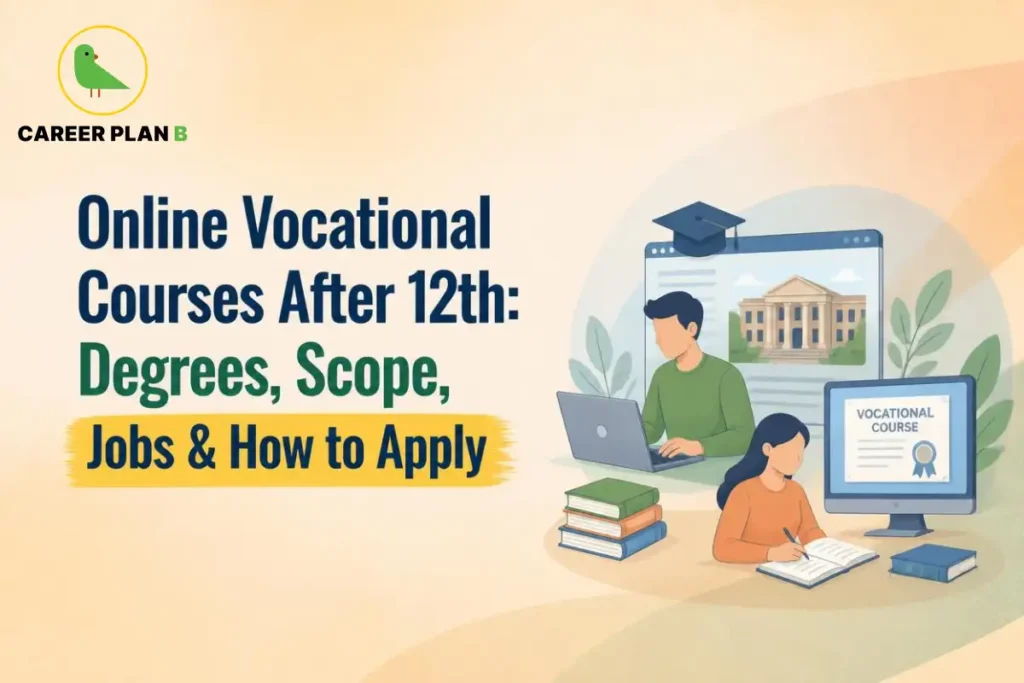
Introduction
Navigating tertiary education after high school requires choosing paths that lead directly to sustainable employment. Consequently, pursuing online vocational courses after 12th has become an effective pathway for career-focused students across India.
Many candidates actively search for online vocational degree courses after 12th to balance coursework with workplace training. Furthermore, learners frequently explore online vocational courses after 12th in India to secure immediate industry employment.
Vocational standards and curriculum frameworks nationwide are regulated by the National Council for Vocational Education and Training (NCVET). Higher education approvals and degree equivalencies are supervised by the University Grants Commission (UGC). Open and digital learning accreditations are monitored through the UGC Distance Education Bureau (DEB). National skills policies are steered under the Ministry of Skill Development and Entrepreneurship (MSDE).
This comprehensive guide details vocational qualifications, stream-wise options, short-term certifications, and career avenues.
What Are Online Vocational Courses After 12th?
Enrolling in vocational courses after 12th provides hands-on practical training rather than abstract academic lectures. Unlike conventional arts or science streams, online vocational courses focus directly on specific industry competencies.
Students complete theoretical modules through digital learning management systems and virtual labs. Meanwhile, essential practical skills are honed via scheduled industry apprenticeships or simulation software.
Therefore, modern online vocational education bridges the divide between formal schooling and real-world employer expectations.
The Landscape of Vocational Education in India
The landscape of vocational education in India has evolved significantly under the National Skills Qualifications Framework. The framework standardizes competencies from secondary levels up to advanced research qualifications.
Government policies encourage accredited universities to deliver vocational degree courses in India. These flexible formats allow candidates to earn while learning, reducing financial stress on families.
Consequently, modern vocational courses in India enjoy complete regulatory parity with conventional college qualifications.
Exploring Online Vocational Degrees: The B.Voc Framework
Candidates seeking an online vocational degree usually choose the Bachelor of Vocation (B.Voc) structure. This specialized undergraduate format includes multiple entry and exit points:
- Exit at Year 1: Students earn an accredited Diploma aligned with NSQF Level 5.
- Exit at Year 2: Candidates receive an Advanced Diploma corresponding to NSQF Level 6.
- Exit at Year 3: Graduates obtain a full vocational degree online matching NSQF Level 7.
As a result, completing online vocational degrees ensures learners hold valid qualifications even during academic pauses.
Popular Vocational Degree Courses in India
Universities deliver diverse vocational degree courses tailored to fast-growing corporate, medical, and technical sectors:
| Vocational Specialization Track | Core Practical Competencies | Primary Target Sectors |
|---|---|---|
| B.Voc in Medical Lab Technology (MLT) | Diagnostic biochemistry, hematology, and sample pathology. | Diagnostic labs, trauma hospitals, and pathology clinics. |
| B.Voc in Software Development & IT | Full-stack coding, database querying, and cloud deployment. | Software development companies and IT consultancies. |
| B.Voc in Digital Media & Animation | Motion graphics, 3D modeling, and visual video effects. | Digital media agencies, gaming hubs, and film studios. |
| B.Voc in Banking, Financial Services & Insurance (BFSI) | Ledger audits, mutual fund operations, and retail credit reviews. | Commercial banks, fin-tech startups, and insurance agencies. |
| B.Voc in Retail Management & E-Commerce | Supply chain logistics, retail merchandising, and stock inventory. | E-commerce platforms and multi-brand retail outlets. |
| B.Voc in Renewable Energy & Solar Tech | Photovoltaic design, inverter assembly, and grid power audits. | Solar farm developers and electrical contractors. |
Note: Curricula in online vocational degree courses in India require a minimum 60% practical training component.
Best Vocational Courses After 12th for Science Students
Science school graduates possess strong analytical foundations and technical curiosity. Consequently, selecting practical vocational options provides a rapid entry route into high-demand engineering and healthcare sectors:
| Vocational Course Domain | Specialization Options | Primary Clinical / Tech Employers |
|---|---|---|
| Medical Laboratory & Diagnostic Tech | DMLT, B.Voc in MLT, Radiology Assistance. | Multispecialty hospitals and diagnostic chains. |
| Software Development & Cyber Security | Full-Stack Web Development, Cloud Computing. | IT services enterprises and SaaS companies. |
| Renewable & Solar Energy Engineering | Solar PV Design, Energy Audit Management. | Solar infrastructure developers and power utilities. |
| Automotive Diagnostics & Mechatronics | Electric Vehicle Systems, Hybrid Diagnostics. | EV manufacturers and modern service hubs. |
Therefore, science students can secure rewarding technical careers without spending four years in rigid engineering programs.
Best Vocational Courses After 12th Commerce Students
Commerce students already understand accounting basics, commercial regulations, and market mechanisms. Consequently, enrolling in industry-aligned vocational programs prepares them for corporate financial operations:
| Vocational Program Domain | Practical Skills Imparted | Target Corporate Roles |
|---|---|---|
| Banking & Financial Services (BFSI) | Retail credit analysis, loan approvals, wealth assets. | Commercial banks and NBFC credit units. |
| Business Accounting & Taxation (BAT) | Tally Prime, GST filing, TDS compliance, payroll. | CA firms and corporate accounting teams. |
| Digital Marketing & E-Commerce | Search engine optimization, PPC ads, social media. | E-commerce brands and advertising agencies. |
| Supply Chain & Logistics Operations | Inventory control, cargo tracking, warehouse systems. | Global logistics firms and retail chains. |
Moreover, commerce graduates can balance these vocational tracks with professional exams like CA or CMA effortlessly.
Short-Term Vocational Courses After 12th (3–12 Months)
If you wish to enter the job market quickly, short-term certifications offer targeted vocational training:
| Short-Term Certification Course | Typical Duration | Focus Areas & Software Tools |
|---|---|---|
| Certificate in Accounting & GST (Tally) | 3 to 6 Months | Tally Prime, e-invoicing, GST portal returns. |
| Certificate in Digital Marketing | 3 to 6 Months | Google Analytics, meta advertisements, SEO tools. |
| Certificate in Web Interface Design (UI/UX) | 6 to 9 Months | Figma, wireframing, user persona research. |
| Certificate in Data Analytics & Excel | 6 to 12 Months | Advanced Excel, SQL querying, Power BI dashboards. |
| Certificate in Phlebotomy & Lab Assistance | 6 to 12 Months | Blood collection, sample handling, lab hygiene. |
As a result, online vocational certificate programs provide fast, actionable skill upgrades at a fraction of degree costs.
Short-Term Vocational Certificate Programs vs Full Degrees
Understanding the differences between short certifications and complete degrees helps candidates plan their study paths:
| Feature / Metric | Online Vocational Certificate Programs | Online Vocational Degree Programs |
|---|---|---|
| Standard Duration | 3 months to 12 months. | 3 academic years (6 semesters). |
| Primary Curriculum Focus | Single operational trade skill. | Holistic managerial and technical trade mastery. |
| Regulatory Standing | Skill-level certificate. | Recognized undergraduate university degree. |
| Government Job Validity | Eligible for technical trade posts. | Fully valid for UPSC, SSC, and graduate exams. |
| Average Tuition Cost | ₹4,000 to ₹18,000 total. | ₹35,000 to ₹1,20,000 for three years. |
Consequently, vocational certificate programs suit short-term upskilling, while degrees support long-term managerial promotions.
Eligibility Criteria for Online Vocational Programs
Reviewing eligibility requirements ensures candidates complete their enrollment without administrative delays:
- Qualifying Examination: Candidates must pass Class 12 (10+2) from a recognized state or central board.
- Academic Streams: Students from Arts, Commerce, Science, and technical ITI backgrounds are welcome to apply.
- Minimum Marks: Most institutions mandate a simple passing grade or 45% aggregate marks in senior secondary.
- Age Limits: Accredited online vocational schools enforce no upper age cap for adult distance learners.
Therefore, flexible admission norms make these programs accessible to learners from diverse academic backgrounds.
Step-by-Step Online Vocational Degree Admission Process
The online vocational degree admission process is conducted smoothly through digital university admission portals:
| Admission Stage | Candidate Action Required | Formal Milestone / Outcome |
|---|---|---|
| Stage 1: University Selection | Browse UGC-DEB approved institutions offering B.Voc programs. | Valid institute confirmed |
| Stage 2: Application Entry | Complete the online form with academic details and trade choices. | Application ID created |
| Stage 3: Document Verification | Upload Class 10 and 12 mark sheets along with identity verification. | Credentials submitted |
| Stage 4: Fee Payment | Pay semester fees online via net banking, UPI, or debit cards. | Confirmed vocational degree admission |
| Stage 5: LMS Onboarding | Access the online learning portal to begin coursework and practicals. | Academic session commenced |
Core Skills Built During Online Vocational Training
Enrolling in online vocational training builds practical problem-solving capabilities required by modern corporate employers:
- Technical Trade Mastery: Students learn industry-standard software, testing machinery, and modern diagnostic protocols.
- Digital Literacy & Tools: Programs teach enterprise communication tools, data analytics, and digital management dashboards.
- Workplace Ethics & Safety: Courses cover occupational health regulations, statutory compliance, and industrial standards.
- Applied Business Communication: Candidates practice presentation skills, technical client reporting, and team collaboration.
For Personalized Guidance
Vocational Degree Career Scope and Job Opportunities
Evaluating the vocational degree scope and career options reveals strong employment prospects across diverse sectors:
| Vocational Job Profile | Core Day-to-Day Responsibilities | Average Starting Salary (INR) |
|---|---|---|
| Medical Laboratory Technologist | Conducting diagnostic blood analyses and running clinical testing. | ₹2,80,000 – ₹4,60,000 |
| Junior Web / Software Developer | Writing clean code, building responsive interfaces, and debugging. | ₹3,60,000 – ₹6,00,000 |
| Renewable Energy Field Engineer | Installing rooftop solar panels and inspecting electrical lines. | ₹3,20,000 – ₹5,20,000 |
| Digital Marketing & SEO Associate | Managing ad budgets, optimizing content, and reviewing web traffic. | ₹3,00,000 – ₹5,00,000 |
| Supply Chain & Logistics Assistant | Tracking warehouse shipments and monitoring wholesale dispatches. | ₹2,80,000 – ₹4,40,000 |
Disclaimer: The salary figures mentioned above are indicative annual estimates and may vary based on experience, location, industry, employer, qualifications, skill level, and job role.
Long-Term Vocational Degree Career Scope: Promotions & Higher Studies
Graduates frequently wonder about the long-term vocational degree career scope after completing their studies.
Holding an accredited undergraduate qualification qualifies candidates for all central and state government competitive examinations. For example, graduates can sit for UPSC Civil Services, SSC CGL, and national banking exams.
Furthermore, students can pursue postgraduate studies like Master of Vocation (M.Voc), regular MBA, or MCA programs. Consequently, these vocational degree jobs serve as stable stepping stones toward senior executive leadership.
Why Choose Vocational Courses Online Over Conventional Degrees?
Selecting modern vocational courses online offers distinct practical advantages over standard classroom education:
High Practical Curriculum Alignment
Traditional degrees emphasize memorization and theoretical lectures. In contrast, vocational education focuses entirely on trade skills demanded by current hiring managers.
Lower Total Tuition Expenses
Conventional campus degrees often require costly hostel, transportation, and campus lifestyle fees. Conversely, distance vocational learning minimizes overall educational expenses.
Immediate Workplace Employability
Employers frequently complain about college graduates lacking actionable skills. Vocational graduates enter corporate roles ready to deliver value from their very first week.
How Career Plan B Helps
Choosing the right vocational course and career pathway requires careful evaluation of your interests, skills, qualifications, and long-term goals. Career Plan B supports learners through:
- Personalized Career Counselling: Get guidance based on your academic profile, interests, career goals, and preferred vocational field.
- Psycheintel and Career Assessment Tests: Identify your aptitude, strengths, and interests to match you with suitable vocational career options.
- Career Roadmapping: Build a structured pathway covering the right course, skill development, certifications, and future career opportunities.
- Admission and Academic Profile Guidance: Evaluate your academic profile and guide you toward suitable vocational programmes and admission options aligned with your career goals.
Get In Touch With Us
Frequently Asked Questions
Q1. Is an online vocational degree valid for government jobs in India?
Yes, B.Voc degrees granted by UGC-recognized universities carry complete legal equivalence for all central and state civil service exams.
Q2. Can I study an online vocational course while working full-time?
Yes, flexible online learning portals let working candidates study recorded modules during evenings and weekends.
Q3. How are practical workshops conducted in online vocational programs?
Universities partner with local accredited industry centers or employ virtual interactive simulation platforms for practical labs.
Q4. Can I pursue an MBA after completing a B.Voc degree?
Yes, B.Voc graduates are fully eligible to appear for CAT, MAT, and CMAT to secure business school admissions.
Q5. Which stream is best for vocational courses after 12th?
Software development, medical lab technology, and digital marketing offer the highest placement rates and starting compensation.
Conclusion
Choosing the right online vocational courses after 12th can be a practical way to develop job-ready skills while enjoying the flexibility of online learning. Industry-focused programmes can help students build relevant technical and professional skills for opportunities across healthcare, IT, business, hospitality, and other growing sectors.
A recognised vocational qualification can also provide a foundation for higher education, professional certifications, and future career advancement. Before enrolling, consider the course curriculum, accreditation, eligibility, fees, practical training, and career prospects.
Confused about which online vocational course is right for you? Connect with Career Plan B experts which can help you compare courses, evaluate career opportunities, and create a personalized roadmap based on your interests and goals. Start your career journey with Career Plan B!