Team Career Plan B · September 5, 2026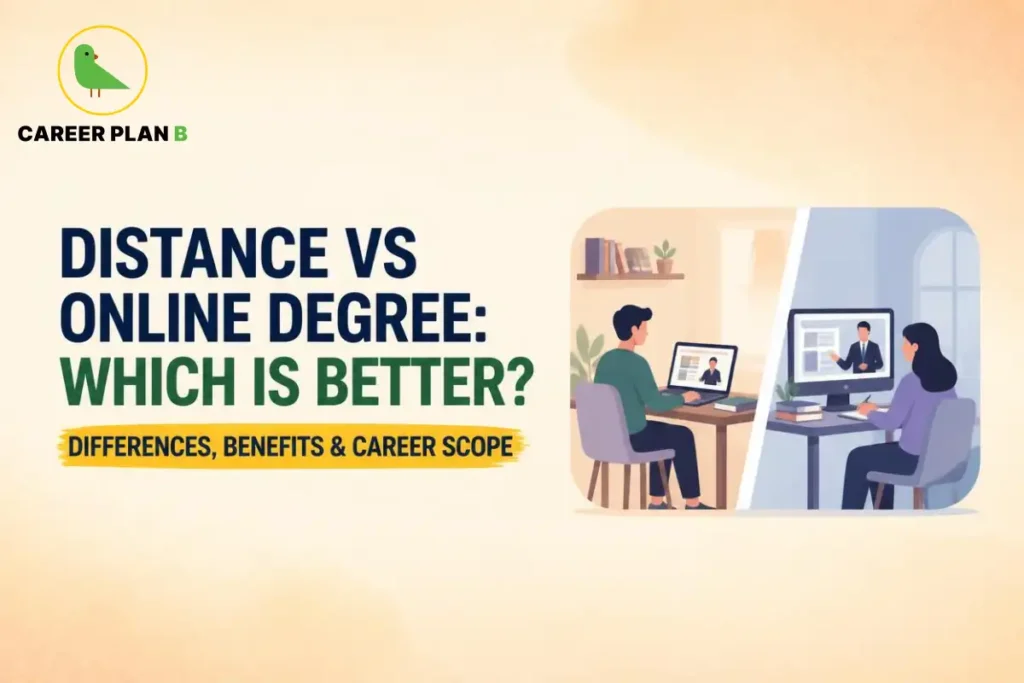
Introduction
Navigating flexible higher education has become an important decision for students and working professionals across India. Consequently, evaluating Distance vs Online Degree Which Is Better is essential before selecting an undergraduate or postgraduate program.
Many learners constantly ask: online degree vs distance degree which is better for corporate placements and government examinations? Furthermore, students actively compare the difference between online and distance degree models to determine suitable daily study routines.
Higher educational standards and university accreditations in India are supervised by the University Grants Commission (UGC). Additionally, open and online degree recognitions are governed through the UGC Distance Education Bureau (DEB). National digital initiatives and higher education regulations are framed under the Ministry of Education (MoE).
This comprehensive guide details pedagogical structures, fee comparisons, technological differences, examination modes, and long-term career growth.
Understanding Distance Education vs Online Education in India
Evaluating distance education vs online education in India requires examining how each learning framework evolved. While both formats eliminate daily on-campus attendance, their delivery systems operate differently.
A traditional distance learning degree primarily utilizes printed self-instructional study materials and designated regional study centers. In contrast, an online education degree operates entirely through interactive digital Learning Management Systems (LMS).
Therefore, analyzing distance learning vs online learning helps learners identify which interface best suits their technical access and personal lifestyle.
What is the Core Difference Between Online and Distance Degree?
Understanding the fundamental difference between distance and online degree structures clarifies how students engage with faculty:
| Comparison Parameter | Distance Degree Courses (ODL) | Online Degree Courses (OL) |
|---|---|---|
| Study Material Delivery | Physical printed books dispatched via post; optional PDF downloads. | 100% digital e-content, interactive e-books, and multimedia modules. |
| Lectures & Faculty Interaction | Optional weekend counseling at physical Learner Support Centres. | Live virtual webinars, recorded interactive video lectures, and discussion forums. |
| Examination System | Pen-and-paper examinations held at designated physical test centers. | Remote AI-proctored online assessments conducted via home webcams. |
| Technological Requirements | Minimal; basic offline reading and occasional internet browsing. | Mandatory high-speed broadband, modern laptop, and webcam setup. |
| Admission & Enrollment Cycles | Biannual university admissions (e.g., January and July sessions). | Biannual digital enrollments with instant online document checks. |
Consequently, distance vs online education reflects a clear contrast between self-paced offline study and interactive digital immersion.
Key Distance Education Benefits
Examining the distinct distance education benefits explains why millions of non-traditional learners choose open and distance universities:
- Minimal Dependence on Digital Devices: Distance education does not require continuous high-speed internet or expensive laptops. Students in tier-3 cities and rural areas can study primarily through printed textbooks and self-learning materials.
- Affordable Tuition Fees: Most distance degree courses offer comparatively affordable fee structures. This makes recognised bachelor’s and master’s degrees accessible to students from different financial backgrounds without creating a heavy financial burden.
- Flexible Study Schedule: Distance learning provides greater control over study hours, as students are generally not required to attend regular live classes. Working professionals, civil-service aspirants, and other busy learners can study according to their personal schedules.
Major Online Degree Benefits
Evaluating the specialized online degree benefits highlights why working professionals increasingly prefer digital learning platforms:
- Interactive Digital Learning Environments: Modern online degree courses use Learning Management Systems (LMS) with video lectures, gamified quizzes, digital study materials, and transcripts. Students can also participate in discussion forums and submit queries for faculty support.
- Live Masterclasses and Industry Mentorship: Many online university programs offer live classes, expert sessions, and industry-led webinars. These sessions help learners understand real-world applications, practical case studies, and current industry trends alongside their academic coursework.
- Remote Online Examinations: Eligible online programs may allow students to complete examinations remotely using secure online examination and proctoring systems. This provides greater convenience for working professionals and learners who may otherwise need to travel to examination centres.
Curriculum, Specializations and Course Offerings
Analyzing online degree vs distance education reveals varying academic choices across disciplines:
- Distance Degree Offerings: Open universities offer extensive catalogs in humanities, social sciences, commerce, and pure sciences. Popular tracks include BA, B.Com, B.Sc, MA, and M.Com.
- Online Degree Offerings: Digital universities focus heavily on technology and corporate administration. Popular tracks include Online BBA, Online BCA, Online MBA, and specialized M.Sc in Data Science.
- Prohibited Academic Disciplines: Under UGC regulations, neither mode may offer medicine, engineering, law, pharmacy, dental, or agriculture.
Consequently, students seeking specialized IT or business credentials often lean toward digital university platforms.
For Personalized Guidance
Fee Structure: Distance vs Online Degree Programs
Comparing program expenses helps learners align their educational goals with personal budgets:
| Program Level & Field | Traditional Distance Degree Fees (Total) | Modern Online Degree Fees (Total) |
|---|---|---|
| Bachelor of Arts (BA General) | ₹10,000 – ₹18,000 | ₹45,000 – ₹90,000 |
| Bachelor of Commerce (B.Com) | ₹12,000 – ₹22,000 | ₹55,000 – ₹1,10,000 |
| Bachelor of Computer Applications (BCA) | ₹35,000 – ₹55,000 | ₹90,000 – ₹1,80,000 |
| Bachelor of Business Administration (BBA) | ₹25,000 – ₹45,000 | ₹95,00,000 – ₹2,00,000 |
| Master of Business Administration (MBA) | ₹35,000 – ₹70,000 | ₹1,20,000 – ₹2,80,000 |
Disclaimer: The fee ranges mentioned above are indicative estimates intended for general comparison purposes only. Actual distance and online degree fees may vary depending on the university, program specialization, duration, admission year, examination fees, study materials, technology or LMS charges, and other applicable costs.
Regulatory Reality: Are Distance and Online Degrees Legally Valid?
Prospective applicants frequently question the legal recognition of an online degree vs distance degree.
Under UGC (Open and Distance Learning Programmes and Online Programmes) Regulations, both formats hold equal legal standing to conventional on-campus degrees. Therefore, degrees awarded by UGC-DEB-recognized universities are fully valid for all corporate and public opportunities:
- Union Public Service Commission (UPSC Civil Services) examinations.
- Staff Selection Commission (SSC CGL) and Railway Recruitment Board (RRB) recruitments.
- Public sector banking examinations conducted by IBPS and SBI.
- State Public Service Commission (State PSC) exams.
- Postgraduate admissions in premier institutions across India and abroad.
Furthermore, official regulations forbid public employers from discriminating between regular, distance, or online qualifications.
Career Scope and Placement Realities
Evaluating whether an online degree or distance degree offers superior employment opportunities depends on candidate performance:
| Professional Career Path | Primary Corporate Recruiters | Expected Annual Starting Package (INR) |
|---|---|---|
| Junior Software / Web Developer | IT consultancies, tech startups, and digital service firms. | ₹3,60,000 – ₹6,00,000 |
| Digital Marketing & Growth Associate | E-commerce brands, marketing agencies, and media companies. | ₹3,00,000 – ₹5,20,000 |
| Corporate HR Executive | Recruitment agencies, enterprise consultancies, and MNCs. | ₹3,20,000 – ₹4,80,000 |
| Junior Financial Analyst | Fin-tech firms, banking back-offices, and audit agencies. | ₹3,50,000 – ₹5,50,000 |
| Operations & Logistics Coordinator | Retail distribution hubs and supply chain networks. | ₹2,80,000 – ₹4,50,000 |
Corporate hiring managers evaluate demonstrable software tools, communication competence, and internship experience above delivery formats.
Online or Distance Degree: Which Should You Choose?
Deciding online or distance degree which should you choose comes down to your financial budget, tech access, and learning preferences:
Choose a Distance Degree If:
- You want an economical degree with minimal tuition fees.
- You live in an area with limited internet bandwidth.
- You prefer studying from physical, printed textbooks.
- You are preparing full-time for competitive exams like UPSC, SSC, or state PSCs.
Choose an Online Degree If:
- You have a reliable computer, webcam, and stable internet setup.
- You desire interactive LMS tools, live virtual lectures, and digital forums.
- You are a working professional seeking modern management or IT specializations.
- You prefer taking remote proctored examinations from your home desk.
How Career Plan B Helps
Navigating open university accreditations, comparing online programs, and selecting the right specializations requires structured mentorship. Career Plan B assists ambitious learners across India through:
- Personalised Career Counselling: We evaluate your academic background, daily availability, and financial budget. As a result, we recommend whether an online or distance degree aligns best with your professional milestones.
- Psycheintel & Skill Assessments: Our scientific diagnostic evaluations identify whether your aptitudes suit management, data analytics, software development, or public administration. Consequently, you invest your time in the most rewarding degree program.
- University Accreditation Audits: We inspect prospective universities against official UGC-DEB lists and NAAC ranking criteria. Additionally, our mentors ensure your enrolled degree holds complete legal validity for higher studies and government exams.
- Career Roadmapping: Our mentorship extends far beyond enrollment forms. Furthermore, we help you plan professional resume optimization, software skill certifications, and job interview preparation.
Get In Touch With Us
Frequently Asked Questions
Q1. Is an online degree certificate different from a regular degree certificate?
UGC regulations mandate that degrees awarded through online or distance modes state the delivery format on the final certificate. However, their legal equivalence remains identical.
Q2. Can I pursue two degrees simultaneously through distance and online modes?
Yes, UGC guidelines permit students to pursue two academic degrees simultaneously, combining regular, distance, or online formats.
Q3. Which is cheaper between distance and online degrees?
Distance degree courses offered by central and state open universities are significantly more affordable than private online degree programs.
Q4. Are online degree exams conducted from home?
Yes, accredited online degree programs conduct end-semester examinations using remote AI-proctored software.
Q5. Can I apply for an MBA abroad after completing a distance or online bachelor’s degree?
Yes, international universities accept degrees from UGC-recognized universities, subject to foreign credential evaluations and standard language tests.
Conclusion
Choosing between distance vs online degree—which is better depends on your learning style, budget, technology access, and career goals. Distance education offers flexible, largely self-paced learning, while online degrees provide greater digital interaction through virtual classes, learning platforms, and online academic resources.
Both modes can be valuable for higher education, corporate careers, and competitive exam preparation, provided you choose a recognised programme that meets the relevant regulatory requirements. Consider factors such as course structure, flexibility, fees, assessment methods, student support, and career outcomes before making your decision.
Connect with Career Plan B experts which can help you compare programmes, understand your options, and choose the right learning pathway for your career goals.