Team Career Plan B · September 7, 2026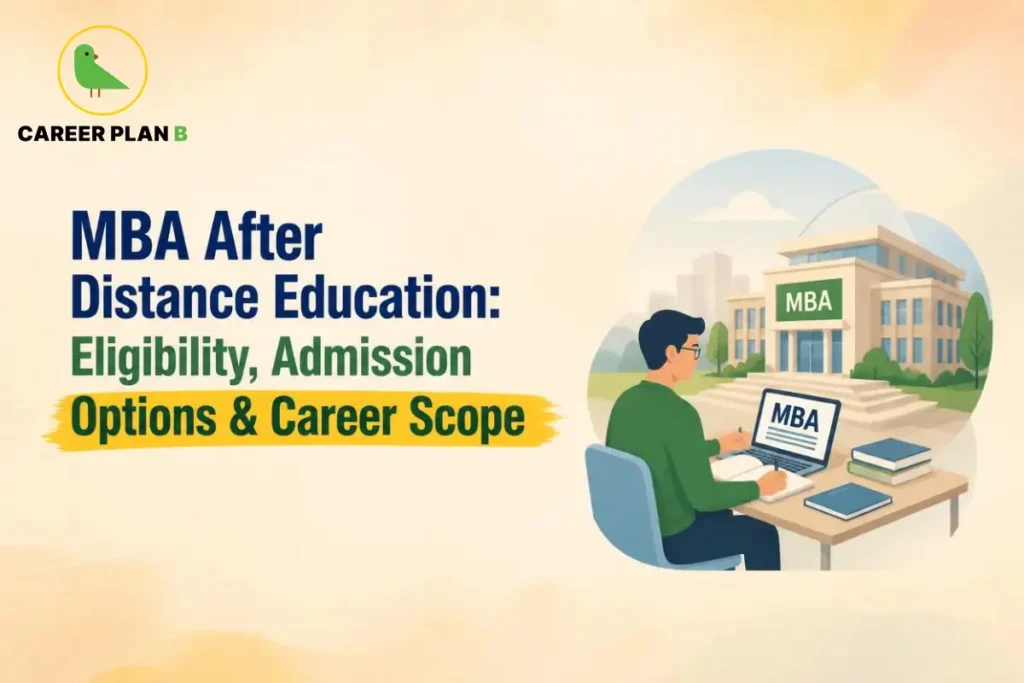
Introductions
Pursuing an advanced business management degree provides an exceptional pathway for career progression across modern corporate industries. Consequently, evaluating an MBA After Distance Education has become an important inquiry for non-traditional university graduates across India.
Many ambitious learners frequently ask: can you do an MBA after distance graduation and is a distance degree valid for MBA admission? Furthermore, candidates actively inquire whether distance graduation restricts eligibility for prestigious national business schools.
Higher education standards and open learning equivalencies in India are governed by the University Grants Commission (UGC). Additionally, Open and Distance Learning (ODL) approvals are monitored by the UGC Distance Education Bureau (DEB). Technical management curriculum approvals and institutional norms are directed under the All India Council for Technical Education (AICTE). National educational initiatives and degree equivalence policies are steered by the Ministry of Education (MoE).
This comprehensive guide details statutory eligibility norms, entrance exam requirements, admission options, and corporate career opportunities.
Can Distance Graduates Apply for MBA Programs in India?
A common question among young graduates is: can distance graduates apply for MBA courses in top institutions? The legal and regulatory answer is an absolute yes.
According to official UGC statutory notifications, degrees earned through accredited open and distance universities carry full legal equivalence. Therefore, holding a recognized distance degree grants complete parity with conventional on-campus degrees.
Consequently, learners wondering if I can pursue MBA after completing graduation through distance education can confidently plan their admission applications.
Does Distance Graduation Affect MBA Admission Prospects?
Prospective management applicants often worry: does distance graduation affect MBA admission during selection rounds?
In reality, business schools evaluate candidates based on entrance exam scores, written analytical tests, and personal interviews. Furthermore, interview panels evaluate problem-solving ability, leadership communication, and professional work experience.
Moreover, many distance graduates accumulate practical workplace experience while studying. As a result, having verifiable industry exposure frequently gives distance learners a distinct advantage during business school evaluations.
Therefore, completing your MBA after graduation via distance learning does not hinder your business school admission chances.
Core MBA Eligibility Criteria for Distance Degree Holders
Understanding the baseline MBA eligibility criteria ensures candidates prepare their documentation without administrative errors:
| Eligibility Dimension | Prescribed Academic Norm | Regulatory / Institutional Guidelines |
|---|---|---|
| Graduation Qualification | Bachelor’s degree in any discipline (BA, B.Com, B.Sc, BBA, BCA, B.Tech). | Must be awarded by a UGC-DEB-recognized open or state university. |
| Minimum Percentage Threshold | Minimum 50% aggregate marks (45% for SC/ST/PwD candidates). | Standard benchmark stipulated by AICTE and university boards. |
| Program Duration Model | Minimum 3-year undergraduate degree pattern (10+2+3 or 10+2+4). | One-year fast-track degrees are strictly invalid under UGC norms. |
| Entrance Examination Score | Valid percentile score in recognized national or state entrance tests. | Required for regular IIMs, top private B-schools, and universities. |
Consequently, satisfying these standardized MBA admission requirements confirms your eligibility for centralized counseling.
What Are the Requirements for MBA After Distance Graduation?
Candidates evaluating what are the requirements for MBA after distance graduation must fulfill distinct academic steps:
1. Verification of University Recognition
Your undergraduate university must possess valid UGC and DEB approvals during your enrolled academic session. Therefore, graduating from unaccredited private educational shops invalidates your MBA admission eligibility.
2. Clearing Recognized Entrance Examinations
Aspirants must register for competitive management entrance tests aligned with their chosen business school track. As a result, earning a competitive percentile score ensures shortlisting for advanced selection rounds.
3. Assembling Mandatory Academic Certificates
Applicants must produce official degree certificates, semester mark sheets, migration clearances, and category certificates during physical verification.
Are Distance Degree Holders Eligible for Regular MBA Colleges?
Many students ask: are distance degree holders eligible for regular MBA full-time residential programs?
Yes, statutory guidelines prevent universities from disqualifying applicants based solely on distance learning degrees. Therefore, premier management institutions welcome distance learners who clear mandatory entrance cutoffs:
- Indian Institutes of Management (IIMs): Accept distance graduates who score high percentiles in the Common Admission Test (CAT).
- XLRI, Jamshedpur & XAMI Institutes: Evaluate distance candidates equally through Xavier Aptitude Test (XAT) scores.
- Symbiosis International University: Accepts distance degree holders through the Symbiosis National Aptitude Test (SNAP).
- NMIMS School of Business Management: Admits distance graduates who achieve qualifying cutoffs in NMAT.
- Central & State Universities: Accept distance graduates through CUET-PG, MAH-CET, and state-level entrance exams.
Consequently, holding a distance learning degree does not restrict your access to premier full-time business campuses.
MBA Entrance Requirements and Examination Options
Meeting standardized MBA entrance requirements involves preparing for specific national, state, or institutional management tests:
| Entrance Examination | Administering Body | Target Management Institutions |
|---|---|---|
| Common Admission Test (CAT) | Indian Institutes of Management (IIMs) | 21 IIMs, FMS Delhi, IIT DoMS, and premier private colleges. |
| Xavier Aptitude Test (XAT) | XLRI Jamshedpur | XLRI, XIMB, IMT Ghaziabad, and over 160 partner B-schools. |
| Graduate Management Admission Test (GMAT) | Graduate Management Admission Council | Global business schools and executive MBA programs across India. |
| Common Management Admission Test (CMAT) | National Testing Agency (NTA) | AICTE-approved management institutions and state universities. |
| Management Aptitude Test (MAT) | All India Management Association (AIMA) | Over 600 business schools offering regular and hybrid MBA programs. |
Note: Preparing early for quantitative aptitude, logical reasoning, and verbal ability is vital for competitive percentile scores.
Top Admission Options for an MBA After Distance Education
Graduates can choose from diverse postgraduate management courses tailored to their professional commitments:
| MBA Study Track | Program Model & Duration | Best Suited For | Key Academic Advantage |
|---|---|---|---|
| Full-Time Regular MBA | 2-Year full-time residential curriculum. | Fresh graduates and early career candidates. | Comprehensive on-campus placements and direct peer networking. |
| Executive MBA (EMBA) | 1-Year intensive cohort program. | Working professionals with 2 to 5+ years of experience. | Accelerated leadership curriculum without leaving jobs permanently. |
| Online & Distance MBA | 2-Year flexible online delivery. | Full-time corporate employees and busy executives. | Self-paced learning modules, weekend lectures, and remote exams. |
Full-Time Residential MBA
This classic two-year track offers daily classroom interactions, student club activities, and structured summer internships. Therefore, it suits younger distance graduates seeking comprehensive corporate transitions.
Executive MBA (EMBA)
Designed specifically for experienced professionals, this one-year intensive program builds strategic managerial acumen. Consequently, distance graduates with two to five years of verifiable workplace experience gain immense leadership value.
Online & Open Distance MBA
For candidates who must maintain full-time jobs, accredited online MBA programs provide maximum scheduling freedom. Furthermore, digital lectures, weekend webinars, and AI-proctored exams allow professionals to upskill without career breaks.
Popular MBA Specializations and Industry Demand
Choosing the right functional track ensures your MBA qualification translates into meaningful industry promotions:
- MBA in Finance: Focuses on corporate valuation, portfolio management, investment banking, and capital market audits.
- MBA in Marketing: Emphasizes digital brand strategy, consumer psychology, market analytics, and customer relationship management.
- MBA in Human Resource Management: Concentrates on talent acquisition, corporate labor laws, organizational design, and employee retention.
- MBA in Business Analytics & Data Science: Merges statistical modeling with management decision-making using SQL, Python, and Tableau.
- MBA in Operations & Supply Chain: Prepares managers for global logistics coordination, manufacturing operations, and inventory optimization.
Career Scope and Salary Outlook After Completing an MBA
Earning a recognized postgraduate business degree unlocks high-paying managerial opportunities across diverse economic sectors:
| Managerial Designation | Primary Industry Employers | Average Starting Salary (INR) |
|---|---|---|
| Management Consultant | Strategy firms, advisory consultancies, and Big Four agencies. | ₹9,00,000 – ₹18,00,000 |
| Corporate Financial Analyst | Investment banks, private equity firms, and corporate treasuries. | ₹7,50,000 – ₹14,00,000 |
| Product Marketing Manager | Tech startups, FMCG corporations, and e-commerce platforms. | ₹8,00,000 – ₹15,50,000 |
| Human Resources Business Partner | Multinational enterprises, IT consultancies, and manufacturing firms. | ₹6,50,000 – ₹12,00,000 |
| Supply Chain Operations Manager | Logistics giants, export-import houses, and retail networks. | ₹7,00,000 – ₹13,50,000 |
Note: Salary packages vary widely depending on business school ranking, academic percentile, past work experience, and interview performance.
Essential Steps to Transition from Distance Degree to Regular MBA
Securing admission into premier business schools requires strategic, disciplined planning. Follow this structured roadmap to maximize your admission chances:
- Verify Degree Recognition: Confirm that your undergraduate open university appears on the official UGC-DEB entitlement lists.
- Start Entrance Preparation Early: Dedicate six to nine months to preparing for quantitative, verbal, and analytical sections.
- Build Profile Strength: Complete industry certifications, engage in meaningful NGO volunteer work, or gain practical internships.
- Master Personal Interviews: Practice explaining your non-traditional educational journey with confidence, highlighting self-discipline and time management.
How Career Plan B Helps
Navigating business school entrance exams, verifying university accreditations, and structuring MBA applications requires experienced guidance. Career Plan B assists ambitious distance graduates across India through:
- Personalised Career Counselling: We evaluate your academic performance, work experience, and long-term career aspirations. As a result, our mentors recommend whether a full-time, executive, or online MBA aligns best with your professional goals.
- Psycheintel & Skill Assessments: Our scientific diagnostic evaluations identify whether your leadership mindset matches finance, marketing, human resources, or analytics. Consequently, you invest your efforts into the most rewarding specialization.
- University Accreditation Audits: We inspect prospective business schools and universities against official UGC-DEB and AICTE databases. Additionally, our mentors ensure your target degree holds complete statutory validity for executive corporate placements.
- Career Roadmapping: Our mentorship extends far beyond entrance forms. Furthermore, we help you plan profile enhancements, mock interview preparation, corporate resume building, and strategic post-MBA job transitions.
Get In Touch With Us
Frequently Asked Questions
Q1. Can I appear for the CAT exam with a distance education degree?
Yes, the Common Admission Test accepts distance graduates holding a recognized bachelor’s degree with at least 50% aggregate marks.
Q2. Do IIMs accept students who graduated through open universities?
Yes, IIMs admit candidates based strictly on CAT scores, academic profiles, diversity factors, and personal interview performance without discriminating against distance degrees.
Q3. Is work experience mandatory for an MBA after distance education?
Work experience is not mandatory for regular two-year MBA programs, though it is compulsory for specialized executive MBA courses.
Q4. Can a distance graduate pursue an MBA abroad?
Yes, international business schools accept UGC-recognized 3-year or 4-year distance degrees, provided candidates submit acceptable GMAT/GRE and IELTS scores.
Q5. What is the minimum percentage required in distance graduation for MBA admission?
Most premier universities require a minimum of 50% aggregate marks for general category applicants and 45% for reserved categories.
Conclusion
Pursuing an MBA after distance education can be a valuable pathway for graduates looking to advance into management and leadership roles. A recognised distance degree can provide the academic foundation needed to pursue higher education, while your professional experience, entrance exam performance, and industry-relevant skills can further strengthen your MBA profile.
Whether you aim for careers in finance, marketing, human resources, operations, consulting, or entrepreneurship, choosing the right MBA programme is essential. Before applying, verify your degree recognition, check the MBA’s eligibility criteria, and evaluate the institution, curriculum, placement opportunities, and admission requirements.
Planning to pursue an MBA after distance education? Connect with Career Plan B experts who can help you assess your eligibility, shortlist suitable MBA programmes, and plan your next academic and career move with confidence.