Team Career Plan B · September 8, 2026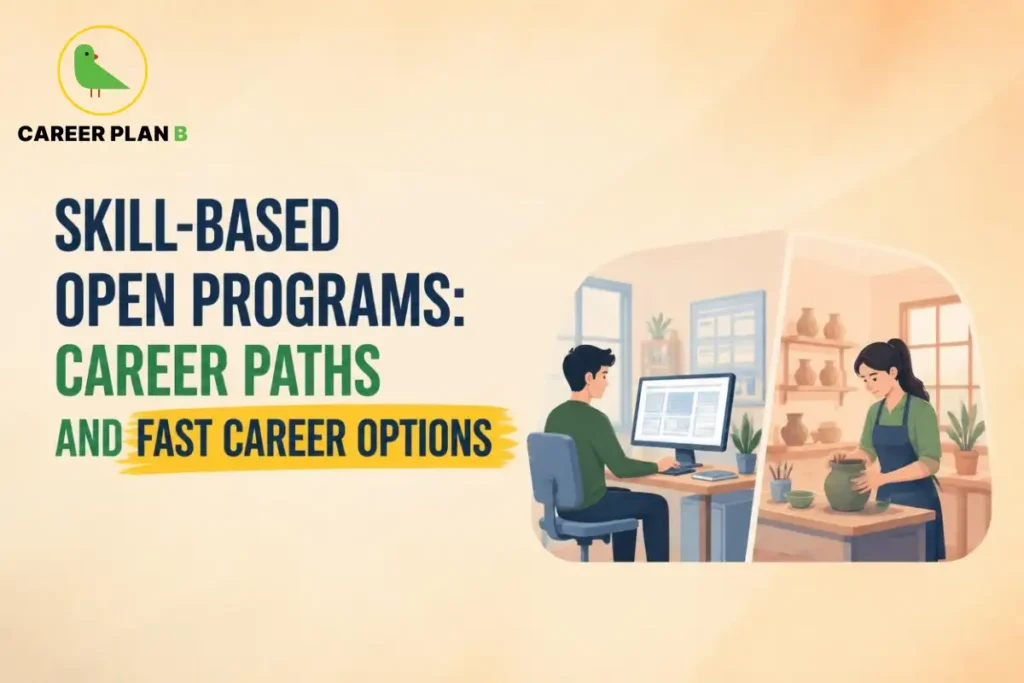
Introduction
Securing rapid employment in today’s dynamic job market requires practical capability rather than textbook memorization. Consequently, enrolling in skill based programs has become a transformative strategy for students, school leavers, and job switchers nationwide.
Many ambitious learners actively search for the best skill-based courses for fast career options to start earning quickly. Furthermore, working professionals evaluate skill-based programs for career growth to transition seamlessly into high-demand technical sectors.
National vocational qualifications, awarding bodies, and training frameworks in India are regulated by the National Council for Vocational Education and Training (NCVET). Higher education alignments and academic credit transfers are governed by the University Grants Commission (UGC) under the National Credit Framework. Sovereign digital skilling initiatives, apprenticeship portals, and certified programs are operated by the Ministry of Skill Development and Entrepreneurship (MSDE) through the Skill India Digital Hub. Additionally, online learning pathways and credit mobility operate through the SWAYAM Portal under the Ministry of Education (MoE).
This comprehensive guide details vocational certifications, stream options, learning durations, industry tools, and career pathways.
What Are Skill Based Programs and Skill-Based Education?
Unlike conventional academic degrees that focus heavily on theory, modern skill-based education concentrates entirely on workplace execution. Students acquire targeted capabilities that solve immediate operational challenges faced by corporate employers.
Through structured skill-based learning, candidates complete hands-on assignments, software simulations, and supervised trade tasks. Meanwhile, conceptual lessons are condensed to provide maximum time for applied execution.
Therefore, completing accredited practical skill courses bridges the gap between formal schooling and real-world employment.
Why Choose Skill-Based Programs Over Traditional Degrees for Fast Entry?
Traditional three-year and four-year degree curriculums often move slowly while industries evolve rapidly. In contrast, modern job-oriented courses update their learning modules every semester to match commercial demands.
Furthermore, standard campus degrees require substantial tuition investments, long daily commutes, and mandatory hostel expenses. Conversely, open vocational programs reduce educational costs dramatically while offering flexible study schedules.
Consequently, selecting targeted career-oriented courses allows candidates to enter the active workforce years ahead of peers.
National Credit Framework: How Skill-Based Education Operates in India
The landscape of professional training in India operates under the National Skills Qualification Framework. This framework standardizes competency benchmarks from secondary vocational levels up to advanced postgraduate specializations.
Under UGC and NCVET guidelines, students can transfer vocational credits directly into mainstream academic records. This mechanism enables multiple entry and exit points across diplomas and undergraduate degrees.
As a result, learners completing skill development courses earn sovereign academic recognition alongside verifiable workplace credentials.
Top Sectors Offering Skill-Based Programs for Fast Career Options
Evaluating the best skill-based courses for fast career options requires examining sectors with urgent hiring needs:
| Industry Domain | Key In-Demand Competencies | Primary Software Tools & Machinery | High-Growth Target Roles |
|---|---|---|---|
| Information Technology & Cloud | Web development, cloud architecture, cybersecurity defense, bug fixing | Linux, Python, AWS, Docker, Git, SQL | Junior Cloud Engineer, Frontend Developer |
| Data Analytics & BI | Data cleaning, dashboard visual design, spreadsheet modeling | Microsoft Excel, Power BI, SQL, Tableau | Data Analytics Associate, Junior BI Analyst |
| Digital Marketing & Growth | Search engine optimization, conversion copywriting, ad optimization | Google Analytics 4, Meta Ads, SEMrush | Performance Marketer, SEO Specialist |
| Healthcare & Diagnostics | Phlebotomy, diagnostic biochemistry, sample collection, sanitation | Centrifuges, hematology analyzers, EHR | Medical Lab Assistant, Phlebotomy Trainee |
| Logistics & Supply Chain | Warehouse tracking, inventory audit control, shipping paperwork | SAP MM, RFID scanners, Excel spreadsheets | Logistics Coordinator, Dispatch Assistant |
Consequently, these career-focused courses ensure rapid placement across thriving private and public enterprises.
Short-Term Skill Courses vs Long-Term Diplomas
Understanding course timelines helps students select suitable formats matching their immediate financial and career goals:
| Evaluation Dimension | Short-Term Skill Courses (3–6 Months) | Long-Term Professional Diplomas (1–2 Years) |
|---|---|---|
| Core Curriculum Focus | Single operational software tool or trade skill. | Multi-functional technical and managerial trade mastery. |
| Program Duration | 12 to 24 weeks of intensive practice. | 2 to 4 formal academic semesters. |
| Tuition Investment | Highly economical (₹4,000 to ₹25,000). | Moderate (₹30,000 to ₹90,000). |
| Corporate Placement Window | Immediate entry-level trade or junior roles. | Mid-level technical roles and supervisory tracks. |
| Academic Credit Yield | Micro-credentials and NSQF certificates. | Formal diplomas eligible for degree progression. |
Therefore, enrolling in short-term skill-based courses for jobs suits candidates seeking immediate personal income.
Essential Employability Skills Courses and Professional Competencies
Mastering isolated technical tools is rarely enough to sustain long-term career advancement. Corporate employers actively seek candidates who complete comprehensive employability skills courses:
- Professional Business Communication: Learn concise corporate email drafting, client project presentations, and stakeholder management.
- Analytical Problem Solving: Develop structured root-cause analysis to address operational bottlenecks quickly.
- Workplace Ethics & Data Privacy: Understand enterprise confidentiality standards, intellectual property rules, and statutory compliances.
- Agile Collaboration & Tools: Master modern project management dashboards such as Jira, Trello, Notion, and Slack.
Consequently, acquiring these career skills courses transforms entry-level technicians into dependable corporate team contributors.
Step-by-Step Roadmap: How to Select and Complete Skill-Based Programs
Following a structured preparation plan prevents confusion and optimizes your learning investments:
- Conduct a Skill Audit: Identify your natural strengths, computational logic, and long-term sector interests.
- Verify Institutional Accreditation: Inspect course curricula against official NCVET or UGC regulatory registers.
- Master Software Tool Stacks: Dedicate three to five hours daily to practical exercises and simulated problems.
- Build an Independent Portfolio: Create three functional, deployed projects showcasing demonstrable business value.
- Target Placement Drives: Leverage institutional placement cells, apprenticeship portals, and LinkedIn outreach.
As a result, this systematic approach ensures reliable skill-based courses for career development.
For Personalized Guidance
High-Growth Career Paths After Skill-Based Courses
Evaluating diverse career paths after skill-based courses reveals strong salary trajectories and rapid advancement:
Therefore, completing targeted professional skill courses delivers substantial financial return on investment.
How to Build a Job-Ready Portfolio During Vocational Training
Hiring managers in technical and creative fields evaluate live project portfolios before checking academic degrees. Therefore, developing verified project repositories is the most vital phase of your training:
- Publish Open Code Repositories: Upload clean, commented code to GitHub to demonstrate version control proficiency.
- Deploy Live Demonstrations: Host interactive dashboards, web applications, or landing pages on public domains.
- Document Detailed Case Studies: Write comprehensive summaries detailing the problem, technical execution, and business results achieved.
- Obtain Verified Micro-Credentials: Display official course verification badges on your resume and LinkedIn headline.
Consequently, presenting verifiable proof of competency eliminates doubts regarding non-traditional educational backgrounds.
Comparing Online Open Programs vs Offline Polytechnic Centers
Choosing between online and in-person study models depends directly on the trade discipline:
| Learning Channel | Best Suited Trades | Key Advantage | Potential Limitation |
|---|---|---|---|
| Online Open Skill Portals | Software coding, data analysis, digital marketing, UI/UX design | Complete schedule flexibility and low fees | Requires strong personal study discipline |
| Offline Industrial Training Centers | Automotive diagnostics, CNC machining, electrical wiring, phlebotomy | Hands-on physical machinery access | Fixed physical lecture hours and commutes |
For computing, finance, and marketing fields, online platforms deliver exceptional depth and practical flexibility. Conversely, heavy manufacturing and clinical healthcare require hands-on physical workshop laboratories.
Long-Term Career Mobility: Can Vocational Skills Lead to Degrees?
A common misconception is that vocational training restricts future academic advancement.
However, National Education Policy norms establish seamless progression between vocational certifications and formal degrees. For example, candidates holding NSQF Level 4 or Level 5 certificates can enter Bachelor of Vocation (B.Voc) programs.
Furthermore, vocational graduates qualify fully for competitive civil service exams like UPSC and SSC after completing accredited degrees. As a result, starting with short vocational tracks never hinders long-term academic ambitions.
How Career Plan B Helps
Navigating hundreds of vocational certifications, evaluating institutional accreditations, and launching new careers requires experienced mentorship. Career Plan B supports ambitious students and professionals across India through:
- Personalised Career Counselling: We assess your educational background, natural aptitudes, and income targets. As a result, our mentors recommend whether technical computing, corporate analytics, or creative media fits you best.
- Psycheintel & Skill Assessments: Our scientific diagnostic evaluations identify whether your problem-solving mindset matches software programming, design, or business operations. Consequently, you invest your study hours into high-yield learning modules.
- Accreditation & Quality Audits: We inspect prospective training academies against official NCVET and UGC-DEB recognition registers. Additionally, our mentors ensure your target credentials hold complete corporate validity.
- Career Roadmapping: Our mentorship extends far beyond course selection. Furthermore, we help you build technical portfolios, optimize your resume, and prepare for rigorous corporate interviews.
Get In Touch With Us
Frequently Asked Questions
Q1. Are skill-based programs recognized by multinational corporate employers?
Yes, multinational companies evaluate your practical portfolio, software fluency, and problem-solving skills above conventional degree titles.
Q2. Can I pursue skill development courses alongside my regular college degree?
Yes, UGC guidelines explicitly allow students to pursue online skill courses or diplomas while completing full-time graduation programs.
Q3. How quickly can I get a job after completing a vocational skill course?
Dedicating three to six months to rigorous hands-on projects is generally sufficient to qualify for entry-level corporate roles.
Q4. Do I need prior coding knowledge to learn data analytics?
No, modern analytics programs start with foundational spreadsheets and visual tools like Power BI before introducing introductory SQL.
Q5. Are government-funded skill courses free for Indian students?
Yes, various initiatives under Skill India Digital and SWAYAM offer free lecture access, charging only nominal fees for proctored exams.
Conclusion
Enrolling in skill-based programmes offers a practical and cost-effective pathway to build career-ready expertise. While traditional university education provides broad conceptual knowledge, focused skill courses help learners develop job-relevant technical abilities, practical competencies, and industry-focused experience.
With flexible learning options and evolving vocational education frameworks, students and professionals can build verifiable skills alongside their existing education or career commitments. Choosing the right programme based on your interests and career objectives can also improve your employability and long-term growth.
Ready to build a career with the right skills? Identify your target career domain, choose a suitable training programme, and meet the Career Plan B counsellors for personalized guidance on course selection, skill development, and career planning.