Team6 · September 19, 2026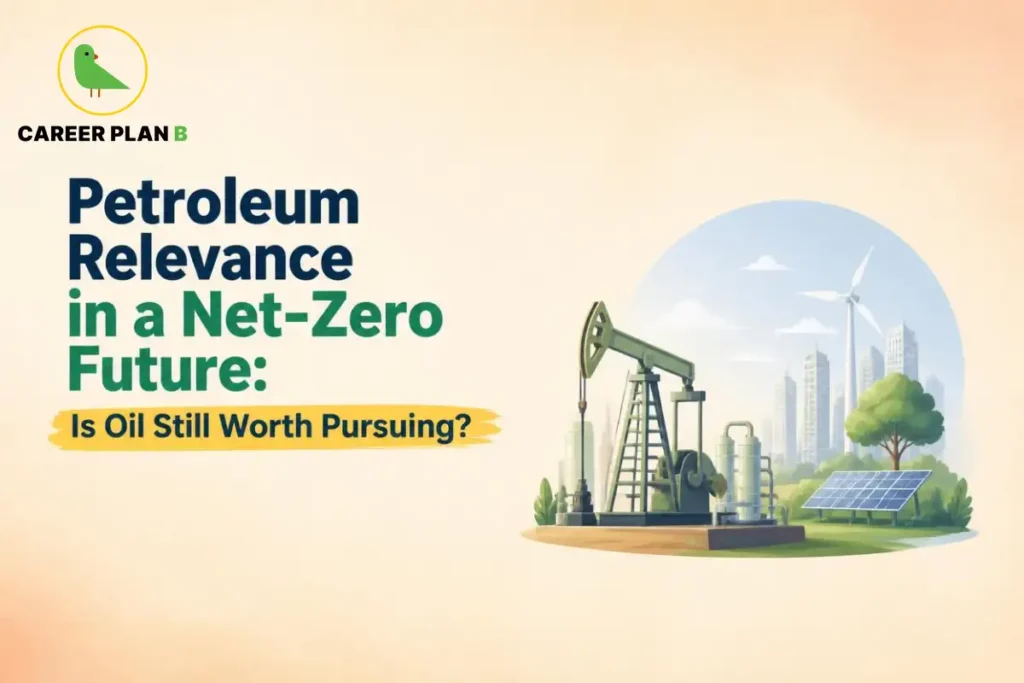
Introduction
Every few months, a headline declares the death of oil. Wind farms are expanding. Solar panels are getting cheaper. Electric vehicles are filling Indian streets. And yet, in 2024, global oil demand hit an all-time high. So what is actually going on?
If you are a petroleum engineering student or an early-career professional in India, this contradiction is not just confusing; it is deeply personal. Your career decisions depend on whether petroleum relevance in a net-zero future is real or just a comforting myth told by an industry protecting itself.
The honest answer is more nuanced than either side admits. Petroleum is not dying. But it is changing faster than most people in the sector are prepared for. This blog breaks down what net-zero actually means, why oil is not disappearing overnight, where petroleum and renewables genuinely overlap, and what all of this means for your career in India’s energy sector.
What Does Net-Zero Actually Mean for Energy?
There is a lot of confusion around the term “net-zero”, and that confusion is costing students and professionals clarity they need.
Net-zero does not mean zero fossil fuels. It means balancing the amount of greenhouse gases emitted with the amount removed from the atmosphere. India has committed to achieving net-zero 2070 as its official climate target, announced at COP26 and outlined in policy documents by NITI Aayog. The country also aims to meet 50% of its energy needs from non-fossil sources by 2030.
But here is the critical detail: India is also the world’s third-largest energy consumer, with hundreds of millions of people still gaining access to reliable electricity. The Ministry of Petroleum and Natural Gas continues to invest in domestic oil and gas exploration precisely because energy security and climate goals must be pursued simultaneously, not in opposition.
Net-zero is a destination decades away. Petroleum is part of the road getting there.
Why Petroleum Is Not Going Away Anytime Soon
Petrochemicals Are in Almost Everything You Use
When people talk about eliminating fossil fuels, they typically mean burning them for energy. But petroleum serves a second, largely invisible role: it is the raw material for petrochemicals. Plastics, fertilisers, synthetic fibres, pharmaceuticals, and even the components inside solar panels and wind turbines rely on petroleum-derived feedstocks.
This is not a loophole. It is a structural reality. The International Energy Agency projects that even in aggressive decarbonisation scenarios, petrochemical demand for oil will continue growing through 2050. Phasing out combustion does not phase out petroleum.
India’s Oil Import Dependency Is a National Priority
India currently imports over 85% of its crude oil requirements. Reducing this dependency through domestic production, strategic reserves, and eventually fuel switching is a matter of national energy security, not just economics. The Ministry of Petroleum and Natural Gas actively supports upstream exploration and production for this reason.
The oil and gas industry’s future in India, therefore, is not one of sudden shutdown but of managed, strategic transition over several decades.
Where Petroleum and Renewables Actually Overlap
This is where the narrative gets genuinely interesting and where the career opportunity lies.
Green Hydrogen: Led by Oil Companies
Green hydrogen is widely seen as one of the cleanest fuels of the future. But producing, storing, and transporting it at scale requires exactly the infrastructure and engineering expertise that the oil and gas sector has already built. ONGC and GAIL have both announced green hydrogen initiatives, positioning themselves as energy companies, not just oil companies.
For a petroleum engineer, this is renewable energy and oil coexistence in practice: the same pipelines, the same compression technology, and the same reservoir simulation skills applied to a cleaner fuel.
Carbon Capture and Storage: A Petroleum Engineering Domain
Carbon Capture and Storage, or CCS, involves capturing CO₂ emissions from industrial sources and injecting them into deep geological formations for long-term storage. This is, almost literally, petroleum engineering in reverse. The skills used to extract fluids from subsurface rock formations are the same skills needed to safely store carbon dioxide in them.
As fossil fuels and climate change concerns intensify globally, CCS is becoming a core decarbonisation tool. Engineers who understand subsurface geology, reservoir behaviour, and fluid dynamics will be in high demand for CCS projects, and those engineers come from petroleum programmes.
The Ministry of New and Renewable Energy and MoEFCC are both involved in framing India’s low-carbon infrastructure policy, which increasingly includes such transition technologies.
Have Any Doubts?
What This Means for Petroleum Engineering Careers
The energy transition in India is not eliminating petroleum engineering careers. It is redefining them.
Companies like ONGC, IOCL, and GAIL are not winding down. They are diversifying. They need engineers who understand conventional oil and gas operations and who can apply that knowledge to cleaner energy systems. This dual fluency is the career advantage of the next decade.
Which New Roles Are Emerging in India’s Energy Sector
- Energy Transition Engineer: Specialists helping oil companies reduce their carbon footprint while maintaining production
- Hydrogen Infrastructure Engineer: Designing storage and transport systems for green hydrogen
- CCS Project Engineer: Managing subsurface carbon storage operations
- Sustainability Analyst in Oil & Gas: Bridging technical operations and ESG (Environmental, Social, Governance) reporting
Petroleum engineering skills for energy transition, reservoir engineering, drilling technology, pipeline management, and thermodynamics transfer directly into these emerging roles. Students who build these skills now are positioning themselves for a market that will reward technical depth combined with energy transition awareness.
How Career Plan B Helps
Navigating a career in a sector that is evolving this fast is not something you should do alone. Career Plan B offers personalised career counselling for engineering students in the energy space, helping you understand where your petroleum engineering skills can take you from conventional oil and gas to hydrogen, CCS, and beyond. With career assessment tools, academic profile guidance, and roadmapping tailored to India’s energy sector, Career Plan B helps you make informed decisions in a rapidly changing landscape.
Get In Touch With Us
Frequently Asked Questions
1. Is petroleum engineering still a good career choice in India in 2026?
Yes. India’s energy demand is growing, domestic oil and gas exploration remains a national priority, and petroleum engineering skills are increasingly valued in transition sectors like hydrogen and CCS.
2. When will India stop using petroleum?
India’s net-zero 2070 target means a gradual transition over decades, not an abrupt stop. Petroleum will remain part of India’s energy mix well into the 2040s and likely beyond in petrochemical applications.
3. Can petroleum engineers work in renewable energy?
Absolutely. Skills in reservoir engineering, pipeline systems, and subsurface analysis apply directly to geothermal energy, hydrogen infrastructure, and carbon capture projects.
4. Which PSUs in India are hiring petroleum engineers?
ONGC, IOCL, and GAIL are the primary public sector recruiters for petroleum and energy engineers in India.
5. What skills should petroleum engineers develop for the energy transition?
Focus on carbon capture fundamentals, hydrogen technology basics, data analytics for reservoir management, and sustainability reporting frameworks alongside your core petroleum engineering curriculum.
Conclusion
The question is not whether petroleum is dying. The question is whether you are positioning yourself for the version of the energy industry that is actually emerging.
Petroleum relevance in a net-zero future is not a contradiction; it is a nuanced reality. Oil and gas is evolving into a broader energy sector, and the engineers who thrive will be those who understand both the legacy systems and the transition technologies built on top of them.
India needs engineers who can hold both truths at once: that the country must decarbonise, and that it must also power its growth. That space, right in the middle, is where your career opportunity lives.
Ready to map out your path in India’s energy sector? Visit Career Plan B and take the first step toward a career that is built for what is coming, not just what has already passed.