Team6 · September 23, 2026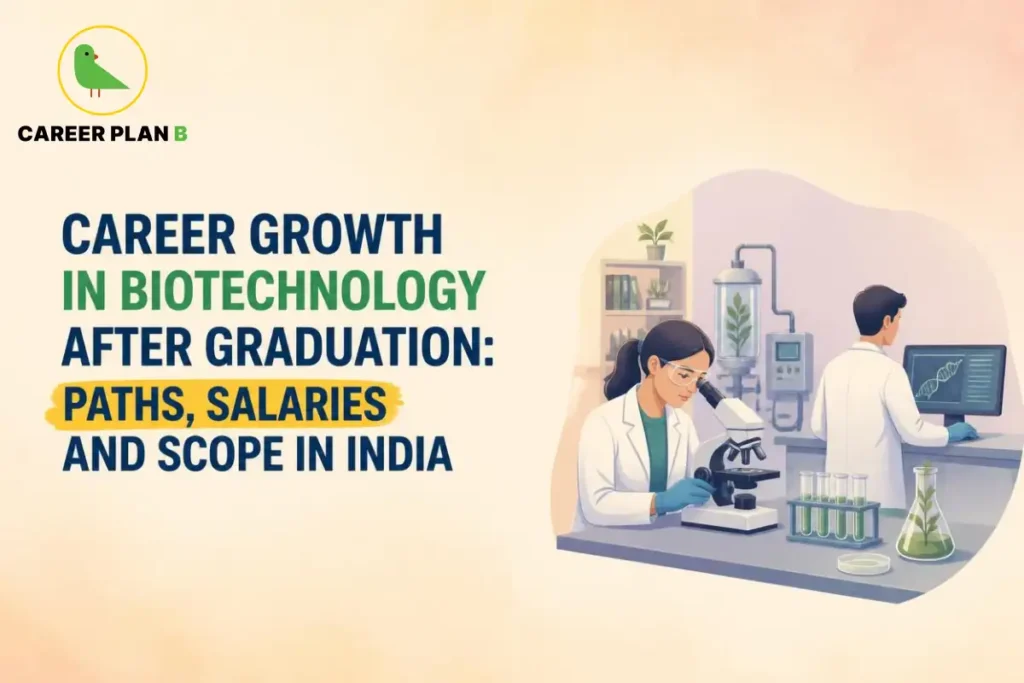
Introduction
You have just completed your biotechnology degree, and now you are standing at one of the most exciting crossroads in Indian science education. The good news is that the path ahead is not narrow. Career growth in biotechnology after graduation is genuinely multi-directional, spanning research, industry, government service, clinical settings, and even entrepreneurship. The challenge is not a lack of opportunity; it is knowing which direction suits you best and how to move forward with clarity.
India’s biotechnology sector is one of the fastest-growing in the world. Backed by the Department of Biotechnology (DBT) and the Biotechnology Industry Research Assistance Council (BIRAC), the industry is expanding across pharmaceuticals, agricultural biotech, genomics, diagnostics, and industrial biotech. According to DBT’s vision for the sector, India aims to become a top global biotech destination, creating tens of thousands of new roles for trained professionals over the next decade. Whether you are a fresh B.Sc graduate exploring your first job or a final-year student deciding between a job and higher studies, this blog gives you a complete, practical map of every major path available to you.
Is Biotechnology a Good Career Choice After Graduation in India?
The short answer is yes, and the data supports it strongly. India’s biotech industry has grown into one of the country’s most strategically important sectors, with pharma biotech, agribiotech, diagnostics, and genomics all expanding simultaneously. Jobs in biotechnology for freshers in India are available across a wide range of functions from laboratory research and bioprocess manufacturing to clinical trials, regulatory affairs, quality control, and bioinformatics.
What makes biotechnology particularly strong as a career foundation is its cross-sector applicability. A biotechnology graduate can enter pharmaceutical companies, agricultural research institutes, food technology firms, hospital diagnostic labs, contract research organisations, environmental agencies, and government research bodies all with the same core degree. The DBT’s continued investment in research infrastructure and BIRAC’s support for biotech startups are further expanding this ecosystem every year. Biotechnology salary growth in India is also strong, with consistent upward progression linked to experience, specialisation, and additional qualifications. For students who choose the right path early, a biotechnology degree can be the foundation of a deeply rewarding and financially strong career.
Career Paths After Biotechnology Graduation Industry vs Research vs Government
Private Sector Career Paths
Private sector biotechnology careers India are the most immediately accessible for fresh graduates. The pharmaceutical and biopharmaceutical industry is the largest employer of biotechnology graduates, offering roles in quality control, quality assurance, bioprocess manufacturing, regulatory affairs, and clinical research. Agri-biotech companies hire seed technology specialists and plant biotech researchers. Food biotech firms recruit food safety analysts and product development scientists. Diagnostics companies hire molecular diagnostics technicians and genomics analysts. Contract Research Organisations (CROs) are among the fastest-growing employers of biotechnology freshers, offering roles in clinical trial management, pharmacovigilance, and regulatory documentation.
Common entry-level roles in the private sector include:
- Quality Control and Quality Assurance Analyst
- Bioprocess / Fermentation Technician
- Clinical Research Assistant or Associate
- Research and Development Associate
- Molecular Diagnostics Technician
- Regulatory Affairs Assistant
Private sector biotechnology careers in India offer faster salary progression, exposure to commercial applications, and opportunities to work across domestic and multinational companies. Cities like Hyderabad, Pune, Bengaluru, Ahmedabad, and Mumbai are major biotech employment hubs.
Government Research and Public Sector Career Paths
Government jobs in biotechnology in India are among the most sought-after for graduates seeking job security, research infrastructure, and funded fellowship opportunities. Key government employers include ICMR, CSIR institutes, ICAR, DBT-funded research institutes, DRDO, and government hospital diagnostic labs.
The primary entry routes into government research are through competitive examinations. GATE Biotechnology career opportunities open doors to research associate and scientist positions at CSIR, DBT, and public sector undertakings. The CSIR-NET Life Sciences examination qualifies candidates for Junior Research Fellowships and lectureship positions at universities. The ICMR Junior Research Fellowship targets clinical and biomedical research. The DBT Junior Research Fellowship is specifically designed for biotechnology research. These fellowship programmes provide monthly stipends, research access, and a structured pathway toward a PhD and a long-term government research career.
Higher Studies as a Career Growth Strategy
Higher studies in biotechnology after graduation is one of the most powerful strategies for accelerating both career options and salary potential. An M.Sc. in Biotechnology, Molecular Biology, Genomics, or a related specialisation significantly expands the range of roles you can access and the seniority at which you can enter them. An M.Tech in Bioprocess Engineering or Pharmaceutical Biotechnology is valuable for manufacturing and engineering-orientated careers. For students with an interest in the business side of biotech, an MBA in Biotechnology Management or Life Sciences Management opens pathways into business development, product management, and leadership roles.
A PhD remains the gateway to independent research, principal investigator positions, and the highest-level roles in government and academic science. Many students pursue a PhD through the fellowship routes mentioned above, making it a funded pathway rather than a financial burden.
Entry routes for postgraduate programmes include GATE, CUET PG, ICMR JRF, DBT JRF, and IIT JAM for M.Sc. programmes at IITs. Each additional qualification directly accelerates biotechnology salary growth in India and broadens your sector options significantly.
Sector-Wise Career Opportunities After Biotechnology Graduation
Understanding which sector fits your interests is key to making smart career decisions as a biotechnology graduate. Here is a practical sector-by-sector overview of biotechnology career options after B.Sc:
Pharmaceutical Biotechnology: drug discovery, clinical research, regulatory affairs, pharmacovigilance, bioprocess manufacturing, and QA/QC. Employers include Sun Pharma, Biocon, Dr. Reddy’s Laboratories, Cipla, and the Serum Institute of India.
Agricultural Biotechnology: Crop improvement research, seed technology, plant tissue culture, ICAR-funded research programmes, and agri-biotech startups. Key employers include ICAR institutes, Mahyco, Bayer CropScience India, and BIRAC-supported agri-biotech companies.
Medical Diagnostics and Genomics: Molecular diagnostics, next-generation sequencing, genetic counselling, pathology lab roles, genomics data analysis. Employers include MedGenome, Strand Life Sciences, Metropolis Healthcare, and hospital-based diagnostic divisions.
Environmental Biotechnology: Bioremediation, pollution monitoring, water treatment biotechnology, and environmental impact assessment. Opportunities exist with government environmental agencies, CSIR-NEERI, and sustainability-focused private firms.
Industrial Biotechnology: Bioprocess engineering, fermentation technology, enzyme production, and biofuel development. Private sector employers and government-backed industrial biotech units offer strong opportunities in this growing niche.
Have Any Doubts?
Salary Growth Trajectory: What Can You Expect Over 10 Years?
One of the most important factors in planning career growth in biotechnology after graduation is understanding how salaries progress over time. Here is a realistic trajectory based on the Indian biotech job market:
Entry Level Years 0 to 2 (B.Sc. / B.Tech. graduate, fresher):
- Private sector roles (QC/QA, bioprocess technician, CRA): ₹2.5 – ₹4.5 LPA
- Government research fellowship (DBT JRF / ICMR JRF): ₹31,000 – ₹35,000 monthly stipend
- Diagnostics and hospital labs: ₹2.5 – ₹4 LPA
Mid Level Year 3 to 6 (with M.Sc., experience, or specialisation):
- Research Scientist / Senior CRA / Regulatory Affairs Officer: ₹5 – ₹12 LPA
- Genomics / Bioinformatics Analyst: ₹6 – ₹15 LPA
- Bioprocess Engineer: ₹6 – ₹13 LPA
- Government Scientist B / C positions: ₹7 – ₹14 LPA
Senior Level Year 7 to 10 (with PhD or significant industry experience):
- Principal Scientist / R&D Head: ₹15 – ₹30 LPA and above
- Senior Regulatory Affairs Manager: ₹15 – ₹25 LPA
- Clinical Operations Director: ₹12 – ₹22 LPA
- Government Scientist D and above: ₹14 LPA and above with additional government benefits
The most significant salary jumps in biotechnology salary growth in India come at two points: when a candidate completes an M.Sc. or relevant certification and transitions from entry to mid-level roles, and when a PhD-qualified professional moves into senior research or leadership positions. Certifications in GMP, GCP, bioinformatics, and regulatory affairs also meaningfully accelerate salary progression at every stage.
Key Examinations and Certifications That Accelerate Career Growth
For biotechnology graduates planning to maximise their career growth in India, the following examinations and certifications are the most strategically important:
GATE Biotechnology: The primary qualifying exam for research associate and scientist positions at CSIR institutes, DBT-funded labs, and public sector undertakings. Also required for M.Tech admissions at IITs and NITs, GATE biotechnology career opportunities span both research and industry PSU roles. CSIR-NET Life Sciences: Qualifies candidates for junior research fellowships at CSIR institutes and for assistant professor lectureship positions.
ICMR Junior Research Fellowship: Targets biomedical and clinical research. Conducted by ICMR and open to M.Sc. life sciences graduates. DBT Junior Research Fellowship: Specifically for biotechnology students seeking research fellowship positions at DBT-funded institutes. IIT JAM: For B.Sc. graduates seeking admission to M.Sc. programmes at IITs and IISc.
Key industry certifications that strengthen private sector profiles:
- Good Manufacturing Practice (GMP) certification
- Good Clinical Practice (GCP) ICH E6 guidelines
- Bioinformatics tools training Python, R, GATK, BLAST
- Pharmacovigilance certification: ICH E2 series
- Regulatory affairs training covering CDSCO and ICH CTD dossier preparation
How Career Plan B Helps
For many biotechnology graduates, the biggest challenge is not a lack of options; it is too many options without a clear sense of which one fits. Career Plan B is designed specifically for students in this situation. Through personalised career counselling, Career Plan B helps biotechnology graduates cut through confusion and identify the path that genuinely aligns with their interests, strengths, and long-term goals. The Psycheintel psychometric assessment goes deeper than generic aptitude tests; it identifies whether your profile is best suited for research, private sector industry roles, government science, regulatory affairs, or biotech entrepreneurship.
Career Plan B also provides academic profile guidance for students planning higher studies in biotechnology after graduation, helping you build the examination scores and application profiles needed for top M.Sc and PhD programmes. Whether you are a fresher looking for your first job or a graduate planning your next qualification, Career Plan B gives you a structured, personalised roadmap from where you are today to where you want to be.
Get In Touch With Us
Frequently Asked Questions
1. What are the best career options after a B.Sc. in biotechnology?
The best biotechnology career options after a B.Sc. depend on your interests. For research-orientated students, GATE Biotechnology and CSIR-NET open pathways to government research fellowships and PhD programmes. For industry-focused graduates, roles in QC/QA, clinical research, bioprocess technology, and regulatory affairs are strong entry points.
2. Is GATE necessary for career growth in biotechnology after graduation?
GATE is not mandatory for all career paths, but it is highly beneficial. GATE biotechnology career opportunities include research associate positions at CSIR and DBT institutes, M.Tech. admissions at IITs and NITs, and eligibility for public sector undertaking positions.
3. Which sector pays the most for biotechnology graduates in India?
At entry and mid levels, bioinformatics and genomics roles in the private sector tend to offer the highest packages, followed by clinical research and regulatory affairs in pharmaceutical biotech. At senior levels, R&D leadership and principal scientist positions in pharma and biotech companies offer the highest compensation. Government positions offer lower starting salaries but come with stability, funded research access, and structured progression.
4. Can I get a government job after B.Sc Biotechnology?
Yes. Government jobs in biotechnology in India are accessible through multiple pathways. Project assistant and junior research fellow positions at ICMR, CSIR, DBT, and ICAR institutes are open to B.Sc graduates with qualifying examination scores. Lab technician positions in government hospitals and diagnostic centres are also available.
Conclusion
Medicine is entering an era where treatment is no longer based only on population-level averages. Instead, it is increasingly tailored to you, your genome, and your unique biological profile.
Genetic engineers in precision medicine help make this possible. They design tools, therapies, diagnostics, and data systems for personalised healthcare. Their work spans CRISPR research, genomics data science, molecular diagnostics, and gene therapy regulation. This creates a broad and impactful career landscape in healthcare and biotechnology.
India’s investment in the Genome India Project, ICMR’s genomics programmes, and BIRAC’s support for precision medicine startups highlights the growing importance of this field. Professionals trained today could contribute to the scientists, counsellors, analysts, and innovators shaping Indian medicine in the coming decades.If you are a biotechnology or genetic engineering student, precision medicine offers many career opportunities to explore. Expert guidance can help you understand these options and choose a path that matches your skills, interests, and career goals.
The key is making the right choice at the right time, and that requires knowing yourself as much as knowing the field. Visit Career Plan B to connect with expert career counsellors, take the Psycheintel psychometric assessment, and get a personalised career roadmap that moves you from your graduation day to the biotechnology career you have been working toward.
Your degree opened the door; now it is time to walk through it with purpose and direction.