Team6 · September 23, 2026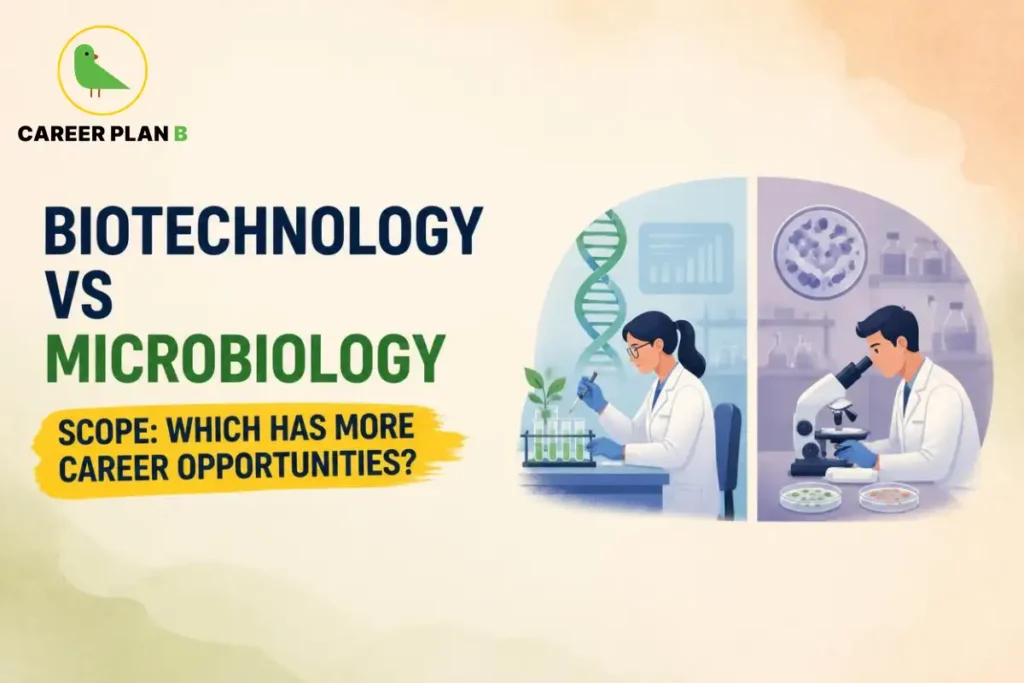
Introduction
Walk into any BSc science admissions office in India during June, and you will find the same conversation happening in different variations. A student with strong PCB scores, a genuine interest in biology, and a complete lack of clarity about which degree to choose. And somewhere in that conversation, the question comes up: biotechnology or microbiology?
On the surface, these two disciplines look like close cousins. But underneath that surface similarity, biotechnology vs microbiology scope leads to meaningfully different career destinations, and choosing between them without understanding those differences can mean years of study in a direction that does not align with your actual goals.
This blog puts both disciplines side by side in a clear, honest comparison. What each covers, where each leads, what it pays, and most importantly, which one fits the kind of career you actually want to build. Whether you are a Class 12 student shortlisting colleges or a BSc graduate deciding on postgraduate options, this guide will give you the clarity you need.
What Does a Biotechnology Degree Cover?
Biotechnology is the science of using living organisms, cells, and biological molecules as tools to develop products and solve problems across healthcare, agriculture, food production, and the environment. It is a discipline that combines biology with engineering, computation, and applied science, making it broader in scope than most pure science degrees.
A B.Sc. or B.Tech in biotechnology typically covers the following:
- Molecular biology and genetics the foundation of modern biotech
- Genetic engineering and recombinant DNA technology manipulating genes to create useful products
- Fermentation technology and bioprocess engineering using microorganisms at industrial scale
- Bioinformatics and computational biology analysing biological data using software tools
- Cell culture and immunology growing cells and understanding immune responses
- Industrial and environmental biotechnology applying biotech to manufacturing and ecological problems
The degree is broadly orientated toward research, product development, and applied biological innovation. Students spend significant time in laboratories working with DNA, proteins, enzymes, and biological data, but the emphasis is always on application. How can this biological knowledge be used to make something useful?
Biotechnology jobs after BSc span a wide range of industries. A biotech graduate can enter pharmaceutical R&D, agricultural biotechnology, food technology, diagnostics, bioinformatics, or environmental science. The Department of Biotechnology and BIRAC actively fund the sector, creating a growing ecosystem of research and industry employment for graduates. For students who enjoy both biology and its real-world applications, biotechnology offers an unusually broad starting point.
What Does a Microbiology Degree Cover?
Microbiology is the study of microorganisms, bacteria, viruses, fungi, algae, and protozoa and their interactions with each other, with human beings, and with the environment. It is one of the oldest and most fundamental disciplines in biological science, and it sits at the core of modern medicine, food safety, environmental monitoring, and pharmaceutical manufacturing.
A B.Sc. in microbiology typically covers the following:
- Bacteriology: the study of bacteria, their structure, behaviour, and role in disease and industry
- Virology: the study of viruses, viral infections, and antiviral strategies
- Mycology: the study of fungi and fungal diseases
- Immunology: how the human body defends itself against microbial threats
- Clinical microbiology: diagnosing infectious diseases through laboratory methods
- Industrial microbiology using microorganisms in manufacturing processes
- Environmental microbiology: studying microorganisms in soil, water, and air ecosystems
- Food microbiology: understanding microbial contamination and safety in food production
The scope of microbiology in India is substantial and consistent. Unlike some emerging science fields whose career pipelines are still forming, microbiology has deeply established demand across hospitals, diagnostic laboratories, food safety agencies, pharmaceutical quality departments, and public health organisations. It is a discipline with a clear professional identity and well-defined entry points into multiple industries.
What makes microbiology particularly relevant in the Indian context is the country’s ongoing challenges with infectious disease burden, food safety regulation, and public health infrastructure, all of which require trained microbiologists at scale. Institutions like ICMR and FSSAI are significant employers and regulators in this space.
Biotechnology vs Microbiology Scope: Head-to-Head Comparison
Here is a direct comparison to help you see the key differences between both disciplines clearly:
| Parameter | Biotechnology | Microbiology |
|---|---|---|
| Core Focus | Applied biology product development, genetic engineering, bioprocess | Study of microorganisms disease, environment, food, industrial processes |
| Key Subjects | Genetic engineering, bioinformatics, fermentation, molecular biology | Bacteriology, virology, immunology, clinical microbiology, food microbiology |
| Work Environment | R&D labs, biotech companies, agri-biotech firms, startups | Hospitals, diagnostic labs, food companies, public health agencies, pharma QC |
| Career Breadth | Wide spans: pharma, agri, food, data, environment, genomics | Deep strong in healthcare, diagnostics, food safety, pharma manufacturing |
| Further Study Options | M.Tech. Bioinformatics, MSc Biotech, MBA, PhD | MSc Microbiology, MD Microbiology, MPH, PhD |
| Top Recruiters | Biocon, CSIR, Dr. Reddy’s, genomics startups, ICAR | ICMR, hospitals, FSSAI, diagnostic chains, pharma QC departments |
| Starting Salary | INR 3.5 – 6 LPA | INR 3 – 5 LPA |
| Government Roles | CSIR, DBT, ICAR, DRDO research positions | ICMR, FSSAI, state public health labs, hospital microbiology departments |
The comparison reveals something important: biotechnology offers greater breadth across industries, while microbiology offers greater depth and a more direct pathway into clinical and public health settings. Neither is universally superior. The question is which type of career environment suits you better.
Career Paths After Biotechnology
Biotechnology jobs after B.Sc. are diverse and span multiple sectors. Here are the most significant career directions:
Research and Development:
- A research scientist develops new biological products, drugs, or agricultural innovations in R&D laboratories
- Bioinformatics analysts use computational tools to analyse genomic, proteomic, and clinical data; one of the fastest-growing roles in Indian life sciences
- A bioprocess engineer designs and optimises biological manufacturing processes for pharmaceutical and industrial applications
Quality and Regulatory:
- A quality assurance and Quality Control Analyst ensures biological and pharmaceutical products meet safety and regulatory standards
- Regulatory Affairs Specialist prepares and manages submissions for product approvals with CDSCO and international regulatory bodies
Clinical and Diagnostics:
- Clinical Research Associate manages clinical trials for new drugs and biological therapies
- A molecular diagnostic scientist works with DNA-based diagnostic tools in hospital or commercial laboratory settings
Agricultural and Environmental Biotechnology:
- Plant biotechnologists develop improved crop varieties using genetic and tissue culture tools
- Environmental biotechnologists apply biological solutions to pollution control and waste treatment
Government and Research Fellowship Opportunities:
- CSIR Junior Research Fellowship: one of India’s most competitive funded science research pathways
- DBT Junior Research Fellowship specifically designed for biotechnology graduates
- DST-INSPIRE Fellowship for exceptional science graduates pursuing research careers
- ICAR agricultural biotechnology research positions across its national network of institutes
- DRDO defence-related biotech and life sciences research roles
The biotechnology career ecosystem is characterised by breadth. A BSc Biotech graduate has genuine pathways into pharma, agri-tech, genomics, food technology, environmental science, and data-driven life sciences, making it one of the most flexible undergraduate science degrees in India.
Career Paths After Microbiology
Microbiology career options in India are well-established, clearly defined, and in consistent demand. Here are the primary career directions:
Clinical and Healthcare:
- A clinical microbiologist works in hospital laboratories diagnosing infectious diseases through culture, sensitivity testing, and molecular methods
- Infection Control Officers monitor and manages hospital-acquired infections, a growing priority in Indian healthcare facilities
- A medical laboratory technologist performs diagnostic tests across microbiology, haematology, and biochemistry in hospital or diagnostic lab settings
Food and Environmental Safety:
- Food Safety Analysts test food products for microbial contamination and ensures compliance with FSSAI standards; one of the most direct government-linked career pathways for microbiology graduates
- Environmental microbiologists study microbial communities in soil, water, and air for environmental monitoring and remediation projects
- Water quality analysts test drinking water and industrial water sources for microbial safety
Pharmaceutical and Industrial:
- A pharmaceutical QC Microbiologist ensures that pharmaceutical products and manufacturing environments are free from microbial contamination; a critical GMP-compliance role
- An industrial microbiologist works with fermentation processes, enzyme production, and bio-based manufacturing
- A bioprocess technician supports fermentation and cell culture operations in pharmaceutical or food biotechnology companies
Government and Research Opportunities:
- ICMRIndia’s apex biomedical research body actively employs microbiologists for infectious disease research, epidemiology, and public health projects
- FSSAI recruits food safety analysts and technical officers with microbiology backgrounds
- State Public Health Laboratories: government-run facilities across India that employ microbiologists for disease surveillance and outbreak investigation
- National Centre for Disease Control recruits microbiologists for communicable disease monitoring and response
- ICMR Research Fellowships funded research pathways specifically for biomedical science, including microbiology
The scope of microbiology in India is particularly strong in the healthcare and public health sectors, and given India’s ongoing infectious disease burden and expanding diagnostic infrastructure, this demand is likely to grow consistently over the coming decade.
Salary Comparison: Biotechnology vs Microbiology
Understanding the microbiology vs biotechnology salary India landscape is an important part of making a well-informed decision.
Biotechnology Salary Benchmarks:
Entry-Level (0–3 years):
- Research or laboratory roles at biotech or pharma companies: INR 3.5 to 6 LPA
- Government research fellowships (CSIR-JRF, DBT-JRF): INR 3.1 to 3.5 LPA stipend basis
- QA/QC or regulatory roles: INR 4 to 6.5 LPA
- Bioinformatics or data-adjacent roles: INR 4.5 to 7 LPA
Mid-Level (3–7 years):
- Bioinformatics Specialist or Data Scientist in life sciences: INR 8 to 14 LPA
- Bioprocess or Fermentation Scientist: INR 7 to 12 LPA
- Clinical Research professional with specialisation: INR 7 to 11 LPA
Senior Level (7+ years):
- R&D Manager or Department Head at established biotech or pharma firm: INR 18 to 30 LPA
- A doctoral qualification in a high-demand specialisation commands significant salary premium
Microbiology Salary Benchmarks:
Entry-Level (0–3 years):
- Clinical or hospital microbiologist: INR 3 to 5 LPA
- Pharmaceutical QC Microbiologist: INR 3.5 to 5.5 LPA
- Food Safety Analyst: INR 3 to 4.5 LPA
- Government laboratory positions: INR 3 to 4 LPA plus government benefits
Mid-Level (3–7 years):
- Senior Clinical Microbiologist in tertiary hospital: INR 6 to 10 LPA
- QC Manager in pharmaceutical manufacturing: INR 7 to 12 LPA
- Industrial Microbiologist in established food or pharma company: INR 6 to 9 LPA
Senior Level (7+ years):
- Head of Microbiology at a large hospital or diagnostic chain: INR 12 to 20 LPA
- Quality Director or Microbiology Head at pharmaceutical manufacturing firm: INR 15 to 25 LPA
- MD Microbiology holders in academic hospital settings command higher packages with clinical leadership roles
Key Insight: Biotechnology tends to offer slightly higher entry-level salaries, particularly in data-driven and bioinformatics roles. However, microbiology offers stronger salary stability and consistent demand across healthcare and pharmaceutical quality functions. At senior levels, both fields offer comparable earning potential, with the specific industry and role specialisation being the primary determinant of compensation rather than the undergraduate discipline.
Have Any Doubts?
B.Sc. Biotechnology vs BSc Microbiology: Which Should You Choose?
This is the question the entire blog has been building toward. And as with most meaningful career decisions, the honest answer depends on who you are, not on which degree is objectively superior.
Choose BSc Biotechnology if:
- You are fascinated by the idea of engineering biology manipulating genes, developing biological products, and applying science at an industrial or technological scale
- You want career flexibility across multiple industries: the ability to move between pharma, agriculture, food tech, genomics, and data science over your career
- You are comfortable with or excited by quantitative work. Bioinformatics, computational biology, and data analysis are growing parts of the biotech career landscape
- You are open to a career path that may require a postgraduate degree for full specialisation. Many biotech roles at senior levels expect an M.Sc. or M.Tech
- You are drawn to entrepreneurship or the startup ecosystem; agri-tech and health-tech startups disproportionately hire biotech graduates
Choose BSc Microbiology if:
- You are genuinely interested in microorganisms, their biology, their role in disease, and their applications in food, pharma, and the environment
- You want a career with a clear, immediate professional pathway. Hospital and diagnostic laboratory roles for microbiology graduates are well-defined and in consistent demand
- You are drawn to clinical settings working in hospital microbiology departments, public health labs, or diagnostic centres
- You are interested in food safety, environmental monitoring, or pharmaceuticalquality,y all of which have strong microbiology demand and clear government-linked career pathways
- You are considering MD Microbiology after MBBS, or a research career in infectious disease microbiology is the natural undergraduate foundation for both
How Postgraduate Choices Can Change the Equation: One of the most important things to understand about B.Sc. biotechnology vs B.Sc. microbiology is that the postgraduate degree you choose can significantly redirect your trajectory regardless of which BSc you hold. A BSc Microbiology graduate who pursues an M.Sc.. in bioinformatics or a B.Tech-level bridge programme can access many biotechnology career pathways. Similarly, a BSc Biotechnology graduate who specialises in clinical microbiology at the postgraduate level can enter hospital and diagnostic settings. The undergraduate degree sets your foundation, but it does not permanently define your ceiling.
Where Do Both Fields Overlap?
One of the most practically useful things to understand about biotechnology vs microbiology scope is that they are not mutually exclusive career universes. There is a significant overlap zone, a set of roles and industries where graduates from either background can compete and succeed, particularly with the right postgraduate specialisation.
Shared Career Spaces:
Industrial Microbiology and Bioprocess: Both biotech and microbiology graduates work in fermentation-based manufacturing, producing antibiotics, enzymes, amino acids, and organic acids using microbial systems. The knowledge bases are complementary, and employers in this space often hire from both disciplines.
Pharmaceutical Quality Control: Pharmaceutical QC microbiology is one of the most accessible and consistently in-demand roles for both biotech and microbiology graduates. The work involves testing products and environments for microbial contamination, a function that draws equally on both disciplines.
Clinical Diagnostics: Molecular diagnostic laboratories which use DNA-based tools like PCR for disease diagnosis hire from both fields. Biotechnology graduates bring molecular biology skills; microbiology graduates bring clinical context and pathogen knowledge. Both are valuable.
Environmental Science: Environmental monitoring for microbial contamination in water, soil, and air draws on microbiology fundamentals. Biotechnology graduates with environmental biotech specialisations compete for similar roles.
Research in Infectious Disease: Infectious disease research, particularly in the post-pandemic era, actively draws on both microbiology and biotechnology expertise. ICMR-funded research programmes and CSIR institutes regularly recruit from both disciplines for infectious disease and public health research projects.
The existence of this overlap zone means that the choice between biotechnology and microbiology is less about permanently closing doors and more about which starting point better matches your interests and learning style. Both are legitimate, flexible, and valuable life sciences degree options India’s job market actively values.
Top Colleges and Regulatory Bodies in India
For Biotechnology:
- IIT Delhi Department of Biochemical Engineering and Biotechnology B.Tech and M.Tech programmes
- IIT Bombay, IIT Kharagpur, IIT Madras strong biotechnology programmes at undergraduate and postgraduate levels
- IISERs Pune, Kolkata, Mohali, Bhopal research-intensive integrated MSc programmes
- JNU School of Life Sciences excellent for research-oriented biotechnology students
- BITS Pilani’s strong industry-linked biotechnology programme
- Verify B.Tech programme approvals through AICTE and BSc programme recognitions through UGC
For Microbiology:
- University of Delhi Department of Microbiology at Kirori Mal College and other constituent colleges: one of India’s most respected BSc Microbiology programmes
- Savitribai Phule Pune University’s strong microbiology department with excellent research infrastructure
- Banaras Hindu University, Varanasi, has well-regarded BSc and MSc Microbiology programmes
- AIIMS New Delhi BSc programmes in allied health sciences, including microbiology-related disciplines
- Jamia Hamdard, New Delhi: strong pharmaceutical microbiology focus
- All university-affiliated BSc programmes are recognised under UGC. Always verify university recognition before applying
What to Look for When Evaluating Any Programme:
- Access to functional, well-equipped laboratories not just on paper but in practice
- Faculty with active research publications and industry connections
- Internship or project placement arrangements with hospitals, diagnostic labs, or industry
- Placement records in core discipline-relevant roles, not just any job
How Career Plan B Helps
Choosing between biotechnology and microbiology involves understanding not just the differences between the two fields but also which one genuinely matches your strengths, learning style, and career goals. Career Plan B offers personalised career counselling and the PsycheIntel assessment, a tool that maps your aptitude, interests, and personality to the right life sciences career path. If you are torn between these two disciplines, visit careerplanb.co before you make your final decision.
Get In Touch With Us
Frequently Asked Questions
1. Which has more scope, biotechnology or microbiology, in India?
Both have strong scope but in different directions. Biotechnology offers broader industry diversity spanning pharma, agri-tech, food technology, genomics, and data science. Microbiology has deeper and more consistent demand in healthcare, clinical diagnostics, food safety, and pharmaceutical quality. Which has more scope depends entirely on which industry environment aligns with your career goals.
2. Can a microbiology graduate apply for biotechnology jobs?
Yes, particularly for roles in pharmaceutical QC, industrial microbiology, clinical diagnostics, and some research positions. However, for core biotechnology roles in genetic engineering, bioinformatics, or bioprocess development, a postgraduate qualification in biotechnology or a related specialisation significantly improves competitiveness. The overlap between the two fields is substantial at the postgraduate level.
3. What are the best government jobs for microbiology graduates in India?
Key government opportunities include positions at ICMR for biomedical research, FSSAI for food safety roles, state public health laboratories under respective state health departments, and the National Centre for Disease Control. Hospital microbiology positions at AIIMS and other central government hospitals are also among the most sought-after government roles for microbiology graduates.
4. Is B.Sc. microbiology enough for a good career, or do I need an MSc?
A B.Sc. Microbiology opens entry-level positions in clinical and diagnostic laboratories, pharmaceutical QC, and food safety testing. However, an M.Sc. in microbiology significantly improves access to senior laboratory positions, research roles, and government research fellowships. For research careers at institutions like ICMR or CSIR, a postgraduate degree is typically the minimum requirement.
Conclusion
The biotechnology vs microbiology scope debate does not have a single winner, and it was never meant to. These are two distinct disciplines that serve different functions within India’s life sciences ecosystem, and both are genuinely valuable, consistently in demand, and capable of supporting rewarding long-term careers. Biotechnology gives you breadth, the flexibility to move across industries and the tools to work at the cutting edge of biological innovation. Microbiology gives you depth and a clear professional identity in healthcare, public health, food safety, and pharmaceutical quality that has been in demand for decades and will remain so for decades more.
What the choice really comes down to is this: do you want to engineer biology to build new products and solutions, or do you want to understand microorganisms deeply enough to diagnose, control, and apply them in clinical and industrial settings? Your honest answer to that question is a more reliable guide than any comparison table. Take the time to reflect on what genuinely interests you, assess your strengths, and talk to professionals already working in both fields if you can. The right degree is the one that sets you up to do work you care about, not just work that sounds impressive. Start with self-awareness, and the career decision becomes significantly clearer from there.