Team6 · September 23, 2026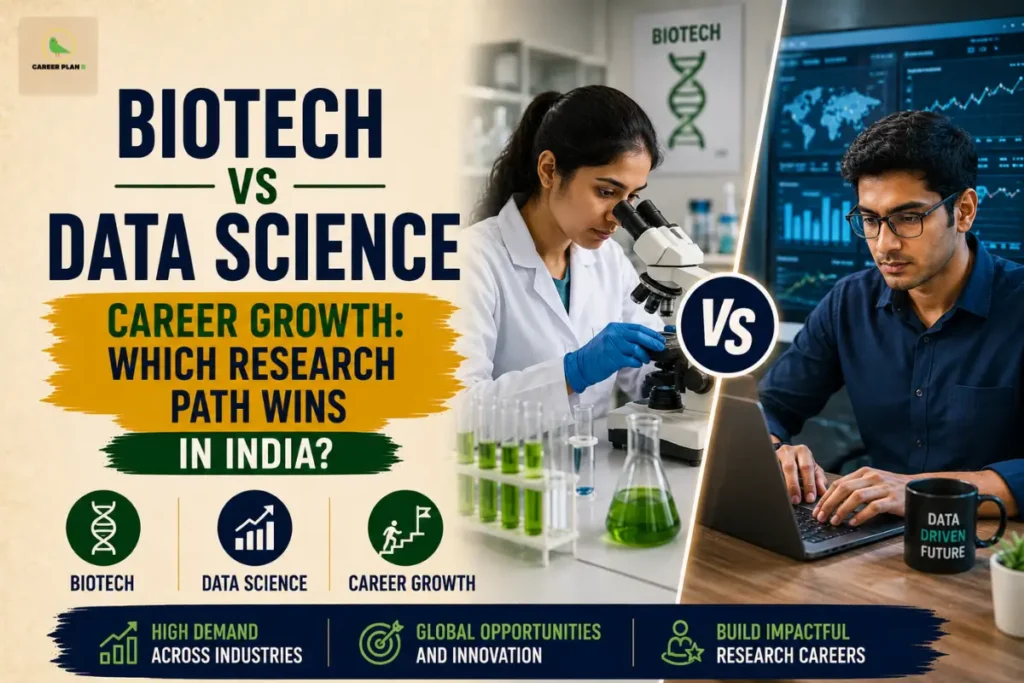
Introduction
Biology is producing more data today than at any other point in human history. Every genome sequenced, every drug trial conducted, every protein mapped adds to an ocean of biological information that the world is still learning how to navigate. Standing at the edge of this ocean are two kinds of professionals: the biotechnologist who understands the biology and the data scientist who knows how to make sense of the numbers. But here is the question thousands of Indian students are asking right now: when it comes to biotech vs data science career growth, which path offers more in research, more opportunity, more salary, and more future? This blog breaks down both fields honestly, compares their research trajectories in India, and shows you where the two worlds are beginning to merge into something even more powerful.
What Does a Research Career in Biotech Actually Look Like?
A research career in biotechnology in India is built on laboratory science, biological problem-solving, and the slow, rigorous process of turning discoveries into applications. Biotechnology researchers work on some of the most consequential challenges of our time developing new medicines, engineering disease-resistant crops, creating sustainable biofuels, and understanding the genetic basis of human disease. On a typical day, a biotech researcher might be culturing cells, running PCR experiments, analysing protein expression, or writing up findings for peer review. At more senior levels, they design experiments, manage research teams, apply for grants, and collaborate with industry partners to translate laboratory findings into real-world products.
Research Career in Biotechnology: Indian Institutions and Employers
India has a rich ecosystem for biotech research. The Indian Institutes of Technology (IITs), the Indian Institute of Science (IISc) in Bengaluru, Jawaharlal Nehru University (JNU), and the National Institute of Immunology (NII) are among the top academic institutions producing high-quality biotech research. On the government side, the Department of Biotechnology (DBT) and the Indian Council of Medical Research (ICMR) fund hundreds of research projects annually across the country. Private sector research employers include major pharmaceutical companies like Sun Pharma, Dr. Reddy’s Laboratories, and Biocon, as well as contract research organisations and agri-biotech firms operating across India.
What Does a Data Science Research Career Look Like in Life Sciences?
Data science in life sciences is a newer but explosively growing field. As biological research generates increasingly vast datasets from genomic sequences and clinical trial records to medical imaging and electronic health records, the need for professionals who can extract meaningful patterns from that data has become urgent. Data scientists working in life sciences research apply tools like machine learning, statistical modelling, natural language processing, and network analysis to biological problems. They might build algorithms that predict how a drug will interact with a protein, identify genetic variants associated with disease risk, or develop models that detect cancer from medical images.
Data Science in Life Sciences: What Roles Actually Exist
The roles in this space span a wide range. Bioinformatics Analyst, Computational Biologist, Clinical Data Scientist, Genomics Data Engineer, Drug Discovery Algorithm Developer, and Healthcare AI researchers are all active job titles being hired for in India right now. These roles exist in pharmaceutical companies, genomics startups, hospital networks building data platforms, global health organisations, and academic research centres. The important thing to understand is that data science in life sciences is not pure computer science; it requires genuine understanding of biological context. A data scientist who understands how gene expression works, or what a clinical trial endpoint means, is far more valuable than one who does not.
Official Reference: Council of Scientific and Industrial Research (CSIR)
Biotech vs Data Science: A Head-to-Head Comparison
When comparing biotech vs data science career growth directly, several dimensions matter beyond just starting salary. Here is an honest, structured comparison across the parameters that affect your long-term career.
| Parameter | Research Career in Biotechnology | Data Science in Life Sciences |
|---|---|---|
| Entry Qualification | B.Sc./B.Tech in Biotechnology, Microbiology, or related fields | B.Tech in CS/Statistics or B.Sc. with strong programming skills; bioinformatics background preferred |
| Core Skill Set | Molecular biology, cell culture, genomics, laboratory techniques | Python/R programming, machine learning, statistics, biological data interpretation |
| Entry-Level Salary (India) | INR 2.5 – 4.5 LPA (private); JRF stipend INR 3.7 – 4.4 LPA | INR 4 – 8 LPA depending on company and skill level |
| Mid-Level Salary (India) | INR 7 – 15 LPA | INR 10 – 22 LPA |
| Industry Demand | High in pharma, agri-biotech, vaccine, and biofuel sectors | Very high and growing rapidly across pharma, health-tech, genomics, and hospital networks |
| Global Scope | Strong bench-research opportunities, traditional wet-lab hubs, and academic fellowships (USA, UK, Germany, Singapore) | Exploding demand for computational biology, AI drug discovery, and multi-omics analysis (USA, Switzerland, UK, Singapore) |
Computational biology job roles sit interestingly at the midpoint of this comparison; they require both deep biological understanding and strong programming ability, making them some of the most sought-after and well-compensated positions in life sciences research today.
Have Any Doubts?
Where Do Biotech and Data Science Converge?
The most exciting development in modern life sciences is not happening purely in wet labs or purely in data centres. It is happening where the two meet. Bioinformatics careers in India are growing precisely because this convergence is accelerating and professionals who can navigate both worlds are in extraordinary demand. Biotechnology and AI research is producing breakthroughs that would have seemed impossible a decade ago. DeepMind’s AlphaFold used artificial intelligence to predict the three-dimensional structure of nearly every known protein, a problem that had stumped biologists for fifty years.
In India, this convergence is being actively supported at the government level. DBT and BIRAC have funded multiple projects at the intersection of artificial intelligence and biological research. IISc, IIT Bombay, and IIT Delhi have established dedicated computational biology and bioinformatics research groups. The National Informatics Centre and the Ministry of Electronics and IT are also supporting health data infrastructure that will drive demand for data-driven biology careers for years to come. For students today, the most powerful career position is not choosing between biotech and data science; it is learning enough of both to operate at their intersection. A biotechnologist who can write Python and analyse genomic data, or a data scientist who genuinely understands molecular biology, is not just employable; they are exceptional.
Life Sciences Research Opportunities in India: Who Is Hiring?
Life sciences research opportunities India offers are spread across government institutions, academic centres, private industry, and global organisations with Indian operations.
On the government and academic side, major hirers include DBT-funded research centres, CSIR laboratories, ICMR institutes, AIIMS for clinical research roles, and premier academic institutions like IITs, IISc, and JNCASR. These organisations hire both traditional biotech researchers and, increasingly, computational biologists and bioinformaticians. On the private sector side, pharma giants like Biocon, Dr. Reddy’s, and Sun Pharma have active R&D divisions hiring across both wet-lab and computational research roles. Health-tech startups in Bengaluru, Hyderabad, and Pune are building data platforms for genomics, diagnostics, and precision medicine. Global MNCs like AstraZeneca, Novartis, and Roche also have significant India-based research operations, hiring data-driven biology career professionals regularly.
How Career Plan B Helps
Torn between a research career in biotech and a data science path in life sciences? Career Plan B offers personalised career counselling built specifically for life science and biotechnology students. Through the PsycheIntel assessment, it identifies whether your strengths lie in laboratory research, computational analysis, or the hybrid space between both and builds a focused career roadmap tailored to exactly where you want to go.
Get In Touch With Us
Frequently Asked Questions
Q1. Can a biotechnology graduate shift into data science or bioinformatics?
Yes, absolutely. Many biotechnology graduates successfully transition into bioinformatics and data science roles by learning Python, R, and statistical analysis tools. Several online and postgraduate programmes in bioinformatics offer structured pathways to make this transition. The biological knowledge you already have is a significant advantage over a pure computer science graduate entering the same space.
Q2. Which field has better salary growth over time: biotech research or data science in life sciences?
Data science in life sciences currently shows faster salary growth, particularly in the private sector, due to high demand and a relatively limited supply of qualified professionals. However, senior biotech researchers, especially those with PhDs and industry experience, also command very competitive salaries, particularly in pharmaceutical R&D and regulatory roles.
Q3. What skills should I build to work at the intersection of biotech and data science?
Focus on building proficiency in Python or R for biological data analysis, familiarity with genomic databases and bioinformatics tools like BLAST and Bioconductor, an understanding of machine learning fundamentals, and strong domain knowledge in molecular biology or genomics. This combination makes you highly competitive for computational biology job roles.
Q4. Are there government funding opportunities for research at the intersection of AI and biotechnology?
Yes. DBT and BIRAC both fund research projects exploring AI applications in life sciences. The Department of Science and Technology (DST) also supports interdisciplinary research at the interface of computational science and biology through its various grant programmes.
Conclusion
The biotech vs data science career growth debate does not have a single answer. Both fields offer different career paths and opportunities. The future of life sciences increasingly connects biology with data science, creating opportunities in bioinformatics, computational biology, and AI-driven research.
India continues to develop capabilities across biotechnology and data science. This growth is also creating opportunities at the intersection of both fields.
Whether you prefer laboratory work or data-driven problem-solving, understanding both areas can expand your career options. Build skills that match your interests and explore opportunities where biology and technology come together.