Team6 · September 23, 2026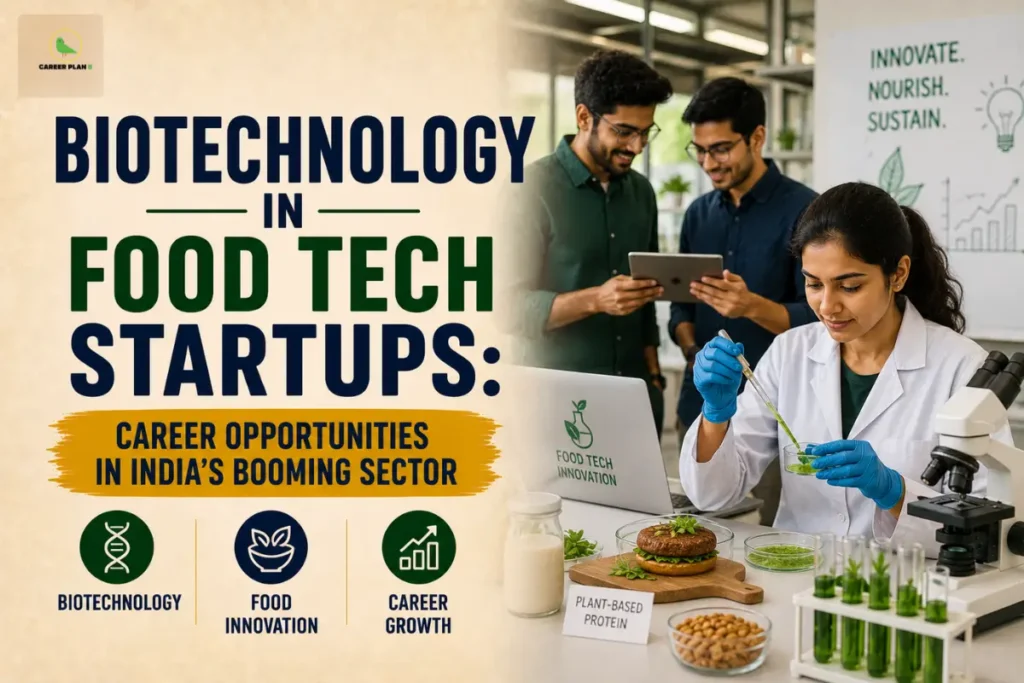
Introduction
India’s food system is being reinvented not in kitchens, but in laboratories. Across the country, a new generation of startups is using the tools of modern biology to rethink how food is grown, produced, packaged, and consumed. At the heart of this transformation is biotechnology in food tech startups a powerful convergence of life science innovation and entrepreneurial ambition that is creating products the world has never seen before. From meat grown directly from animal cells to dairy proteins produced without a single cow, the food industry is undergoing a biological revolution.
For life science students in India, this is not just an interesting trend to watch. It is a career landscape full of real, growing, and genuinely exciting opportunities. This blog breaks down how biotechnology is reshaping food tech, which startups are leading the charge in India, and what career paths are opening up for the next generation of food biotechnologists.
How Biotechnology Is Transforming the Food Industry
The relationship between biology and food is not new. Humans have been using fermentation one of biology’s most fundamental processes to make bread, cheese, beer, and yoghurt for thousands of years. What is new is the precision and intentionality with which biotechnology is now being applied to food production at every level of the supply chain.
Modern food biotechnology goes far beyond traditional fermentation. It includes the genetic engineering of crops for improved nutrition or pest resistance, the use of microbial cell factories to produce food ingredients like proteins and fats, the development of cell-cultivated meat using animal cell culture techniques, and the application of molecular biology tools to food safety testing and quality assurance. Each of these applications draws directly on the skills and knowledge that life science graduates develop during their education.
What Makes Food Biotech Different from Pharmaceutical Biotech?
The fundamental biological tools are often the same fermentation, genetic engineering, cell culture, protein expression systems. What differs is the application and the regulatory environment. Pharmaceutical biotech focuses on developing molecules that treat disease. Food biotech focuses on developing products that nourish, satisfy, and sustain and must do so at a price point and scale that the food industry demands. This makes food biotech uniquely challenging and commercially dynamic, requiring professionals who combine rigorous scientific training with an understanding of consumer markets and food regulation.
India’s Agri-Food Biotech Startup Ecosystem
India’s agri-food biotech startup landscape is young but growing with remarkable energy. Driven by a combination of venture capital interest, government support, and a domestic market of 1.4 billion people facing real food security and sustainability challenges, Indian food tech startups are attracting both talent and investment at an accelerating pace.
Several startups are already making significant progress. String Bio, based in Bengaluru, uses precision fermentation to convert methane into single-cell protein for animal feed a solution that addresses both greenhouse gas emissions and protein scarcity simultaneously. Evo Foods is developing plant-based egg alternatives using food science and biotechnology. New Wave Foods and similar companies are working on seafood alternatives. Across the country, agri-food biotech startups India is nurturing are tackling problems from food waste and crop nutrition to cultivated meat and functional food ingredients.
Agri-Food Biotech Startups India What Problems Are They Solving?
The problems these startups are addressing are urgent and large. India loses an estimated 30–40% of its food to post-harvest losses annually. Its protein consumption per capita remains below global averages. Its agricultural sector is under increasing stress from climate change and water scarcity. Biotechnology offers solutions to all of these challenges and startups are the vehicles through which those solutions are being developed and commercialised fastest.
Government support for this ecosystem comes through multiple channels. The Department of Biotechnology (DBT) funds early-stage food biotech research. BIRAC runs specific programmes supporting agri-food biotech innovation. The FSSAI regulates food safety standards, including novel foods like cell-cultivated products and precision fermentation ingredients, and is actively developing regulatory frameworks to accommodate these new categories.
Key Biotechnology Applications Driving Food Tech Innovation
Understanding the specific biotechnology applications at work in this sector helps you identify where your skills and interests might fit best. The food tech startup world is not monolithic it encompasses several distinct technology platforms, each with its own career ecosystem. Alternative protein and biotech jobs represent one of the largest and fastest-growing segments. Alternative proteins include plant-based proteins, precision fermentation-derived proteins, and cell-cultivated meat. Each of these requires distinct biotechnology expertise. Plant-based protein development involves food science, protein chemistry, and flavour science. Cell-cultivated meat requires animal cell culture, bioreactor engineering, and scaffold biomaterials. Precision fermentation involves metabolic engineering, microbiology, and downstream processing.
These products are molecularly identical to their animal-derived counterparts but produced without animals. Companies globally are using this technology to create dairy proteins, and the demand for scientists who understand microbial engineering, fermentation scale-up, and food-grade purification is growing sharply.
Fermentation technology in the food industry more broadly including traditional and novel fermentation for probiotics, enzymes, organic acids, and flavour compounds remains a foundational area with strong and consistent demand for trained professionals. Biofortification the engineering or breeding of crops to contain higher levels of vitamins, minerals, or essential amino acids is another significant application. India’s history with Golden Rice, iron-biofortified pearl millet, and Vitamin A-enriched crops reflects both the potential and the complexity of this field.
Have Any Doubts?
Here is a summary of key applications and the career roles they create:
Application | Technology Used | Career Roles Created Alternative Proteins (Plant-based) | Protein extraction, texturisation, flavour science | Food Biotechnologist, Protein Scientist, Sensory Analyst Cell-Cultivated Meat | Animal cell culture, bioreactor engineering, scaffold biomaterials | Cell Culture Scientist, Bioprocess Engineer, Biomaterials Researcher Precision Fermentation | Metabolic engineering, microbiology, downstream processing | Fermentation Scientist, Strain Development Scientist, Purification Engineer Biofortification | Genetic engineering, crop science, nutritional analysis | Plant Biotechnologist, Nutritional Scientist, Regulatory Affairs Specialist Food Safety Diagnostics | PCR, biosensors, molecular testing | Quality Control Analyst, Food Safety Scientist, Laboratory Manager
Official Reference: Indian Council of Agricultural Research (ICAR)
Career Opportunities in Biotechnology and Food Tech
Food biotechnology careers in India span a wide range of roles across startup R&D teams, established food companies, regulatory bodies, and academic research centres. The sector is young enough that entry-level professionals can grow quickly and take on significant responsibility early in their careers which makes it particularly attractive for ambitious science graduates.
Here is a detailed look at the key roles available:
| Role | Core Responsibilities | Key Skills Required | Avg. Salary in India |
|---|---|---|---|
| Fermentation Scientist | Develops and optimises microbial fermentation processes for food ingredient production | Microbiology, bioreactor operation, metabolic engineering, downstream processing | INR 4 – 10 LPA |
| Food Biotechnologist | Applies biotechnology tools to develop or improve food products and ingredients | Cell biology, food science, protein chemistry, analytical techniques | INR 3.5 – 9 LPA |
| R&D Scientist (Alternative Proteins) | Develops plant-based or cell-cultivated protein products from concept to prototype | Protein science, food formulation, sensory evaluation, scale-up | INR 5 – 12 LPA |
| Regulatory Affairs Specialist (FSSAI) | Manages regulatory submissions for novel food products; ensures compliance with FSSAI standards | Food law, regulatory science, documentation, novel food frameworks | INR 4 – 10 LPA |
| Bioprocess Engineer (Food) | Designs and optimises upstream and downstream bioprocessing systems for food ingredient production | Biochemical engineering, bioreactor design, process scale-up, GMP | INR 5 – 12 LPA |
| Quality Assurance Manager | Oversees food safety, quality control systems, and compliance across production operations | GMP, HACCP, food safety standards, microbiology, analytical testing | INR 6 – 14 LPA |
| Strain Development Scientist | Engineers and selects microbial strains for optimal production of target food ingredients | Genetic engineering, synthetic biology, metabolic flux analysis | INR 5 – 12 LPA |
Food science and biotechnology roles at the entry level are accessible to graduates with a B.Sc. or B.Tech in Biotechnology, Food Technology, Microbiology, or Biochemistry. Senior and specialised roles particularly in strain development, precision fermentation, and regulatory affairs typically require postgraduate qualifications or industry experience.
Official Reference: Council of Scientific and Industrial Research (CSIR)
Sustainable Food Technology India The Bigger Picture
The career opportunity in food biotech is not just about interesting science and growing startups. It is tied to some of the most urgent challenges facing India and the world. Sustainable food technology India needs is increasingly dependent on biotechnology to deliver. India’s population is projected to exceed 1.5 billion by 2030. Feeding that population sustainably while managing the water stress, soil degradation, and climate variability that conventional agriculture faces requires fundamentally new approaches to food production. Biotechnology offers tools that can significantly reduce the land, water, and carbon footprint of food production while improving nutritional quality and food safety.
The Government of India’s National Biotechnology Development Strategy explicitly identifies food and agricultural biotechnology as a priority area. This means government funding, policy support, and institutional infrastructure will continue to flow into this sector making it not just commercially exciting but structurally supported over the long term. The Ministry of Food Processing Industries (MoFPI) also supports food tech innovation through schemes that fund research and infrastructure development in food processing, creating additional career opportunities at the intersection of food technology and biotechnology.
How Career Plan B Helps
Excited about biotechnology in food tech startups but unsure which role or pathway suits you best? Career Plan B offers personalised career counselling designed specifically for life science and biotechnology students. Through the PsycheIntel assessment, it identifies your strengths, interests, and working style and maps them to the right career paths in emerging fields like food biotech, precision fermentation, and agri-food innovation, with a clear roadmap to get you there.
Get In Touch With Us
Frequently Asked Questions
Q1. What qualifications do I need to work in a food tech biotech startup in India?
A B.Sc. or B.Tech in Biotechnology, Food Technology, Microbiology, or Biochemistry is a strong starting point for entry-level roles. For R&D and strain development positions, an M.Sc. or M.Tech is often preferred. Startups tend to value hands-on laboratory skills and a demonstrated interest in food science and biotechnology alongside formal qualifications.
Q2. What is precision fermentation and why is it important for food tech careers?
Precision fermentation uses genetically engineered microorganisms to produce specific food ingredients such as dairy proteins, egg proteins, or animal fats without using animals. It is one of the fastest-growing areas of food biotechnology globally, and the demand for scientists with skills in microbial engineering, fermentation scale-up, and food-grade purification is increasing rapidly in both Indian startups and global companies.
Q3. How does FSSAI regulate novel food products developed using biotechnology in India?
FSSAI the Food Safety and Standards Authority of India regulates all food products sold in India, including novel foods produced using biotechnology. Companies developing precision fermentation ingredients, cell-cultivated products, or genetically modified food ingredients must seek approval under FSSAI’s regulatory framework before commercialisation. FSSAI is actively developing updated regulations to accommodate these new food categories.
Q4. Are there government funding opportunities for food biotech startups and researchers in India?
Yes. BIRAC supports food and agri-biotech startups through grant programmes, incubation support, and the BIG (Biotechnology Ignition Grant) scheme. DBT funds food biotechnology research projects at academic and research institutions. The Ministry of Food Processing Industries also offers schemes supporting food technology innovation and infrastructure development.
Conclusion
Food is the next great frontier of biotechnology and India’s startups are already staking their claim on it. Biotechnology in food tech startups is creating a new category of careers that did not exist a decade ago, powered by some of the most important scientific tools of our time and aimed at some of the most urgent challenges humanity faces. For life science students in India, the opportunity is genuine and growing.
Do not wait for this field to become crowded before you enter it. Build the right skills now, connect with the ecosystem early, and position yourself at the frontier of a sector that is redefining what food means scientifically, commercially, and for the future of the planet.