Deepti · September 24, 2026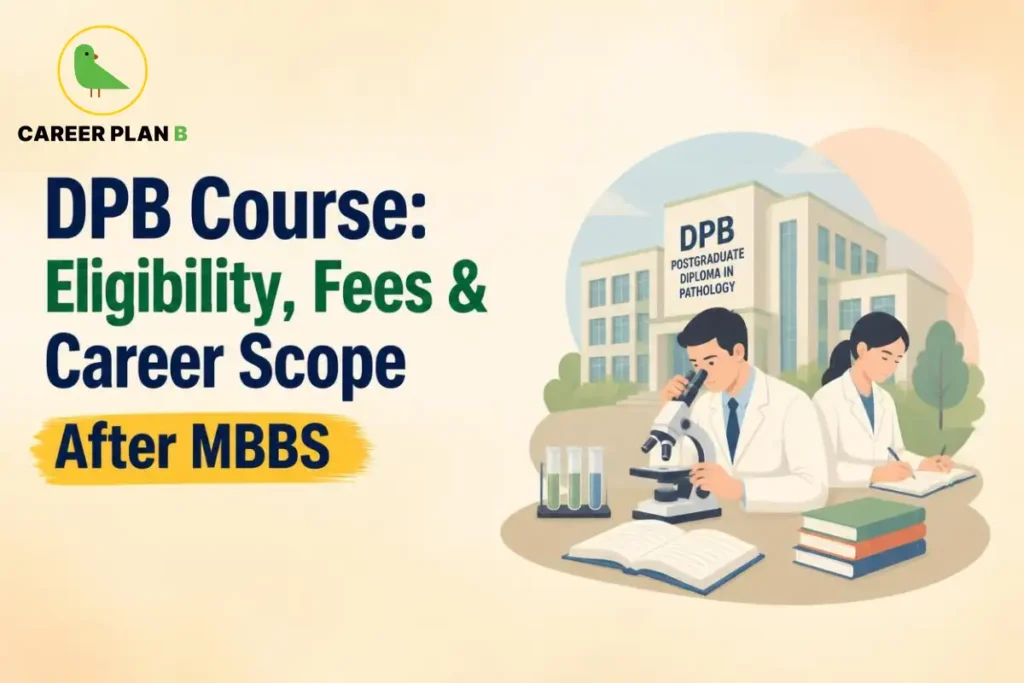
The DPB Course, or Diploma in Pathology and Bacteriology, gives MBBS graduates a postgraduate pathway focused on pathology, laboratory medicine and bacteriology. The course runs for two years under the College of Physicians and Surgeons of Mumbai (CPS) framework. The bigger question in 2026 concerns its current admission and recognition status, so students must check the latest regulatory position before applying.
What Is the DPB Course?
DPB stands for Diploma in Pathology and Bacteriology. The course trains doctors in disease diagnosis through laboratory methods, tissue examination, cytology, haematology, microbiology, blood banking and clinical biochemistry.
The official CPS syllabus sets objectives that include recognising microscopic and morphological changes, performing laboratory procedures, interpreting patient samples, handling transfusion medicine work and conducting clinico-pathological correlation. The syllabus also includes research methods, epidemiology, medical ethics and laboratory quality control.
Read the official CPS DPB syllabus for the detailed curriculum.
Why Do MBBS Graduates Consider DPB After MBBS?
DPB after MBBS suits doctors who enjoy diagnostic work and laboratory-based medicine. The training gives exposure to pathology and microbiology without following the longer MD pathway.
The qualification does not equal an MD Pathology degree. Candidates must check the recognition, registration and employment rules that apply when they complete the course.
The DPB syllabus gives students practical exposure to histopathology, cytology, haematology, blood banking, clinical pathology, serology and laboratory biochemistry.
DPB Eligibility: Who Can Apply?
The CPS course framework lists MBBS or an equivalent medical qualification as the basic requirement. The CPS enrollment rules further require permanent registration with the relevant State Medical Council before enrollment. Candidates must produce the original registration certificate during enrollment.
The standard checklist includes:
- MBBS or an equivalent recognised qualification
- Compulsory rotating internship
- Permanent medical registration
- The entrance and counselling requirements that apply to the active admission cycle
Students should not use old percentile figures as current DPB eligibility rules. A current notification must define the applicable NEET PG requirements for that session.
DPB Admission: Does It Require NEET PG?
The CPS Enrollment and Examination Rules, approved in November 2024, state that admission to CPS diploma and fellowship courses should follow PG-NEET and central CPS counselling. The same rules list a ₹15,000 application processing or registration fee.
The regulatory picture changed after that document. In 2024, the National Medical Commission issued a public notice that discontinued all courses under the CPS umbrella with immediate effect and warned that additional qualifications from admissions after that notice would not receive recognition for registration.
The CPS position and the NMC position became part of ongoing litigation. The Supreme Court case SLP(C) Nos. 13079-13081/2025 remains relevant, and the official Supreme Court cause-list portal lists the matter. Candidates should check the latest court order and the official CPS and NMC notices before treating DPB Admission as open.
For Personalized Guidance
DPB Course Duration and Training
DPB Course Duration: 2 years or 24 months under the CPS syllabus.
The official posting schedule divides the training across major pathology and laboratory areas:
| Training Area | Duration |
|---|---|
| Histopathology and autopsy | 10 months |
| Clinical pathology, haematology, cytopathology, blood bank | 10 months |
| Biochemistry, serology and museum work | 2 months |
| Revision across sections | 2 months |
| Total | 24 months |
CPS describes the programme as on-the-job training. Students work through histopathology, cytology, haematology, transfusion medicine, clinical pathology, serology and laboratory procedures.
The rules require four recognised stipendiary resident posts of six months each for the diploma.
DPB Syllabus: What Will You Study?
The DPB Syllabus covers much more than basic pathology.
Pathology
Students study general pathology, systemic pathology, haematology, cytopathology, clinical pathology, blood banking, transfusion medicine, autopsy techniques and laboratory quality control.
Laboratory and Diagnostic Methods
The practical syllabus covers:
- Histopathology and section cutting
- H&E and special stains
- Fine-needle aspiration cytology
- Body-fluid cytology
- Peripheral smear and bone marrow examination
- Blood grouping and cross-matching
- Clinical biochemistry
- Serology
- Immunopathology
- Immunohistochemistry
- Cytogenetics
- Molecular biology
Bacteriology and Microbiology
The microbiology component includes microscopy, bacterial morphology, culture-related methods, quality assurance, biosafety and healthcare-associated infection control. The examination pattern covers general microbiology, systemic bacteriology, virology, parasitology and mycology.
The syllabus even introduces techniques such as PCR, FISH, CISH, SKY, flow cytometry and blot techniques. This gives DPB a broader laboratory technology component than many short course descriptions suggest.
DPB Fees: What Can Students Expect?
The official CPS fee document available on its website gives a Maharashtra fee structure for the 2023 academic year. It lists DPB under two-year diploma courses.
| Fee Component | Merit Quota | Institutional Quota |
|---|---|---|
| CPS fee | ₹1,00,000 | ₹1,00,000 |
| Institution fee per year | ₹6,00,000 | ₹12,00,000 |
The document states that institution fees apply to unaided private institutions and that the listed amount represents the maximum fee those institutions could charge under that structure. It also states that aided institutions should not charge more than the merit-quota ceiling for the respective course.
That 2023 structure would produce a base two-year amount of about ₹13 lakh for merit quota or ₹25 lakh for institutional quota, assuming the same annual institution fee for both years. Other charges can change the final amount.
Treat these figures as historical fee data, not as confirmed 2026 DPB Fees. Students should check the latest official fee notification before paying any amount. View the CPS fee document.
DPB Colleges: Government and Private Options
Older online college lists often mix DPB seats with total MBBS intake. That practice can create misleading college tables.
Official Maharashtra records have previously listed DPB at government institutions. The 2021-22 revised CPS seat matrix, for example, listed four DPB seats at Government Medical College, Jalgaon. The later 2023-24 provisional matrix did not show a DPB seat there. The difference shows why students must verify the seat matrix for the exact academic year.
Private CPS-linked hospitals and institutions have followed separate fee structures. Students must verify three things before joining:
- The institution appears in the active official seat or counselling document.
- The seat carries the exact DPB course code or course name.
- The institution can currently train students under the applicable regulatory framework.
The CPS rules themselves warn candidates not to join an institution without a counselling selection letter.
What Career Options Can DPB Offer?
DPB Career options centre on pathology and laboratory medicine. Depending on current recognition, registration and employer rules, graduates can explore roles in:
- Hospital pathology departments
- Diagnostic laboratories
- Histopathology and cytology services
- Haematology and blood-bank services
- Laboratory medicine
- Microbiology and bacteriology-related services
- Healthcare and diagnostic organisations
- Research and laboratory-focused roles
The course can support diagnostic work, but candidates should not treat DPB as an automatic route to every role associated with MD Pathology.
A useful progression point comes from the National Board of Examinations in Medical Sciences. Its 2025 DNB-PDCET bulletin specifically excluded CPS diploma qualifications other than DPB, DCH and DGO from its stated restriction. That treatment made DPB different from several other CPS diplomas for that admission route. Candidates must still check the current NBEMS bulletin before planning any future qualification.
DPB Scope After MBBS
The DPB Scope depends on more than the syllabus.
Recognition determines how a qualification can support medical registration. State rules can influence recruitment. Employers can set their own eligibility conditions. Further postgraduate pathways can carry separate requirements.
Students who compare DPB with MD Pathology should check the exact qualification they want, the type of practice they plan to pursue and the regulations that govern that role.
Career Plan B’s NEET PG 2026 MD Pathology guide can help readers understand the MD Pathology route alongside other postgraduate choices.
DPB vs MD Pathology
| Factor | DPB | MD Pathology |
|---|---|---|
| Qualification | Postgraduate diploma | Postgraduate degree |
| Main focus | Pathology and bacteriology | Comprehensive postgraduate pathology training |
| Duration | 2 years under CPS framework | Check current NMC programme duration |
| Admission | CPS framework used PG-NEET and counselling | NEET PG and applicable counselling |
| Recognition | Current CPS status requires verification | Verify current NMC recognition |
| Career scope | Depends on registration and recruitment rules | Broader specialist pathway under applicable regulations |
This comparison helps candidates understand the difference without assuming that both qualifications carry identical career rights.
How Career Plan B Helps
Career Plan B helps MBBS graduates compare postgraduate pathways through Personalized Career Counselling, PsycheIntel and Career Assessment Tests, Admission and Academic Profile Guidance, and Career Roadmapping.
These services can help students compare DPB, MD Pathology and other PG options according to their academic profile and long-term goals.
Get In Touch With Us
FAQs
Q1. What is the DPB Course Duration after MBBS?
The DPB Course Duration under the CPS syllabus runs for 24 months, excluding the examination period.
Q2. What is the DPB Eligibility after MBBS?
DPB Eligibility starts with an MBBS or equivalent medical qualification, internship completion and the required medical registration. Current admission rules must confirm the applicable requirements.
Q3. Does DPB Admission require NEET PG?
The CPS enrollment rules require PG-NEET and central counselling. The NMC later discontinued CPS courses, so candidates must verify the current legal and admission status before applying.
Q4. What are the current DPB Fees?
The latest official CPS fee document located here gives a 2023 Maharashtra structure of ₹1 lakh CPS fees plus institution fees of ₹6 lakh or ₹12 lakh per year, depending on quota. Check the latest official notification for current fees.
Q5. Can I pursue Diploma in Pathology after MBBS?
DPB provides a pathology-focused postgraduate diploma pathway after MBBS under the CPS framework. Students must verify current recognition and admission status before joining.
Q6. What are the DPB government colleges?
Official Maharashtra records have listed DPB seats at government institutions in earlier CPS admission cycles. Students must check the current official seat matrix because availability can change by year.
Q7. What is the DPB Scope after MBBS?
DPB Scope centres on pathology, laboratory medicine, haematology, cytology, microbiology and related diagnostic work. Registration and recruitment rules determine the roles a graduate can pursue.
Conclusion
The DPB Course offers focused postgraduate training in pathology and bacteriology after MBBS. Its 24-month structure, laboratory exposure and detailed syllabus make it a distinct pathway. The 2026 regulatory position creates an important checkpoint for every applicant. Check the latest NMC notice, CPS information and Supreme Court updates before making any payment or joining decision.
Planning your post-MBBS path? Connect with Career Plan B for personalised career and admission guidance.