Team6 · September 24, 2026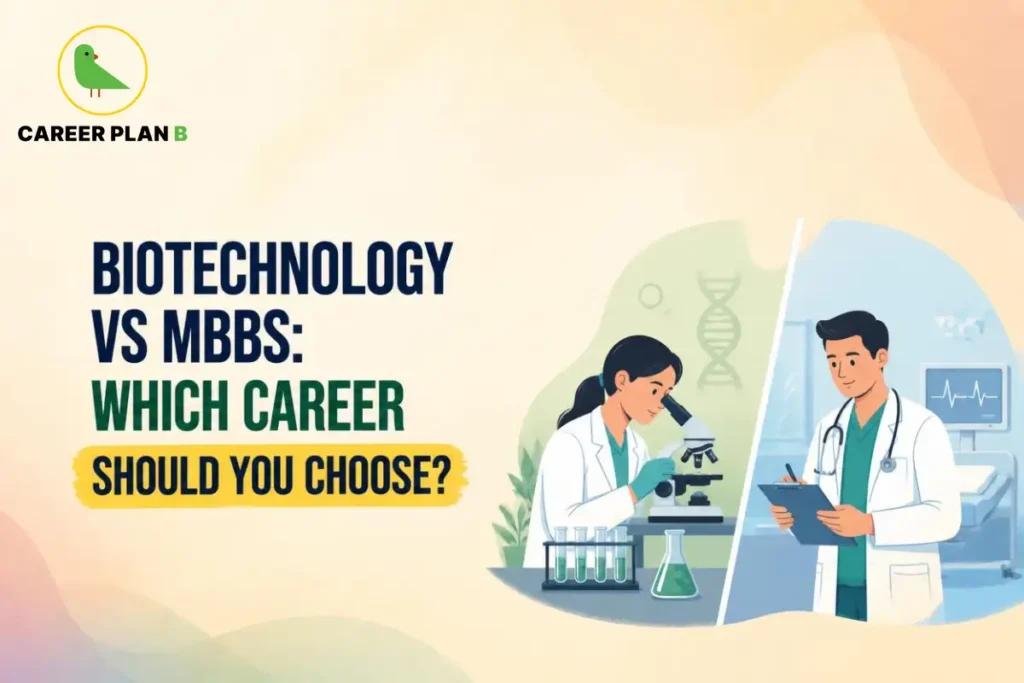
Introduction
You have just cleared Class 12 with Biology, Chemistry, and Physics. You love science, you want to make a difference in healthcare, but the question haunting you is: Biotechnology vs MBBS, which path is actually right for you?
It is one of the most common dilemmas among PCB students in India today, and honestly, it is not a simple one. Both careers sit at the heart of life sciences, both contribute to human health, and both demand dedication. But they take you in very different directions, one towards the clinic and the other towards the laboratory or industry.
In this blog, we break down biotechnology vs MBBS across every parameter that matters: course structure, admission process, career scope, salary, and long-term growth so you can make a confident, well-informed choice.
What Is MBBS and What Does It Offer?
MBBS, or Bachelor of Medicine and Bachelor of Surgery, is India’s primary undergraduate medical degree. The course spans 5.5 years, including a one-year compulsory rotating internship. It trains students to diagnose, treat, and manage patient health across clinical settings.
After MBBS, graduates can practise as general physicians, pursue postgraduate specialisations through NEET-PG, or enter public health, research, or medical administration. It is the foundation of every doctor’s career in India, regulated by the National Medical Commission (NMC).
MBBS Admission Process in India
Admission to MBBS in India is entirely through NEET-UG, conducted by the National Testing Agency (NTA). NEET-UG is held once a year and covers Physics, Chemistry, and Biology from the Class 11 and 12 syllabi. There are approximately 1.09 lakh MBBS seats across government and private medical colleges in India. Government college seats are highly competitive, with cutoffs frequently above the 99th percentile for top institutions.
What Is Biotechnology and Where Does It Lead?
Biotechnology is an interdisciplinary science that applies biological systems and living organisms to develop products, technologies, and solutions across healthcare, agriculture, the environment, and industry. Unlike MBBS, biotechnology is not a single degree; students can pursue a B.Sc. in biotechnology, B.Tech. biotechnology, or integrated programmes, depending on their aptitude and target career.
The scope in India has expanded significantly over the last decade. Graduates work in pharmaceutical companies, biotech startups, research institutions, regulatory bodies, and international organisations. The Department of Biotechnology (DBT), Government of India, actively funds research, innovation, and industry development in this space.
Biotechnology After 12th Entrance Exams and Top Colleges
Students pursuing biotechnology after 12th can appear for CUET-UG for BSc programmes at central universities or JEE Main/state-level engineering entrance exams for B.Tech. biotechnology. Institutions such as IITs, NITs, Delhi University, Jawaharlal Nehru University (JNU), and BITS Pilani offer strong programmes in this field.
Biotechnology vs. MBBS Head-to-Head Comparison
| Parameter | MBBS | Biotechnology (BSc/BTech) |
|---|---|---|
| Duration | 5.5 years (including internship) | 3 years (BSc) / 4 years (BTech) |
| Eligibility | PCB, minimum 50% in Class 12 | PCB or PCM, minimum 50% in Class 12 |
| Admission Exam | NEET-UG | CUET-UG / JEE / State CETs |
| Primary Focus | Clinical diagnosis and patient care | Research, industry, product development |
| Further Studies | MD/MS via NEET-PG | MSc, MTech, PhD, MBA (Pharma/Biotech) |
| Average Starting Salary | ₹6–10 LPA (government/private hospitals) | ₹3–6 LPA (entry-level research/industry) |
| Long-Term Earning Potential | Very high (specialists earn ₹20–50+ LPA) | High (senior roles in MNCs, ₹12–30+ LPA) |
| Global Opportunities | Available but requires country-specific licensing | Widely available, especially in research and pharma |
Doctor vs Scientist: Which Mindset Are You?
This is arguably the most important question, and it has nothing to do with marks.
Ask yourself: Do you find meaning in sitting with a patient, understanding their symptoms, and guiding them towards recovery? Or does your curiosity pull you towards understanding why a disease happens at the molecular level or how a new drug is designed and tested?
The doctor vs scientist career question is really a question of where your energy naturally flows. MBBS suits students who are empathetic communicators, comfortable in clinical environments, and motivated by direct patient impact. Biotechnology suits students who enjoy experimentation, problem-solving at a microscopic scale, and contributing to science that might help millions, even if they never meet those people directly.
Neither path is superior. They are simply different expressions of the same love for biology.
Have Any Doubts?
Career Scope and Salary Outlook
MBBS Career Trajectory:
- Intern / Junior Resident: ₹50,000–80,000/month (government stipend)
- General Physician: ₹6–12 LPA
- Specialist (MD/MS): ₹15–30 LPA
- Senior Consultant: ₹30–60+ LPA
Doctors in India are in consistent demand across public health infrastructure, private hospitals, and rural healthcare. The Ministry of Health and Family Welfare regularly publishes data on healthcare workforce needs.
Biotechnology Career Trajectory:
MBBS vs BSc Biotechnology is not just a course comparison; it is a career ecosystem comparison. Biotechnology opens doors to the following:
- Research Associate / Lab Technician: ₹3–5 LPA
- Scientist / Research Scientist: ₹6–12 LPA
- Senior Scientist / Product Manager: ₹12–25 LPA
- Director of Research / Global Roles: ₹25–50+ LPA
Organisations such as ICMR, CSIR, and BIRAC offer funded research positions and grant support for biotechnology professionals in India. For those interested in a career in biomedical research specifically, these institutions are primary employers and funders.
How Career Plan B Helps
Choosing between biotechnology and MBBS is not just about marks or job salaries; it is about understanding your own aptitude, values, and long-term vision. Career Plan B helps PCB students navigate exactly this decision through its Psycheintel psychometric assessment, which identifies whether your strengths align more with clinical, research, or industry tracks. Paired with one-on-one career counselling and a structured career roadmap, Career Plan B ensures you choose a path that fits who you actually are, not just what looks impressive on paper.
Get In Touch With Us
Frequently Asked Questions
Q1. Can a biotechnology graduate work in a hospital?
Not in a clinical role, only MBBS graduates are licensed to diagnose and treat patients in India. However, biotechnology graduates can work in hospital research departments, diagnostics labs, and medical device divisions in clinical settings.
Q2. Is NEET compulsory for MBBS in India?
Yes. NEET-UG is the sole entrance exam for MBBS admissions in India, conducted by NTA. There is no alternative route for undergraduate medical admission. Visit https://nta.ac.in/ for official details.
Q3. Which has a better scope, biotechnology or MBBS in India?
Both have strong scope but in different sectors. MBBS offers direct, high-demand clinical employment. The biotechnology career scope in India is growing rapidly in the pharma, research, and biotech industries, with significant global opportunities as well.
Q4. Can I do an MSc in biotechnology after an MBBS?
Yes. MBBS graduates can pursue postgraduate life science courses, including MSc Biotechnology or research fellowships through institutions like ICMR and CSIR. This is a less common but increasingly viable path for those interested in a career in biomedical research.
Q5. What if I am not sure which career suits me?
This is exactly where a career assessment helps. Tools like the PsycheIntel assessment available through Career Plan B help you identify your aptitude and align it with the right life sciences career options before you commit to a course.
Conclusion
Biotechnology vs MBBS is not a competition; it is a choice between two genuinely rewarding, high-impact careers in life sciences. MBBS is the right path if you see yourself healing patients and working within clinical systems. Biotechnology is the right path if you see yourself advancing science, developing new solutions, and contributing to healthcare from the research or industry side. The best career is not the most prestigious one; it is the one that matches your strengths, your interests, and your vision for the future.
Not sure which one that is? Visit Career Plan B to take the Psycheintel psychometric assessment and speak with a career counsellor who specialises in life sciences career options. Your clarity is just one conversation away.