Deepti · September 25, 2026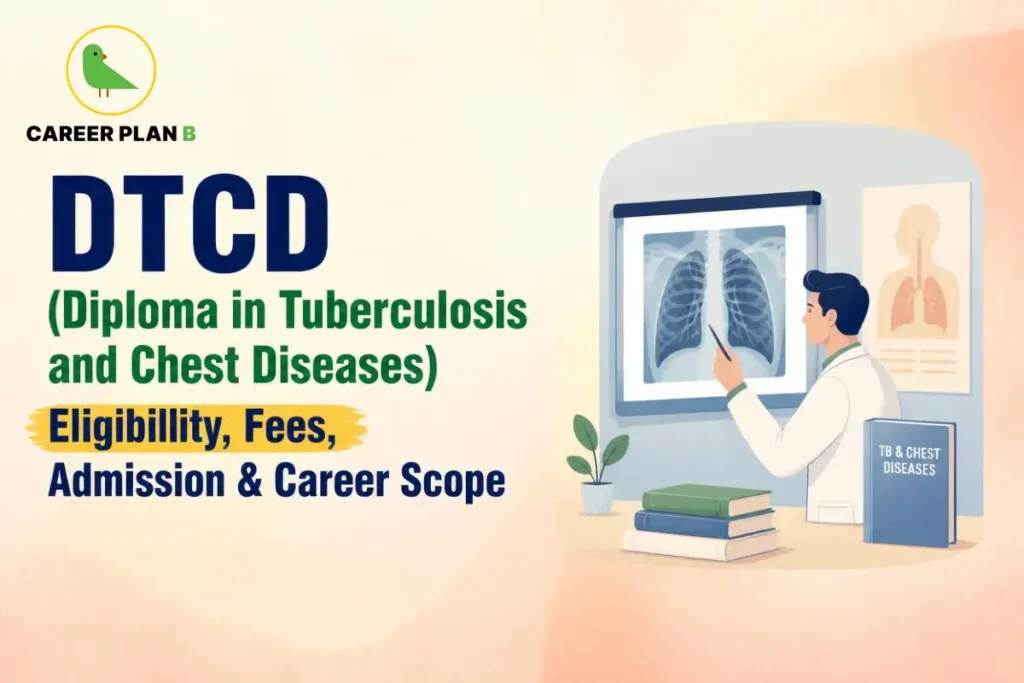
An MBBS degree opens several postgraduate paths. Doctors who enjoy respiratory and chest care can choose a focused route. The DTCD Course, or Diploma in Tuberculosis and Chest Diseases, is a two-year postgraduate diploma that trains doctors in respiratory medicine, tuberculosis, procedures and emergency care. NBEMS emphasises clinical skills and supervised training. This guide covers eligibility, admission, fees, syllabus, colleges and career options.
What Is the DTCD Course?
The Diploma in Tuberculosis and Chest Diseases forms part of the NBEMS Post MBBS Diploma framework. NBEMS lists DTCD (NBEMS) as a two-year Post MBBS Diploma in Tuberculosis & Chest Disease. The curriculum trains clinicians to diagnose and treat pulmonary diseases and support preventive and curative care. Training covers outpatient, inpatient and emergency care.
The DTCD curriculum develops respiratory medicine knowledge, clinical assessment skills, practical respiratory procedures, emergency care skills, professional communication, ethics and teamwork.
NBEMS lists DTCD among its Post MBBS Diploma courses in the 2026 accreditation bulletin. Check the official NBEMS Diploma page for programme updates.
DTCD Course Highlights
| Particular | Details |
|---|---|
| Course | Diploma in Tuberculosis and Chest Diseases |
| Level | Postgraduate diploma |
| Duration | 2 years |
| Entry qualification | MBBS |
| Entrance route | NEET PG |
| Focus | Respiratory medicine, tuberculosis and chest diseases |
| Mode | Full-time clinical training |
| NBEMS pathway | Post MBBS Diploma |
DTCD Eligibility After MBBS
Candidates need an MBBS degree or provisional MBBS pass certificate recognised under the applicable regulations. Candidates need permanent or provisional medical registration under the NEET PG requirements. They must complete the compulsory one-year internship by the prescribed cut-off for the admission session.
NEET PG serves as the single eligibility-cum-entrance examination for MD, MS and PG Diploma courses. Candidates can check the official NBEMS NEET PG page for the current eligibility framework. Candidates must also meet counselling and institute conditions. A qualifying NEET PG result does not guarantee a DTCD seat.
Is NEET PG Required for DTCD Admission?
Yes. Candidates enter the NBEMS DTCD route through NEET PG, use the result for counselling, choose available seats and report to the allotted institute. MCC conducts centralized counselling for applicable All India Quota NBEMS seats. Candidates can track notices on the official MCC counselling portal. State and in-service seats can follow separate rules.
NBEMS requires joining and registration formalities after allotment. Candidates with MCC-allotted NBEMS Diploma seats update joining status through the Online Portal for Joining and Registration.
DTCD Admission After MBBS: Step-by-Step
- Complete MBBS and the compulsory internship.
- Meet the current NEET PG eligibility conditions.
- Appear for NEET PG and secure qualifying status.
- Register for the applicable counselling.
- Check the current DTCD seat matrix and institute details.
- Fill and lock choices within the counselling schedule.
- Accept the allotted seat and complete fee payment.
- Report to the institute and complete NBEMS joining formalities.
Keep MBBS, registration, internship, NEET PG, category and allotment documents ready.
For Personalized Guidance
DTCD Course Duration
The DTCD course duration runs for two years under the NBEMS Post MBBS Diploma structure. NBEMS uses a skills-oriented training model. The training includes bedside teaching, seminars, case discussions, journal reviews and supervised patient care. NBEMS recommends at least five hours of formal teaching each week and requires a training logbook.
The programme gives trainees exposure to outpatient, inpatient, emergency and critical-care situations. Patient safety guides practical training, with trainees learning procedures under supervision before they perform them independently.
DTCD Syllabus: What Do You Study?
The DTCD syllabus covers respiratory medicine from basic science to critical care. The full official NBEMS DTCD curriculum provides the full syllabus.
Core areas include:
- Respiratory anatomy and physiology
- Tuberculosis and respiratory infections
- Tuberculosis diagnosis, treatment and drug resistance
- COPD, asthma and bronchiectasis
- Interstitial lung disease
- Pneumonia and pulmonary infections
- Pleural disease and pneumothorax
- Lung cancer
- Pulmonary hypertension and thromboembolic disease
- Acute respiratory failure and ventilatory support
- Preventive pulmonology, smoking cessation and rehabilitation
The practical component adds strong clinical training. The NBEMS curriculum covers sputum examination, chest X-ray interpretation, pulmonary function testing, arterial blood gas analysis, oxygen therapy, CPAP/BiPAP and tube thoracostomy. It includes supervised exposure to bronchoscopy, pleural aspiration or biopsy, intubation and chest-tube insertion where facilities permit.
DTCD Fees in India
DTCD fees in India depend on the applicable NBEMS fee framework and admission session. The January-May 2026 NBEMS Diploma accreditation bulletin lists annual trainee charges under three heads: ₹75,000 tuition, ₹15,000 library fees and ₹15,000 annual appraisal fees. The listed annual amount comes to ₹1.05 lakh, or ₹2.10 lakh for two years at the same annual rate. Check the latest NBEMS fee notice before payment.
The older ₹1.25 lakh annual figure that appears in several course articles does not automatically represent the 2026 fee structure. Candidates should use the latest NBEMS fee guidance before payment.
DTCD Colleges in India
DTCD colleges in India can change when NBEMS grants, renews or modifies accreditation. Check the live counselling seat matrix and NBEMS accreditation status before choice filling.
Some institutions that currently publish DTCD NBEMS programmes include:
| Institution | Location | Published details |
|---|---|---|
| Jaipur Golden Hospital | Delhi | 2 DTCD NBEMS seats; accreditation published up to Dec 2027 |
| K J Somaiya Medical College and Research Centre | Mumbai | 2 students per year; 2-year full-time programme |
| Kanumuri Hospitals | Andhra Pradesh | DTCD NBEMS programme; 2-year duration |
Jaipur Golden Hospital publishes its DTCD intake and accreditation validity on its academic page. K J Somaiya Medical College publishes the two-year course and two-student annual intake. Kanumuri Hospitals also publishes a two-year DTCD NBEMS programme.
Seat availability can change between counselling rounds. Candidates should verify the institute, specialty, current seat count, accreditation status, fees and applicable service-bond conditions before choice filling.
Career After DTCD
The DTCD career after MBBS can cover hospital respiratory services, tuberculosis care, emergency respiratory management and public-health work. The NBEMS curriculum prepares graduates to diagnose and manage pulmonary disease and understand national health programmes that include tuberculosis.
Possible work areas include:
- Respiratory and chest disease services in hospitals
- Tuberculosis diagnosis and management services
- Medical officer or clinical roles that accept the qualification
- Emergency and critical-care support for respiratory conditions
- Public-health and tuberculosis programme activities
- Teaching roles where current eligibility rules permit
- Research and further postgraduate training, subject to applicable regulations
The DTCD scope after MBBS depends on employer rules, registration, experience and additional qualifications. The diploma does not create eligibility for every specialist or academic post.
DTCD vs MD/DNB Respiratory Medicine
DTCD and MD or DNB Respiratory Medicine follow different postgraduate training structures. It takes two years in the NBEMS Post MBBS Diploma route. MD and Post MBBS DNB programmes follow their own specialty-training structures.
Compare training depth, duration, procedure exposure, academic plans and long-term eligibility before choosing. Career Plan B’s NEET PG Branch Selection Guide can help readers organise these factors.
How Career Plan B Helps
Career Plan B supports MBBS graduates through Personalized Career Counselling, PsycheIntel and Career Assessment Tests, Admission and Academic Profile Guidance, and Career Roadmapping.
Doctors can compare DTCD with other NEET PG pathways, review their academic profile and plan counselling choices with a clearer direction.
Get In Touch With Us
FAQ
Q1. What is the DTCD course duration?
The DTCD course duration is two years under the NBEMS Post MBBS Diploma framework.
Q2. What is DTCD eligibility after MBBS?
DTCD eligibility after MBBS requires an eligible MBBS qualification, applicable medical registration, required internship completion and NEET PG eligibility.
Q3. How does DTCD admission after MBBS work?
DTCD admission after MBBS follows NEET PG qualification, counselling, choice filling, seat allotment and institute joining.
Q4. What are the DTCD fees in India?
The January-May 2026 NBEMS bulletin lists ₹1.05 lakh in annual trainee charges under tuition, library and annual appraisal heads. Candidates should verify the latest fee notice before payment.
Q5. Which are the DTCD colleges in India?
DTCD colleges in India include NBEMS-accredited hospitals such as Jaipur Golden Hospital and K J Somaiya Medical College, with availability subject to current accreditation and counselling seat matrices.
Q6. What is the DTCD scope after MBBS?
DTCD scope after MBBS includes hospital respiratory care, tuberculosis services, emergency respiratory management, public-health work and roles that accept the qualification.
Q7. What is DTCD NEET PG 2026 admission?
DTCD NEET PG 2026 admission uses NEET PG as the entrance route for the NBEMS Post MBBS Diploma, followed by the applicable counselling and seat-allotment process.
Conclusion
The DTCD Course gives MBBS graduates a two-year postgraduate route into respiratory medicine, tuberculosis and chest disease care. The DTCD syllabus combines clinical knowledge with practical respiratory procedures and emergency management. Check the latest NBEMS rules, seat matrix and fee notice before choice filling.
Want to compare DTCD with other NEET PG branches? Explore Career Plan B’s medical career guidance and plan your next step with clearer information.