Team Career Plan B · September 30, 2026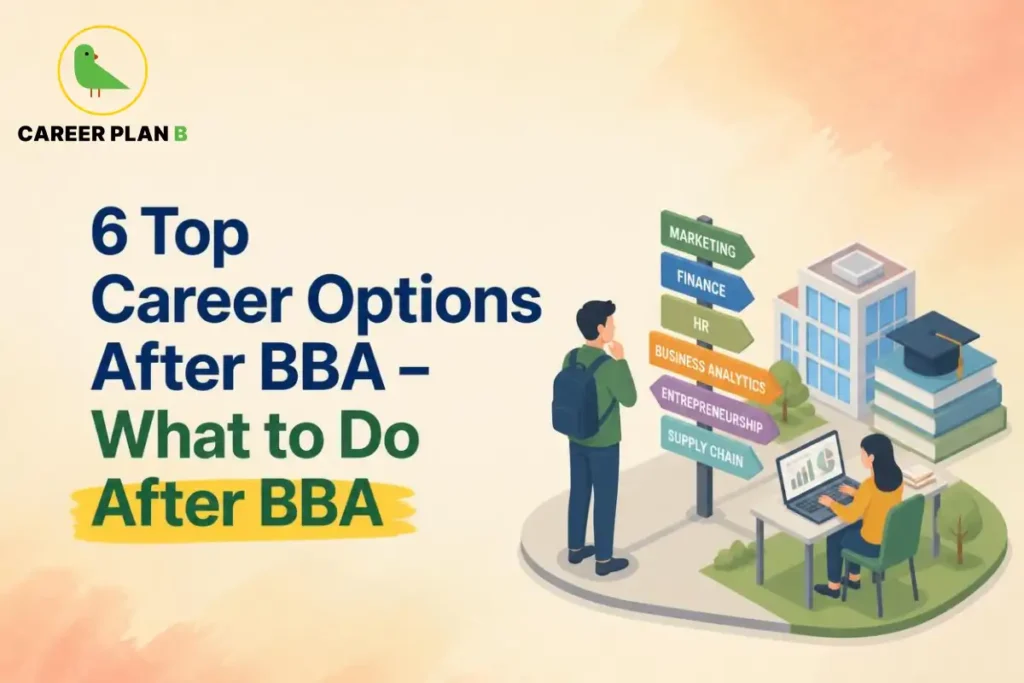
Introduction
You have finished your BBA. Now the real decision begins.
A Bachelor of Business Administration is a genuinely versatile foundation. The challenge is not a shortage of paths but knowing which one actually fits your strengths and long-term goals.
This guide covers the 6 top career options after BBA in India. Each path is mapped with what it involves, what you need next, and how to start.
Why BBA Graduates Have More Options Than They Realise
BBA is one of India’s most flexible undergraduate degrees. It covers management, finance, marketing, HR, and strategy in one programme.
What Makes BBA Graduates Versatile
BBA gives you exposure to multiple business functions over three years. This means you can move into further studies, certifications, or direct employment across many sectors. You are not boxed into one track.
The Key Decision: Study Further or Work First?
Most paths after BBA split into two broad categories. Either you deepen your credentials through further education, or you enter the workforce and build from there. Both approaches are valid. Your choice should depend on your financial situation, goals, and timeline.
Career Option 1: MBA or MMS
An MBA after BBA remains the most widely chosen and high-impact next step for business graduates in India.
Why MBA Makes Sense After BBA
BBA’s broad management foundation aligns naturally with MBA-level thinking. Students often find early MBA coursework more intuitive after a BBA than peers from non-business backgrounds.
How to Get In
The Common Admission Test (CAT) is the primary MBA gateway for IIMs and top B-schools nationally. State-level exams like MAH-MBA CET and TANCET open doors to strong regional institutes. These include JBIMS and SIMSREE.
Expected Career Outcomes
MBA graduates from top institutions access management roles, consulting, and leadership tracks that a BBA alone rarely opens directly. This makes MBA the strongest single credential to add after BBA for long-term earning potential.
Career Option 2: Law (BA LLB or LLB After Graduation)
Law is a less obvious but increasingly popular choice for BBA graduates with interests in corporate, commercial, or business law.
Why BBA to Law Works Well
BBA’s exposure to business and commercial thinking gives you a genuine edge in corporate law. This extends to mergers, acquisitions, and regulatory compliance roles.
Entry Route
BBA graduates can pursue a standard 3-year LLB through the Bar Council of India-affiliated institutions. Some graduates enter integrated BA LLB programmes, though these typically require pre-graduation planning.
Expected Career Outcomes
Corporate law, in-house counsel roles, and compliance positions are among the strongest career areas for BBA-to-law graduates.
Career Option 3: Finance Certifications (CA, CFA, NISM)
For BBA graduates with a clear finance focus, professional certifications offer a structured, credentialled route into high-value finance roles.
Chartered Accountancy (CA)
BBA graduates can directly enter the Intermediate level of the CA programme under the Institute of Chartered Accountants of India (ICAI). This skips the Foundation exam entirely and saves time compared to fresh graduates.
NISM Certifications for Securities Markets
The National Institute of Securities Markets (NISM) is set up by SEBI. It issues mandatory certifications for investment advisory, mutual fund distribution, and research analysis roles. These are short, structured, and often required for regulated finance roles.
CFA Pathway
The CFA designation is globally recognised for investment and portfolio management careers. BBA provides a reasonable analytical foundation for early CFA levels.
Career Option 4: Government Jobs and Competitive Exams
Government roles offer stability, structured career progression, and broad sector access for BBA graduates.
Banking Sector Exams
IBPS PO, IBPS Clerk, SBI PO, and RBI Grade B are all open to any graduate, including BBA holders. These exams have defined timelines and require structured preparation typically starting 6 to 12 months before the exam date.
SSC CGL and Civil Services
BBA graduates qualify for SSC CGL and, depending on age, for UPSC Civil Services preparation. The National Career Service (NCS) portal is run by the Ministry of Labour and Employment. It provides centralised listings and career guidance for graduates targeting government roles.
Why This Path Suits Some BBA Graduates
Government roles offer salary certainty, pension benefits, and structured progression. For BBA graduates who value stability over high variance, this path offers genuine long-term security.
Career Option 5: Entrepreneurship and Startup Roles
BBA’s breadth across management, finance, and marketing makes it a strong foundation for early-stage entrepreneurship or startup roles.
Startup India Support for BBA Graduates
The Startup India initiative, led by DPIIT, offers tax exemptions, compliance support, and funding pathways for recognised startups. BBA graduates building early ventures can access these as a structured support route.
Joining an Early-Stage Startup
Many early-stage startups specifically look for generalist BBA graduates for operations, business development, and marketing roles. This gives you broad exposure and fast skill accumulation.
Career Option 6: Digital Marketing and Analytics
Digital marketing has emerged as one of the fastest entry points for BBA graduates into well-paying, skills-first roles.
Why This Path Works for BBA Graduates
BBA’s marketing exposure provides useful context for digital work. Short certifications in SEO, content strategy, paid media, and analytics are sufficient to begin working in most digital marketing roles.
Government-Backed Skilling Options
The Skill India Digital Hub offers structured, government-backed digital skills bootcamps. These add a verifiable certification layer to your BBA credential.
Expected Career Outcomes
Entry-level digital marketing roles typically offer ₹3 to ₹5 lakh per annum. Specialisation in data analytics, performance marketing, or SEO can significantly accelerate salary growth.
How to Choose the Right Path After BBA
The right choice after BBA depends on three personal factors: your interest area, your risk tolerance, and your timeline.
If Finance Is Your Strongest Area
Pursue CA, CFA, or NISM certifications. These credentials directly translate into higher-value, more regulated finance roles that a BBA alone does not unlock.
If You Want Maximum Long-Term Leverage
An MBA from a top institution is the single most powerful credential to add after BBA. It opens management, consulting, and leadership roles not directly accessible from a BBA alone.
If You Need to Work Immediately
Digital marketing, startup roles, or business development provide income while you build experience. These also help clarify your longer-term direction.
Benefits, Challenges, and What the Data Says
BBA’s versatility is well-supported. Its curriculum spans finance, marketing, HR, and management, giving graduates genuine flexibility across multiple paths.
However, no single official dataset tracks salary outcomes specifically by path chosen after BBA. Instead of estimating these figures, this guide flags where salaries are typically higher with additional credentials. It also notes where direct entry is more accessible.
The consistent pattern is clear. BBA graduates who pair the degree with a next credential see significantly stronger outcomes. This applies to MBA, CA, NISM, or any structured certification.
The Outlook for BBA Graduates in 2026 and Beyond
MBA intake at top institutions continues expanding. Government banking and SSC exam cycles remain stable. Digital marketing and startup roles are growing consistently alongside India’s digital economy.
This confirms that all six paths represent genuine, growing opportunity for BBA graduates. This applies whether you are entering the workforce or further education in 2026.
How Career Plan B Helps
Understanding which of these six paths genuinely fits you can feel overwhelming without guidance. Career Plan B simplifies this through:
- Personalised Career Counselling: matching your BBA background to the right next step based on your goals
- Psycheintel Career Assessment Tests: confirming whether finance, management, law, or entrepreneurship aligns with your strengths
- Admission and Academic Profile Guidance: planning MBA applications, CA enrolment, or NISM certification strategically
- Structured Career Roadmapping: a clear, step-by-step plan from your BBA graduation to your target career role
Get In Touch With Us
Frequently Asked Questions
Q1. What is the best career option after BBA?
MBA from a top institution is the most impactful next step for long-term management and leadership careers. Finance certifications like CA or CFA are stronger for dedicated finance roles.
Q2. Can BBA graduates directly enter the CA Intermediate level?
Yes. ICAI allows BBA graduates to skip the CA Foundation. They enter the Intermediate level directly, saving time compared to Class 12 entrants.
Q3. What government jobs can BBA graduates apply for?
IBPS PO, SBI PO, SSC CGL, and UPSC are all open to BBA graduates meeting standard eligibility criteria.
Q4. What salary can I expect directly after BBA?
Entry-level salaries for BBA graduates typically range from ₹3 to ₹5 lakh per annum. This rises significantly with an MBA, CA, or relevant specialisation.
Q5. Is digital marketing a good option after BBA?
Yes. It is one of the fastest entry points into paid, skills-first roles. Short certifications add credibility to BBA’s existing marketing exposure.
Q6. Which path suits someone who wants to start a business after BBA?
Startup India’s structured support, combined with BBA’s broad business exposure, makes entrepreneurship a viable and supported path directly after graduation.
Conclusion
BBA opens six genuinely strong career paths. Choosing well requires honest alignment between your strengths and the right next step.
MBA, law, finance certifications, government jobs, entrepreneurship, and digital marketing each represent a real, growing opportunity backed by verified pathways. The degree gives you a foundation. What you build on it next determines the outcome.
Start by identifying your strongest interest from these six options. Then commit fully to one next step rather than leaving all doors open indefinitely.
Ready to build a clear career plan after your BBA? Talk to a Career Plan B counsellor and get a personalised roadmap today.