Team Career Plan B · October 5, 2026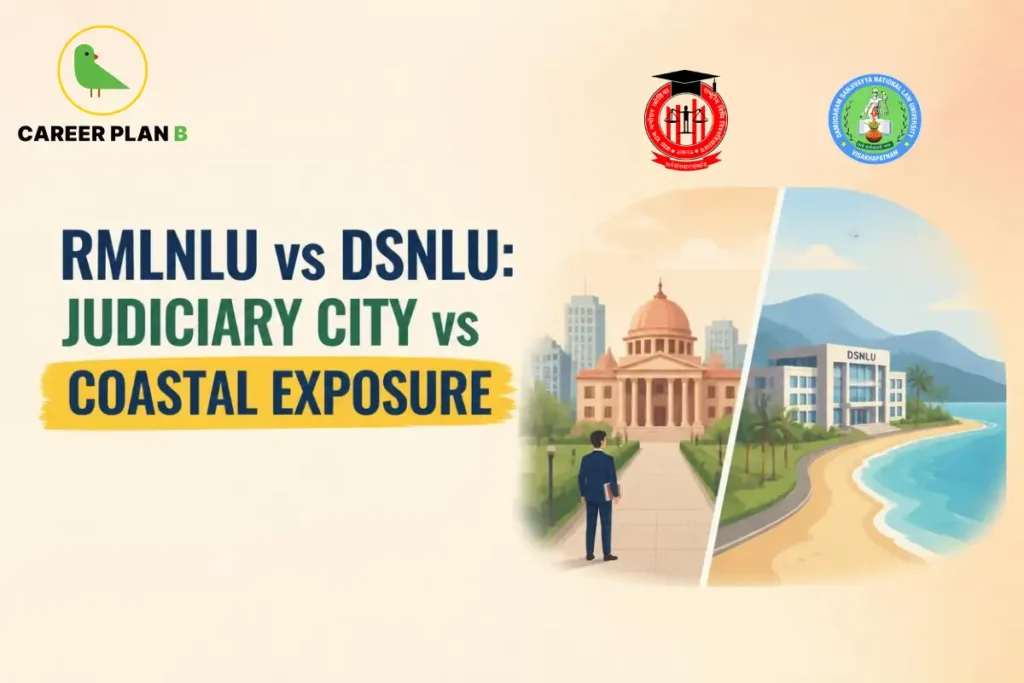
Introduction
Lucknow and Visakhapatnam couldn’t be more different cities, and that difference shapes everything about RMLNLU vs DSNLU, these two law schools. RMLNLU sits inside a genuine judiciary hub, steps from a High Court bench that shapes its entire internship culture. DSNLU, meanwhile, has built its identity around the coast, training students to think in maritime and international trade terms. Let’s see what each city actually gives you.
Why RMLNLU’s Judiciary City Location Actually Matters
Lucknow isn’t just another campus city. It houses the Allahabad High Court’s Lucknow Bench, one of the busiest court benches in North India. This proximity isn’t incidental. It runs straight through RMLNLU’s internship culture and its alumni network.
Allahabad High Court Internship Access Right at Your Doorstep
Students regularly intern directly under judges and senior advocates practising at the Lucknow Bench. They prepare case briefs and observe live proceedings. Moreover, RMLNLU’s own placement records list sitting High Court judges and senior Supreme Court advocates among the professionals who’ve engaged with students over the years. This includes names like Harish Salve and Ram Jethmalani in past sessions.
Manthan and the Alumni Network Built Around Litigation
RMLNLU’s Internship and Placement Committee runs an annual flagship event called Manthan. It brings in partners from firms like Cyril Amarchand Mangaldas, alongside senior advocates from the Allahabad High Court. Therefore, students get structured exposure to both corporate practice and courtroom litigation within the same city.
How DSNLU’s Coastal Location Shapes a Completely Different Curriculum
Visakhapatnam sits on Andhra Pradesh’s coastline, and DSNLU has leaned into that geography deliberately. Rather than building around a High Court bench, the university has built around shipping lanes, ports, and international trade routes.
The Centre for Maritime, Admiralty and Navigation Laws
DSNLU runs a dedicated Centre for Maritime, Admiralty and Navigation Laws. It researches shipping regulation, environmental protection at sea, and maritime security. Additionally, this coastal focus extends into aviation, space law, and banking and finance law. This gives students a varied, sector-linked education beyond litigation alone.
WAVES Newsletter Keeps Students Tuned to Maritime Current Affairs
DSNLU publishes its aptly named WAVES Newsletter, tracking ongoing developments in maritime and international law. Consequently, students here build fluency in trade law and shipping disputes. RMLNLU students, by contrast, build fluency in courtroom procedure.
RMLNLU vs DSNLU: A Side-by-Side Look
| Factor | RMLNLU Lucknow | DSNLU Visakhapatnam |
|---|---|---|
| City Identity | Judiciary hub, Allahabad HC Lucknow Bench | Coastal port city |
| Core Strength | Litigation and judicial exposure | Maritime, aviation, and trade law |
| Distinctive Infrastructure | Judge and senior advocate access | Centre for Maritime, Admiralty and Navigation Laws |
| Flagship Publication | International Legal Essay Writing Competition | WAVES Newsletter |
| Internship Pull | Allahabad High Court, corporate law firms | Shipping, trade, and international law bodies |
Judiciary City Legal Education or Coastal Law University: Which suits your goals?
This decision really hinges on where you see yourself practising. If courtroom work, judicial clerkships, or litigation-heavy corporate law appeal to you, RMLNLU’s proximity to a genuinely busy High Court bench gives you consistent, real exposure to that world.
If Trade, Shipping, or International Law Excites You More
However, if maritime disputes, international trade regulation, or aviation law sound more interesting than courtroom drama, DSNLU’s coastal specialisation offers something few other Indian law schools can match. Neither path is inherently better. They simply train you toward different corners of the profession.
For Personalized Guidance
What Each City Teaches You Beyond the Classroom
Location shapes more than internships. It shapes how students think. RMLNLU students absorb courtroom rhythm simply by being near one of India’s busiest High Court benches. They can develop procedural instincts that classroom teaching alone rarely builds. DSNLU students, meanwhile, absorb a sector-specific worldview. Visakhapatnam’s port economy keeps trade and shipping law relevant well beyond the syllabus.
Building Career Direction Around Your City’s Strength
Therefore, choosing between these two isn’t just about picking a university. It’s about choosing which city’s daily rhythm you want shaping your legal instincts for five years.
How Career Plan B Helps
Choosing between RMLNLU’s judiciary-focused legal environment and DSNLU’s coastal and sector-specific learning ecosystem can be challenging for CLAT aspirants. Career Plan B helps students make informed decisions through:
Personalised Career Counselling: Get guidance based on your CLAT rank, career interests, and preference for litigation, judiciary, corporate law, maritime law, or specialised legal fields.
Psychometric & Career Assessment Tests: Identify your strengths and understand whether courtroom practice, research, trade law, or sector-based legal careers align with your profile.
Career Roadmapping: Create a structured legal career plan covering NLU selection, internships, skill development, specialisations, and long-term opportunities.
Admission & Academic Profile Guidance: Receive support with CLAT preference planning, NLU comparisons, cutoff analysis, and admission strategy to choose the right institution.
Get In Touch With Us
Frequently Asked Questions
Q1. Can RMLNLU students actually intern at the Allahabad High Court’s Lucknow Bench?
Yes. Students regularly secure internships there, preparing case briefs and observing live court proceedings under practising advocates and judges.
Q2. What does DSNLU’s Centre for Maritime, Admiralty and Navigation Laws actually research?
It covers shipping regulation, international trade disputes, maritime environmental protection, and maritime security issues.
Q3. Which university suits someone aiming for judicial services?
RMLNLU’s proximity to a major High Court bench and its litigation-heavy alumni network generally align better with judicial service goals.
Q4. Does DSNLU only focus on maritime law?
No. It also runs specialised centres in aviation and space law, along with banking and finance law, alongside its maritime focus.
Q5. Which entrance exam applies to both universities?
Both admit undergraduate students through CLAT-UG, so the entrance process itself is identical.
Conclusion
RMLNLU vs DSNLU ultimately comes down to judicial city access versus coastal sector specialisation. RMLNLU puts you inside a genuine courtroom ecosystem, building litigation instincts through real High Court exposure. DSNLU puts you inside a maritime and trade-focused world, training you for a genuinely distinctive corner of legal practice.
If you need professional guidance during law counselling, platforms like Career Plan B can help you navigate state quotas with total clarity.