Team Career Plan B · October 6, 2026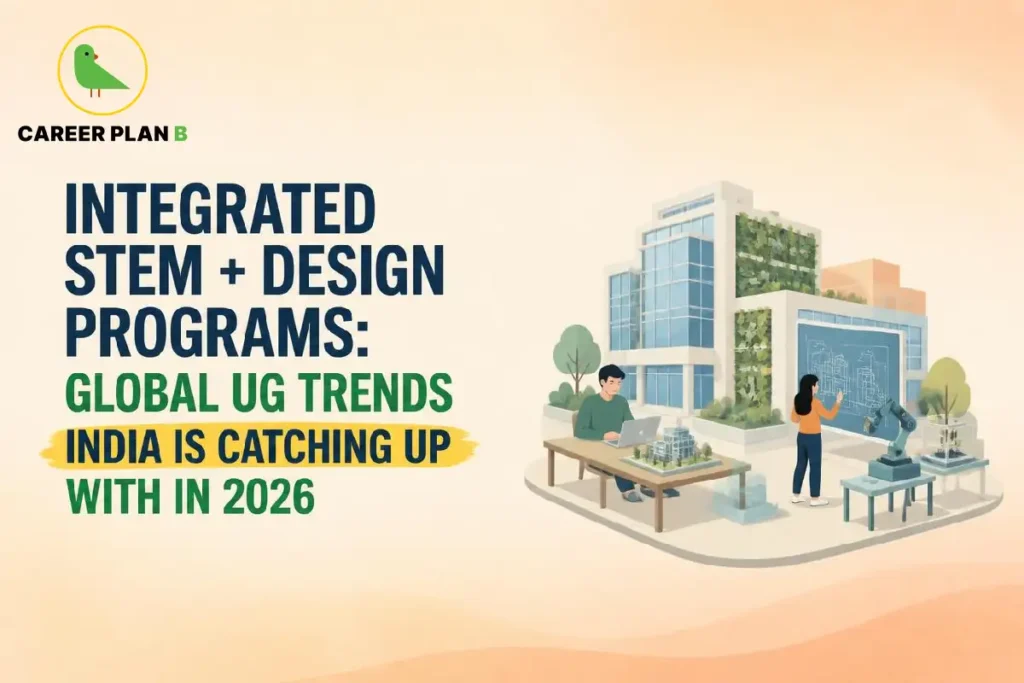
Introduction
For decades, Indian higher education kept engineering, science, and design in separate boxes. Students attended different colleges, followed different entrance exams, and rarely crossed between these fields. Integrated STEM Design Programs are slowly breaking down that separation. Industry demand and government policy reform both support this shift.
This guide focuses on what’s genuinely verifiable. India’s official policy push toward Integrated STEM Design Programs comes from real government initiatives rather than vague claims about global education trends.
What Are Integrated STEM Design Programs, and Why Now?
Integrated STEM and design education blends science, technology, engineering, and mathematics with design thinking, aesthetics, and human-centered problem-solving. Instead of treating these areas as separate academic tracks, it brings them together.
The reasoning behind this shift is straightforward. Real-world problems, from sustainable urban planning to accessible healthcare devices, require both technical knowledge and design thinking.
India’s push in this direction isn’t just industry talk. The approach also appears directly in national education policy.
Read more:-B.Tech in Design 2025: Course Details, Fees, Admission, Top Colleges
India’s Official Policy Push: NEP 2020 and Multidisciplinary Education
The Ministry of Education’s official explainer on NEP 2020 describes holistic and multidisciplinary education as a core pillar of the policy. It aims to develop intellectual and creative capacities through an integrated and flexible curriculum (source: education.gov.in).
The government has also introduced concrete mechanisms to support this shift. These include the National Higher Education Qualifications Framework, guidelines for multiple entry and exit points, and the Academic Bank of Credits. These mechanisms can help students combine disciplines such as STEM and design without unnecessary administrative barriers.
This matters because it moves the STEM-design integration conversation beyond aspiration. It also creates a regulatory framework that can support multidisciplinary study.
AICTE’s IDEA Labs: A Concrete Official Example
Here’s a specific and verifiable government initiative worth knowing about. The All India Council for Technical Education has established 423 IDEA Labs. IDEA stands for Idea Development, Evaluation & Application. These labs operate across technical institutions to promote multidisciplinary education and STEM-based experiential learning. They also aim to strengthen academia-industry linkages (source: Press Information Bureau, Government of India).
This provides a concrete example of policy translating into physical infrastructure. It goes beyond guidance documents and shows how government initiatives can support hands-on multidisciplinary learning.
STEM and Design Courses: What This Looks Like in Practice
In practice, STEM and Design Courses integration can appear through several mechanisms enabled by these policy shifts. Students may choose design-related minors alongside a core engineering or science major. Multidisciplinary institutions may also offer cross-listed electives that cover both domains. Credit transfer flexibility can further help students build a hybrid academic profile instead of remaining locked into one discipline.
For a student evaluating options today, the practical question isn’t whether this trend is real. Policy and infrastructure clearly support the direction. The more important question is whether a specific shortlisted institution has actually built meaningful cross-disciplinary pathways.
Some universities have moved quickly. They have established design studios alongside engineering labs and developed faculty expertise across both domains. Others have made only nominal changes to align with the broader NEP framework. They may not have expanded their actual course offerings significantly.
This gap between policy intent and campus-level execution makes individual verification essential. Before committing to a programme, students should check whether the institution genuinely offers the STEM-design integration they expect.
This structure differs from the older system. Previously, an engineering student often had limited formal opportunities to pursue genuine design electives without changing institutions. However, implementation still varies considerably across institutions. A college’s alignment with the NEP framework does not automatically mean it has created well-resourced cross-disciplinary electives. Therefore, checking each institution’s actual course catalogue remains essential.
For Personalized Guidance
Global UG Trends 2026: Why We’re Keeping This Honest
It’s worth being direct about the scope here. Integrating STEM and design is widely discussed in global higher education. However, we don’t have a single verified government dataset that directly compares India’s adoption rate with other countries’ undergraduate systems.
Claiming specific rankings or comparative statistics on Global UG Trends 2026 without a verifiable source would mean repeating unsubstantiated claims instead of presenting genuine data.
What we can say with confidence is that India’s own official policy documents support this direction. Concrete government action also backs it. Therefore, the shift represents more than marketing language from individual institutions.
How Career Plan B Helps
Understanding where India’s policy is genuinely headed, and how to build a realistic academic path within it, takes more than following industry buzzwords.This is where Career Plan B can help by offering:
- Personalized Career Counselling: Helps you evaluate whether an integrated STEM-design path genuinely fits your interests and available programme options.
- Psychometric & Career Assessment Tests: Identifies whether you’re better suited to a technically focused, design-focused, or genuinely hybrid academic direction.
- Career Roadmapping: Builds a realistic plan for combining STEM and design coursework within NEP’s multidisciplinary framework.
- Admission & Academic Profile Guidance: Supports you in identifying institutions genuinely offering cross-disciplinary electives, not just marketing the term.
Get In Touch With Us
Frequently Asked Questions
Q1. Is the STEM-design integration trend backed by actual government policy, or just marketing?
It’s genuinely backed by policy, specifically NEP 2020’s multidisciplinary education framework and concrete initiatives like AICTE’s IDEA Labs.
Q2. Can I pursue design electives while enrolled in a core engineering programme?
Increasingly, yes, particularly at multidisciplinary institutions implementing NEP’s flexible curriculum and credit transfer mechanisms.
Q3. What is the Academic Bank of Credits, and how does it relate to this trend?
It’s an official UGC mechanism allowing students to accumulate and transfer credits across institutions and disciplines, directly supporting hybrid academic paths like STEM-design combinations.
Q4. Does every Indian institution currently offer genuine Integrated STEM Design Programs?
No. Implementation varies significantly by institution; always verify a specific college’s actual cross-disciplinary offerings rather than assuming policy alignment guarantees availability.
Q5. Is India ahead of or behind other countries in this shift?
We don’t have a verified comparative dataset to make that claim confidently; what’s clear is that India’s own policy direction is genuine and actively being implemented.
Conclusion
Integrated STEM Design Programs in India are backed by real, verifiable government policy, NEP 2020’s multidisciplinary framework and concrete initiatives like AICTE’s IDEA Labs, not just industry trend-chasing. Understanding this policy foundation helps you evaluate genuine programme options rather than marketing claims.
Research your specific target institution’s actual cross-disciplinary offerings before assuming policy direction guarantees availability, since the gap between national policy and individual campus implementation can still be significant. If you’d like help navigating this evolving space and building a realistic academic path, Career Plan B’s counsellors are ready to guide you through it.