Team Career Plan B · October 6, 2026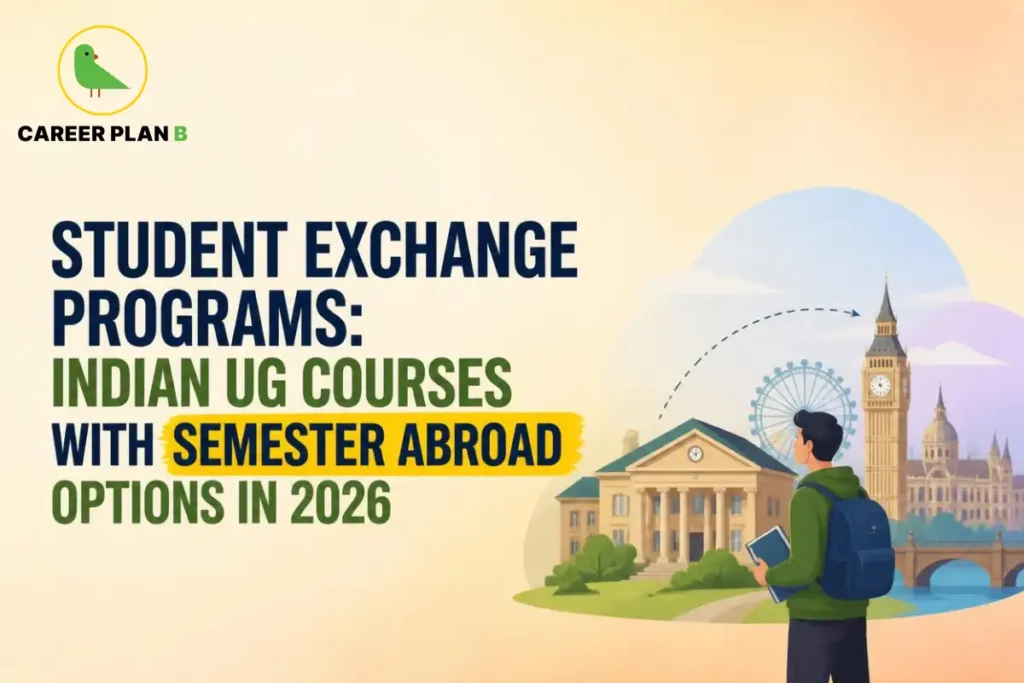
Introduction
IIT Madras genuinely lets undergraduates spend a semester abroad through MoU partner universities, with the Office of Alumni Relations even chipping in partial travel support. Ashoka University sends students to Boston University and King’s College London. Manipal University Jaipur has active tie-ups with Western Sydney and KU Leuven. None of this requires transferring out of your Indian degree, and most students genuinely have no idea this level of access already exists within Student Exchange Programs for Indian UG Students right now.
So which Indian universities genuinely offer this, and what does it actually cost? This guide breaks down real partner universities, honest fee structures, and genuine eligibility behind Student Exchange Programs for Indian UG Students in 2026. By the end, a semester abroad will look like a realistic addition to your degree, not a separate, expensive dream.
How Does a Student Exchange Program Actually Work?
Student exchange programs work on the basis of an agreement between two partner universities, allowing you to pursue education abroad for a period of six months to one year while your credits are transferred back to your home university. Consequently, you genuinely remain enrolled in your original Indian degree the entire time, this is not the same as transferring schools or starting over somewhere new.
Furthermore, the cost of student exchange programs varies depending on the university, course, and agreement between the two institutions, but they are relatively cheaper than pursuing a full course abroad independently, since students typically pay tuition to their home institution rather than the foreign one. Therefore, the financial barrier here is genuinely lower than most families assume before researching it.
Is This the Same as Study Abroad or a Full Foreign Degree?
No, genuinely different. An exchange program lets you study at a partner university for a semester or academic year while your credits count toward your original Indian degree, rather than requiring you to complete an entirely separate qualification abroad. Therefore, you graduate with your original Indian degree, simply with genuine international experience built in.
Indian Universities With Student Exchange Programs 2026: Where Can You Actually Go?
Several genuinely credible Indian institutions maintain active, named partnerships abroad. Here is a real breakdown of what currently exists.
| Indian University | Partner Universities Abroad | Notable Feature |
|---|---|---|
| IIT Madras | Multiple MoU partner universities globally | Partial travel support through Alumni Relations office |
| Ashoka University | Boston University, King’s College London | Strong liberal arts and humanities exchange network |
| Manipal University Jaipur | Western Sydney University, Deakin University, KU Leuven | Focused engineering and technology semester exchange |
| SRM Institute of Science and Technology | Loughborough UK, Rennes France, Western Sydney | Broad multi-country engineering partner network |
Notably, IIT Madras’s exchange programme for UG, dual degree, and postgraduate students specifically permits spending a semester abroad at universities with an MOU, letting students select the university and identify the courses to take while checking language and duration compatibility beforehand. Therefore, this is a genuinely structured, institutionally supported process, not an informal arrangement you piece together yourself.
Which Other Universities Genuinely Have Strong Exchange Networks?
Additional strong options include Christ University Bangalore, running selective exchange programmes with universities in Germany, Singapore, and Italy, and KIIT Bhubaneswar, which maintains a twinning arrangement with Anglia Ruskin UK alongside multiple European semester exchange partners. Meanwhile, business school students at IIM Bangalore can access the Global Network for Advanced Management specifically for semester switches, while IIM Calcutta works with more than eighty partner universities including ESCP Europe.
Semester Abroad Programs India: What Global Networks Should You Also Know About?
Beyond direct university-to-university MoUs, several larger, structured global programmes genuinely accept Indian students through their partner institutions.
- ISEP – a non-profit network spanning over fifty countries and three hundred institutions, with Indian partner universities including Chitkara University, LPU, Symbiosis, and UPES Dehradun
- Erasmus+ – funded by the EU, permitting students to study or intern at European universities, though typically requiring enrollment at a specific partner institution
- Global UGRAD – a fully-funded, semester-long US programme emphasising leadership development and cross-cultural learning
- IIM Indore’s Exchange Network – partners with European business schools like SDA Bocconi in Italy and EDHEC in France
Notably, credits are usually transferable only with official MoUs in place, so it’s genuinely worth visiting your home university’s international relations or global office page specifically to confirm which partnerships are formally approved before assuming a programme applies to you.
Read more:-Exchange Programs After Class 12: Process, Countries, Scholarships
What Does This Genuinely Cost, and Who Pays For What?
Understanding the real financial structure prevents assuming this is either free or unaffordably expensive.
Do You Pay Tuition to Your Home University or the Foreign One?
Under most exchange arrangements, including ISEP specifically, students pay tuition to their home institution rather than the foreign university they’re visiting. Additionally, most partner universities under programmes like Vel Tech’s exchange scheme typically offer a tuition fee waiver, meaning your primary costs genuinely shift toward travel, accommodation, and living expenses rather than duplicate tuition fees.
What Should You Actually Budget For Beyond Tuition?
It is fairly common for exchange students to live with a host family during the programme, which can genuinely reduce accommodation costs compared to independent housing. However, flights, visas, insurance, and daily living expenses remain genuine costs you’ll need to plan for regardless of the tuition arrangement.
For Personalized Guidance
How Should You Actually Apply and Prepare?
A structured approach genuinely improves your chances of securing a strong placement within your university’s exchange programme.
- Check your specific university’s international office page, confirming exactly which partner universities are currently active and approved
- Verify CGPA and eligibility criteria early, since most programmes set minimum academic thresholds you’ll need to maintain
- Confirm course and language compatibility, ensuring your intended courses abroad genuinely map back to your home degree requirements
- Apply well ahead of deadlines, since competitive placements at popular partner universities fill quickly each cycle
A Word of Caution Before You Commit
Program availability and eligibility genuinely change each cycle, so always verify current openings and deadlines directly at each programme’s official website before applying. Additionally, remember that credits transfer only through official MoUs, so an informal arrangement or a university without a confirmed partnership won’t count toward your Indian degree.
How Career Plan B Helps
Figuring out which Student Exchange Programs for Indian UG Students genuinely fit your specific university and goals takes more than browsing a generic list.This is where Career Plan B can help by offering:
- Personalised Career Counselling: Provides expert guidance based on individual interests, skills, and career goals, helping you decide whether a semester abroad genuinely fits your academic and career plan.
- Psychometric & Career Assessment Tests: Identifies strengths, personality traits, and suitable career opportunities, useful for confirming which international exposure genuinely benefits your specific path.
- Career Roadmapping: Creates a clear step-by-step plan to achieve academic and professional goals, including realistic timelines for exchange programme applications.
- Admission & Academic Profile Guidance: Helps in selecting the right courses and colleges and improving academic profiles, so your eligibility for exchange programmes stays genuinely strong.
Get In Touch With Us
Frequently Asked Questions
1. Do I need to transfer out of my Indian degree to study abroad through an exchange programme?
No, genuinely not. You remain enrolled in your home university throughout, and credits earned abroad transfer back toward your original Indian degree.
2. Which Indian universities offer strong student exchange programmes in 2026?
IIT Madras, Ashoka University, Manipal University Jaipur, SRM IST, Christ University Bangalore, and KIIT Bhubaneswar all maintain active, named partnerships abroad.
3. Do I pay tuition to the foreign university or my home institution?
Under most arrangements, including ISEP, you pay tuition to your home institution, and many partner universities offer a tuition fee waiver on top of that.
4. How long do student exchange programs typically last?
Most exchange programmes run for six months to one year, typically structured as either a single semester or a full academic year abroad.
5. Can I access global programmes like Erasmus+ directly as an Indian student?
Generally, you’ll need to be enrolled at a partner institution that has an official MoU with the specific programme, so check your university’s international office first.
6. What costs should I genuinely budget for beyond tuition?
Flights, visas, insurance, and daily living expenses remain real costs, though living with a host family, common in many exchange programmes, can reduce accommodation expenses.
Conclusion
Student Exchange Programs for Indian UG Students are genuinely more accessible than most families assume, with real, named partnerships already active at institutions ranging from IIT Madras to Ashoka University to Manipal Jaipur. A semester abroad no longer requires abandoning your Indian degree or paying foreign tuition fees outright, it just requires knowing which door to knock on within your own university.
If you’re still figuring out whether your specific university offers a genuine exchange pathway, thoughtful guidance can save you significant research time. The world is genuinely more reachable from your current degree than you might think. Talk to a Career Plan B counsellor today to explore exchange programmes that fit your course.