Team Career Plan B · October 7, 2026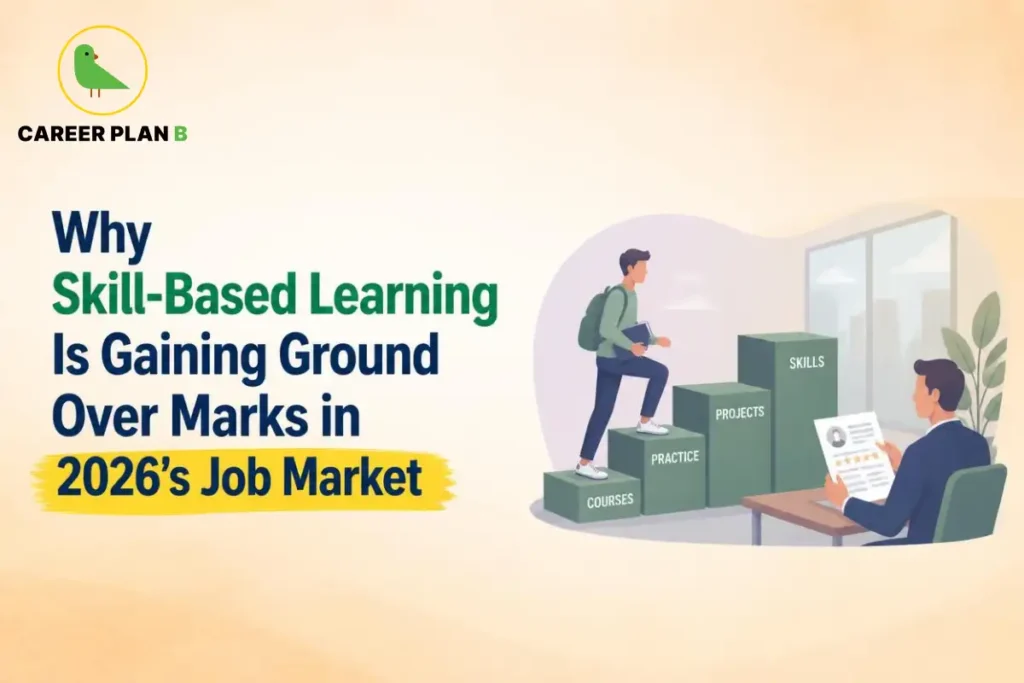
Introduction
For decades, the implicit promise in Indian education was simple: get good marks, get a good degree, get a good job. That equation hasn’t collapsed, but it’s genuinely being challenged — and not by vague online opinion. India’s own Economic Survey 2025-26, a formal government document released alongside the Union Budget, states this directly: employers are increasingly bypassing degree-holders in favor of skilled workers, in some cases paying skilled workers more than many beginner graduate salaries.
This blog looks honestly at what’s actually driving this shift, what the real data shows, and — importantly — how to build genuine skills alongside your education rather than treating this as an either/or choice.
Skill Based Learning vs Marks Job Market 2026: What the Government’s Own Data Shows
Here’s the core, verified finding behind Skill Based Learning vs Marks Job Market 2026: the Economic Survey 2025-26 explicitly frames this as a structural mismatch, not a minor trend. It notes that while organized manufacturing added 10 lakh jobs in FY24, employers increasingly bypassed degree-holders for skilled workers — and large factories now pay skilled workers up to ₹2.7 lakh annually, higher than many beginner graduate salaries, even as 77% of small factories report they can’t find adequately trained personnel.
This is a genuinely striking data point: it’s not that skilled workers are settling for less than graduates — in this specific manufacturing context, they’re earning more, while employers simultaneously struggle to fill skilled positions. That’s a real supply-demand mismatch, documented in an official government economic survey, not an anecdotal claim.
Economic Survey Skills Over Degrees: The Full Picture
Digging deeper into Economic Survey Skills Over Degrees, the government’s own National Skill Gap Study (referenced within the Survey) identifies specific, structural causes behind this mismatch:
- Weak foundational skills – A gap between what formal education provides and what workplaces actually need.
- Training disconnected from industry needs – Existing skill training programs not always aligned with genuine, current employer requirements.
- Youth wage expectations divorced from productivity – A mismatch between what graduates expect to earn and what their actual demonstrated productivity justifies in the market.
This isn’t a simple “skills good, degrees bad” narrative — it’s a more nuanced diagnosis of misalignment between the education system’s outputs and the labor market’s actual needs, which the government is explicitly acknowledging and trying to address through skilling investment.
Employers Bypass Degree Holders India: Where This Is Happening
Here’s a closer look at where Employers Bypass Degree Holders India, based on the Economic Survey’s findings:
- Manufacturing sector – The clearest documented example, where skilled technical workers command higher pay than many entry-level graduates, and small factories specifically report struggling to find trained personnel.
- Gig and platform economy – The Survey also highlights the gig workforce’s rapid expansion (from 77 lakh in FY21 to 120 lakh in FY25, a 55% growth rate outpacing overall employment), projected to contribute ₹2.35 lakh crore to GDP by 2029-30 — a sector that evaluates workers almost entirely on demonstrated capability, not formal credentials.
- Skill-certified technical roles broadly – Any field where a National Occupational Standard-aligned certification (through bodies like NCVET) demonstrates specific, verifiable competency tends to see this same dynamic.
Skill Gap in Indian Job Market: Understanding Both Sides
It’s worth understanding the Skill Gap in Indian Job Market from both the employer and candidate side, since the mismatch cuts both ways:
From the employer side:
- Genuine difficulty finding adequately trained personnel, even when willing to pay competitively for skilled workers.
- A preference, in specific technical contexts, for demonstrated competency over a general degree that doesn’t guarantee specific job-ready skills.
From the candidate side:
- A formal education system that, per the government’s own assessment, doesn’t always align training with genuine industry needs.
- Wage expectations sometimes misaligned with actual, demonstrated productivity — a genuinely two-sided problem, not purely an employer failing to recognize graduate value.
Understanding both sides matters because the solution isn’t simply “abandon degrees for skills” — it’s building genuine, verifiable skills regardless of which educational path you’re on.
NCVET Skill Certification Value: A Genuine Response to This Gap
The government’s structural response to this exact mismatch is visible in bodies like NCVET, which regulates and standardizes vocational education specifically to close this gap. Here’s why NCVET Skill Certification Value matters in this context:
- Standardized against real occupational standards – Certifications map to defined, industry-relevant job roles, addressing exactly the “training disconnected from industry needs” problem the Economic Survey identifies.
- Formal government backing gives certifications genuine credibility – Not an informal or unregulated credential, but one recognized within India’s formal skilling architecture.
- Directly targets manufacturing and technical sectors – The specific sectors the Economic Survey highlights as most acutely affected by this mismatch.
Read more:- Top Certification Courses to Finish Before 2026 for Career Growth
How to Build Skills Alongside a Degree
Here’s the genuinely practical takeaway: this data doesn’t mean you should abandon a degree in favor of skills — it means you should build demonstrable skills regardless of which path you’re on. Here’s How to Build Skills Alongside a Degree:
- Take your mandatory internship seriously – Under UGC’s current framework, undergraduate programs now include mandatory, credit-linked internships specifically designed to close the theory-practice gap the Economic Survey identifies.
- Layer NCVET-aligned certifications onto your degree – Adding a specific, standardized skill certification alongside your formal education directly addresses employers’ documented preference for verifiable competency.
- Build a portfolio of demonstrated work, not just a transcript – Whether through projects, internships, or independent work, tangible evidence of capability increasingly matters more than marks alone.
- Stay realistic about wage expectations relative to demonstrated skill – The Economic Survey’s own diagnosis flags this as a genuine, two-sided issue; aligning your expectations with your actual demonstrated productivity strengthens your position.
- Consider gig and platform-based experience as genuine skill-building, not just supplementary income — given this sector’s documented, rapid growth and its skill-first evaluation approach.
For Personalized Guidance
What This Doesn’t Mean: A Balanced Read
It’s worth being honest about what this data does not mean:
- It doesn’t mean degrees are worthless – Many fields (medicine, law, engineering design, research) genuinely require formal degree-based education and cannot be substituted with skill certification alone.
- It doesn’t mean marks don’t matter at all – Marks remain a genuine gatekeeper for specific competitive academic and professional pathways, as covered in earlier analysis.
- It means the sole reliance on marks/degrees, without demonstrated practical skill, is increasingly insufficient in a growing number of sectors — a genuinely important, but more nuanced, conclusion than “skills outrank marks” as a blanket claim.
How Career Plan B Helps
Navigating this genuine, government-documented shift toward skill-based hiring — without abandoning the real value of formal education — is exactly where Career Plan B helps you build a balanced, well-informed strategy.
- Personalized Career Counselling: We help you understand which fields genuinely require formal degrees versus where skill certification carries real, documented weight.
- Psychometric & Career Assessment Tests: Our assessments identify which skill areas would most strengthen your specific career direction.
- Career Roadmapping: We map out how to layer NCVET-aligned certifications, internships, and portfolio-building onto your existing academic path.
- Admission & Academic Profile Guidance: We help you choose programs and specializations that build genuine, demonstrable skills alongside academic credentials.
Get In Touch With Us
Frequently Asked Questions
Q1. Does India’s Economic Survey really say skills matter more than degrees?
The Economic Survey 2025-26 documents that employers increasingly bypass degree-holders for skilled workers in specific sectors like manufacturing, with skilled workers sometimes earning more than beginner graduate salaries — a genuine, government-acknowledged structural shift, though nuanced rather than absolute.
Q2. Does this mean I shouldn’t pursue a degree?
No. Many fields genuinely require formal degree-based education. The data points to the risk of relying on marks/degrees alone without demonstrated practical skill, not to degrees being worthless.
Q3. What is the National Skill Gap Study?
It’s a government study referenced in the Economic Survey, identifying weak foundational skills, training disconnected from industry needs, and misaligned wage expectations as core issues in India’s skill gap.
Q4. How can I build genuine skills while still pursuing my degree?
Take mandatory internships seriously, add NCVET-aligned certifications relevant to your field, build a demonstrable portfolio of real work, and stay engaged with practical, hands-on learning opportunities alongside your coursework.
Q5. Is the gig economy a legitimate place to build skills?
Yes, genuinely. The Economic Survey documents rapid gig workforce growth (55% growth rate outpacing overall employment), and this sector evaluates workers primarily on demonstrated capability, offering real skill-building and income opportunity.
Conclusion
India’s own Economic Survey 2025-26 confirms a genuine, structural shift: in specific sectors, employers increasingly value demonstrated skill over formal credentials alone, sometimes paying skilled workers more than entry-level graduates. The smartest response isn’t choosing skills over degrees, but building genuine, verifiable skills alongside whatever formal education path you’re already on.
If you want help building a strategy that combines your academic path with real, demonstrable skill-building, Career Plan B is here to help you navigate this shifting job market with clarity.