Team Career Plan B · October 7, 2026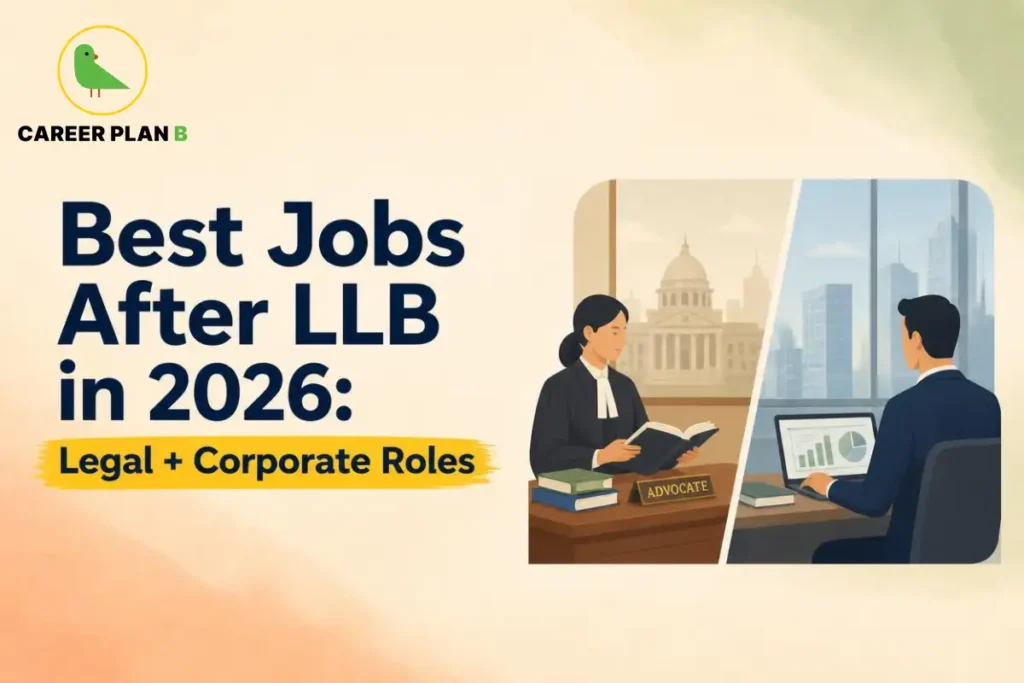
Introduction
Finishing an LLB opens more doors than most students realize while they’re still buried in case law and moot court prep. Litigation, corporate law, judicial services, policy work, legal tech — the range is genuinely wide. Rather than handing you a “top jobs” ranking (which no official body publishes anyway), this blog walks through the real categories of careers open to LLB graduates, the regulatory steps you actually need to take, and how to think about choosing between litigation and corporate paths specifically.
Jobs After LLB in India: Understanding Your Real Categories
Before diving into specifics, here’s the honest structure of Jobs After LLB in India — it splits into a few genuinely distinct categories, each with different entry requirements:
- Litigation practice – Requires formal enrollment as an advocate and passing the AIBE.
- Corporate legal roles – Often don’t require court enrollment at all, depending on the specific role.
- Judicial services – A separate, competitive exam-based path into becoming a judge.
- Alternative legal careers – Legal research, policy, legal tech, and consultancy roles that use your legal training without necessarily requiring court practice.
Each of these has meaningfully different entry requirements, so understanding which category you’re aiming for shapes your next steps significantly.
LLB Career Options Litigation vs Corporate
Here’s a direct comparison for LLB Career Options Litigation vs Corporate:
| Factor | Litigation | Corporate Legal Roles |
|---|---|---|
| Regulatory requirement | Must enroll with State Bar Council + clear AIBE | Often no bar enrollment required, depending on role |
| Work style | Courtroom advocacy, case-building, client representation | Contract review, compliance, transactional work, in-house counsel |
| Income pattern | Often variable, especially early career; builds with reputation over time | Generally more structured, salaried compensation |
| Entry timeline | Can start practicing relatively soon after enrollment | Often recruited through campus placements or direct applications |
| Career ceiling | Senior advocate, potentially judiciary later | General Counsel, legal director, partner-track at law firms |
Neither path is objectively better — litigation suits those drawn to courtroom advocacy and don’t mind a variable early-career income, while corporate legal roles suit those who want more structured environments and are comfortable with transactional, contract-focused work.
AIBE and Bar Council Enrollment Process
If litigation is your goal, understanding the AIBE and Bar Council Enrollment Process is essential, since this isn’t optional if you want to practice in court:
- Complete a BCI-recognized LLB degree – Either the 3-year LLB (after a bachelor’s degree) or the 5-year integrated LLB (after Class 12), from an institution accredited by the Bar Council of India.
- Enroll with your State Bar Council – This is a one-time enrollment under Section 24 of the Advocates Act, 1961, requiring your degree, mark sheets, and prescribed fees.
- Clear the All India Bar Examination (AIBE) – A mandatory qualifying exam conducted by the BCI, which you must clear within two years of enrollment (provisional enrollment expires after this window if not cleared). From 2026, AIBE is conducted twice a year.
- Receive your Certificate of Practice (CoP) – Issued by the BCI upon clearing AIBE, this is what formally authorizes you to represent clients in any lower court and High Court across India.
- Recent flexibility for final-year students – Per recent Supreme Court directions, candidates in their final semester of LLB (with no backlogs) can now appear for AIBE without first obtaining full enrollment certificates, a genuinely helpful timeline change.
Without completing this process, you cannot legally practice as a litigating advocate in Indian courts — this is a hard, non-negotiable requirement, unlike many corporate legal roles.
Corporate Legal Jobs After LLB
Here’s what Corporate Legal Jobs After LLB genuinely look like:
- In-house legal counsel – Working within a company’s legal department, handling contracts, compliance, and regulatory matters.
- Law firm corporate practice – Transactional work, mergers and acquisitions support, corporate advisory, often at firms specializing in corporate/commercial law.
- Compliance and regulatory roles – Particularly relevant in heavily regulated sectors like banking, finance, and pharmaceuticals.
- Legal process outsourcing (LPO) roles – Supporting international legal work, contract review, and legal research for global clients.
- Legal tech and startups – A newer, growing space combining legal knowledge with technology, including AI-driven legal solutions.
An important honest note: many corporate legal roles, especially in-house and LPO positions, don’t strictly require court enrollment or AIBE clearance, since you’re not representing clients in litigation. However, having your CoP can still add credibility and keep the litigation path open if your interests shift later.
Read more:- 5-Year Law Degree (BA LLB, BBA LLB): Admission Tips for 2026
Judicial Services After LLB
If becoming a judge appeals to you, Judicial Services After LLB is a genuinely distinct, separate pathway:
- State-level judicial service exams – Each state conducts its own Judicial Services Examination (often called PCS-J or similar), a competitive, merit-based process distinct from AIBE.
- Eligibility – Generally requires an LLB degree, with specific age and enrollment criteria varying by state.
- Separate preparation track – This exam tests substantive law knowledge deeply, requiring dedicated preparation distinct from general litigation practice.
- A genuinely respected, stable career path – Offering long-term stability and the opportunity to shape legal outcomes directly, distinct from either litigation or corporate practice.
LLB Career Scope 2026: Emerging Directions
Beyond the traditional paths, LLB Career Scope 2026 includes a few genuinely growing areas:
- Legal tech – Combining legal expertise with technology, including AI-driven contract review and legal research tools, a space explicitly noted as an emerging direction for law graduates.
- Policy and legislative drafting roles – Legal researchers increasingly support policy-making bodies and legislative drafting processes.
- Alternative dispute resolution (ADR) – Mediation and arbitration are growing as businesses increasingly prefer these over lengthy litigation.
- Legal consultancy – Many advocates eventually build independent consultancy practices, advising clients without necessarily focusing purely on courtroom litigation.
For Personalized Guidance
How to Choose Your Path
Given these genuinely different options, ask yourself:
- Am I drawn to courtroom advocacy and building a reputation over time, or do I prefer structured, transactional work? This is the core litigation-versus-corporate distinction.
- Am I willing to commit to the AIBE and enrollment process now, even if I’m not certain about litigation, to keep that option open later?
- Does the stability and public service angle of judicial services appeal to me more than private practice or corporate roles?
- Am I interested in newer, less traditional paths like legal tech or policy work, which may value different skills than pure litigation experience?
How Career Plan B Helps
Choosing the right path after LLB is a genuinely significant decision — Career Plan B helps you navigate the real regulatory requirements and career options with clarity.
- Personalized Career Counselling: We help you understand whether litigation, corporate law, judiciary, or an alternative legal career genuinely fits your strengths and interests.
- Psychometric & Career Assessment Tests: Our assessments confirm whether courtroom advocacy or structured, transactional work suits you better.
- Career Roadmapping: We map out your specific path, including AIBE preparation timelines or judicial services exam strategy.
- Admission & Academic Profile Guidance: We help you understand the genuine requirements for each career direction before you commit.
Get In Touch With Us
Frequently Asked Questions
Q1. Do I need to pass AIBE to work in a corporate legal role?
Not always. Many in-house and corporate legal roles don’t strictly require bar enrollment or AIBE clearance, since you’re not representing clients in litigation. However, it’s still valuable to have if you want to keep litigation options open.
Q2. How long do I have to clear AIBE after enrolling with the Bar Council?
You must clear the AIBE within two years of your provisional enrollment with the State Bar Council, or you’ll need to re-enroll if that window expires.
Q3. Can final-year LLB students appear for AIBE?
Yes, per recent Supreme Court directions, students in their final semester of a 3-year or 5-year LLB program (with no backlogs) can now appear for AIBE without first completing full enrollment certificates.
Q4. Is judicial services a separate exam from AIBE?
Yes. Judicial Services Examinations are conducted separately by each state and are distinct from the AIBE, which is specifically the bar enrollment qualifying exam for litigation practice.
Q5. What’s a good alternative to litigation or corporate law after LLB?
Legal research, policy and legislative drafting, alternative dispute resolution (mediation/arbitration), and legal tech are genuinely growing alternative paths for law graduates.
Conclusion
An LLB opens into genuinely distinct career paths — litigation (requiring formal Bar Council enrollment and AIBE), corporate legal roles (often without that requirement), judicial services (a separate competitive exam track), and emerging areas like legal tech and policy work. Rather than chasing an unranked “best jobs” list, the smarter approach is understanding which category’s regulatory requirements and day-to-day work genuinely fit your goals.
If you’re weighing these paths after your LLB and want help mapping out the right one for you, Career Plan B is here to guide that decision with real clarity.