Team6 · October 7, 2026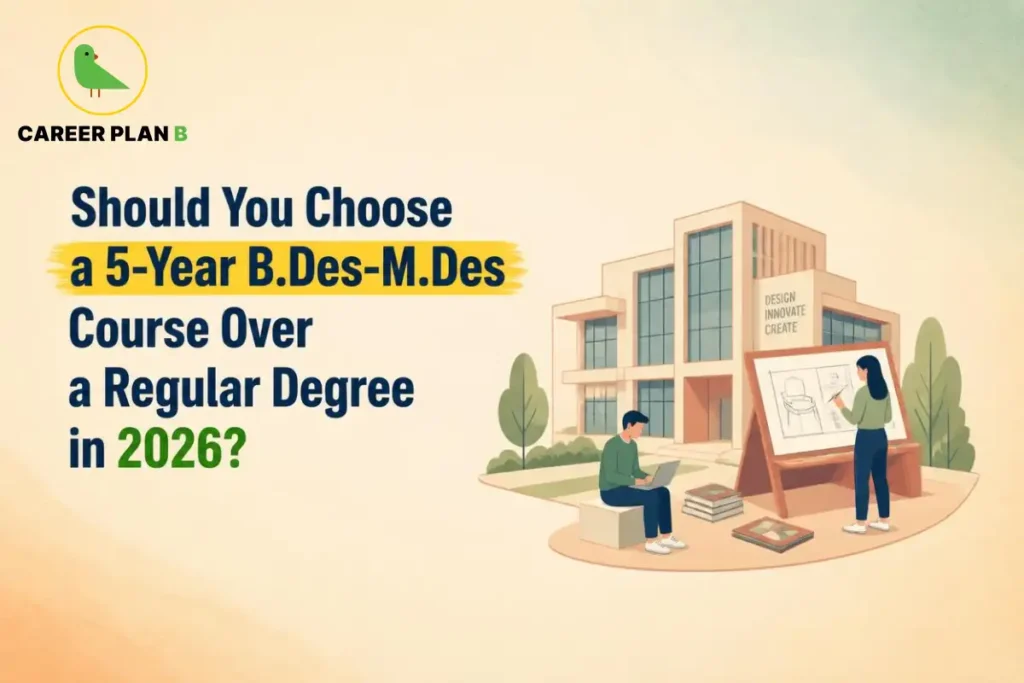
Introduction
The Indian design sector in 2026 is experiencing an explosive, tech-driven transformation that requires highly specialized creative leaders. Consequently, ambitious high school students are constantly asking if they should choose a 5-Year B.Des-M.Des course over a regular degree. This integrated academic pathway completely bypasses the traditional, disjointed higher education system to fast-track your corporate success.
Historically, design students spent four years securing an undergraduate degree before facing the grueling process of applying for a separate master’s program. Today, premier design institutions offer a seamless dual-degree structure that merges foundational aesthetics with advanced, executive-level design strategy. By choosing this intensive route, graduates secure a massive competitive edge in the global job market.
This comprehensive guide breaks down exactly how an integrated dual degree compares to a standard Bachelor of Design. By exploring the accelerated timelines, highly specialized curriculums, and massive 2026 salary scopes, you can confidently navigate your creative future.
The Strategic Advantage of the Dual Degree
Committing to a five-year academic program requires immense clarity, but the strategic benefits completely outweigh the initial time investment.
Saving Time and Entrance Exam Stress
Completing a bachelor’s and master’s degree separately typically requires a minimum of six full years of academic commitment. A 5-Year B.Des-M.Des course seamlessly condenses this journey, completely saving an entire year of tuition and time. Furthermore, it completely eliminates the terrifying anxiety of reapplying for highly competitive postgraduate exams like CEED or the NID DAT.
Achieving Deep Industry Specialization
A regular B.Des produces excellent creative generalists who understand foundational visual communication, textiles, and basic product design. However, the integrated master’s phase allows students to hyper-specialize in high-paying 2026 niches like AR/VR experience design and sustainable product architecture. This deep, master’s-level specialization is exactly what massive tech firms and global design agencies actively hunt for.
Curriculum Evolution and Tech Integration
Modern design is no longer just about making physical products look visually appealing; it is about solving complex human problems through technology.
Moving Beyond Basic Aesthetics
The curriculum within a 5-Year B.Des-M.Des course heavily integrates artificial intelligence, spatial computing, and human-centered design (HCD). During the final two years, students transition from standard studio sketching to executing high-level, research-driven industry projects. They spend their time solving macro-level global challenges rather than just executing basic, entry-level design briefs.
The Power of the Final Thesis
While B.Des students conclude their studies with a standard graduation project, dual-degree students must produce a rigorous master’s thesis. This intensive research paper frequently involves collaborating with massive multinational brands or publishing in international design journals. Having a published, highly technical thesis instantly elevates your corporate portfolio above standard undergraduate applicants.
Have Any Doubts?
Salary Expectations and Return on Investment (2026)
The financial trajectory for integrated graduates is undeniably superior to those holding just an undergraduate diploma. According to 2026 industry placement data, mastering specialized digital fields at the master’s level directly correlates with premium compensation.
| Academic Pathway | Core Corporate Value | Entry-Level Salary (2026) | Senior Salary Scope (8+ Yrs) |
|---|---|---|---|
| Regular B.Des Degree | Creative execution, visual foundations | ₹4.8 – ₹9.0 LPA | ₹15.0 – ₹30.0 LPA |
| 5-Year B.Des-M.Des | Research, UI/UX strategy, leadership | ₹10.0 – ₹18.0 LPA | ₹25.0 – ₹50.0+ LPA |
| MBA in Design Mgmt | Business scaling, creative direction | ₹12.0 – ₹16.0 LPA | ₹30.0 – ₹60.0+ LPA |
(Source: Educational framework comparisons strictly aligned with 2026 Indian design sector recruitment and premier institute placement data).
How Career Plan B Helps
Deciding between a standard four-year path and a rigorous five-year integrated master’s requires meticulous long-term planning. Career Plan B assists ambitious creative students in navigating this high-stakes educational transition with absolute clarity.
- Personalised Career Counselling: We thoroughly evaluate your natural artistic stamina to ensure a 5-Year B.Des-M.Des course perfectly aligns with your long-term goals.
- Psycheintel & Career Assessments: Scientifically backed tests that accurately map your unique strengths for managing high-level design research versus immediate creative execution.
- Customized Admission Guidance: Strategic, end-to-end support to help you crack elite entrance exams like UCEED to secure premier dual-degree seats.
- Career Roadmapping: Tailored, long-term pathways that guarantee your integrated master’s degree perfectly matches the highest-paying corporate roles in 2026.
Get In Touch With Us
Frequently Asked Questions
Q1. Is a 5-Year B.Des-M.Des course worth it in 2026?
Yes, absolutely. It saves you an entire academic year, eliminates the stress of taking separate master’s entrance exams, and instantly qualifies you for high-paying senior design roles.
Q2. What is the salary difference between B.Des and M.Des graduates?
In 2026, fresh B.Des graduates typically start between ₹4.8 and ₹9.0 LPA, while M.Des graduates frequently secure premium starting packages ranging from ₹10.0 to ₹18.0 LPA.
Q3. Can I quit an integrated design course after 4 years?
Some progressive universities offer a highly flexible “exit option” where you can leave after four years with just a B.Des degree, though this varies strictly by institution.
Q4. Are integrated design degrees accepted internationally?
Yes. A fully integrated master’s degree from a recognized Indian university is globally respected and makes securing international tech and design visas significantly easier.
Q5. Which design specialization pays the most currently?
Specializations in User Experience (UI/UX) Design, Product-System Design, and AI-integrated Interaction Design currently command the absolute highest salaries in the global market.
Conclusion
Analyzing the modern creative economy reveals exactly why choosing a 5-Year B.Des-M.Des course over a regular degree is a brilliantly strategic move in 2026. By seamlessly blending foundational artistic execution with advanced, executive-level design research, graduates instantly become irreplaceable corporate assets. Furthermore, bypassing the disjointed traditional academic system saves immense time, money, and entrance exam anxiety.
Ultimately, if you are absolutely certain that design is your lifelong passion, committing to the integrated master’s route guarantees a much higher financial ceiling. If you are ready to identify the exact design institutions that offer the best dual-degree programs for your unique strengths, consult Career Plan B today to build a meticulously personalized roadmap to success.